A Letter to my Nieces & Nephews on Ella Baker’s Birthday

bitstream
Photo Credit:  NAACP Collection, Prints and Photographs Division, Library of Congress

My loves,

One of the greatest Black women poets of our time, Lucille Clifton, is not frequently taught in schools — or at least not taught enough. Her poem, song at midnight, contains a line you may have seen on the internet, in part. We like to circulate it among ourselves as a clarion call, a prayer, a balm & mantra, especially the last lines, but here is the second part of it, from The Collected Poems of Lucille Clifton 1965-2010, edited by Kevin Young and Michael S. Glaser:

born into babylon

both nonwhite and woman

what did i see to be except myself?

i made it up

here on this bridge between

starshine and clay,

my one hand holding tight

my other hand; come celebrate

with me that everyday

something has tried to kill me

and has failed.

The epigraph to this poem is from a Sonia Sanchez poem: “…do not send me out among strangers.”

Black women’s lives, for so long, were shaped around survival, and it had always been so, it’s true. In The People Could Fly: American Black Folktales told by Virginia Hamilton, in the introduction, though, I was reminded of something else.

“It is amazing,” she writes, “that the former Africans could ever smile and laugh, let alone make up riddles and songs and jokes and tell tales. As slaves, they were forced to live without citizenship, without rights, as property – like horses and cows – belonging to someone else. But no amount of hard labor and suffering could suppress their powers of imagination.”


Continue reading “A Letter to my Nieces & Nephews on Ella Baker’s Birthday”

On Rest in Power: The Trayvon Martin Story & Memoirs on the Movement for Black Lives

I’ve been reading some of the beautiful and important memoirs of the Movement for Black Lives that are forthcoming from Black feminists like Barbara Ransby & Charlene Carruthers as well as screening Rest in Power: The Trayvon Martin story, which begins airing tonight on the Paramount Network, since the end of June. I wrote about the docuseries, as well as the books, for the Village Voice:

“They say that time heals all wounds. It does not,” observes Sybrina Fulton, Trayvon Martin’s mother, in Rest in Power: The Trayvon Martin Story. “Had the tragedy not been so public, I probably would have taken more time to grieve, but I wasn’t given that type of privilege.”

The six-part documentary series, produced by Jay-Z and the Cinemart, begins and ends as it should, with the murdered seventeen-year-old’s parents. Over the course of subsequent episodes, the audience hears a series of 911 calls from Martin’s killer, George Zimmerman, the aspiring police officer who became neighborhood watch captain in his previously exclusive gated community in part to live out a racist vigilante fantasy.

Rest in Power establishes a pattern of behavior from Zimmerman: He calls the cops so frequently on Black children who moved to his neighborhood after the 2008 economic crisis that dispatchers know his voice and refer to him by his first name.  Yet, as the series documents, it still took more than forty days, not to mention the intervention of media-savvy civil rights attorney Benjamin Crump, for Zimmerman to be arrested and charged with Martin’s fatal shooting, and to get the killing reported in context by the media.

Martin’s death was the first real major convergence of race and policing in President Barack Obama’s presidency after the euphoria of post-racial liberalism had worn off. In Rest in Power, we see Obama graying at a rapid pace, weary, saying that if he had a son, his son “would look like Trayvon.” He doubles down and says that, put another way, he could have been Trayvon Martin when he was younger. As author Mychal Denzel Smith puts it in an interview, it becomes clear that there will always be more Trayvon Martins than Barack Obamas.

Rest in Power captures this monumental moment in American resistance with moving detail, showing scenes from protests around the country. And forthcoming soon are some additional invaluable histories of this period that provide a broader picture of the modern articulation of Black protest and mobilization in response to racist and vigilante violence.

These books are particularly remarkable because all too often, the narratives of resistance that do exist are positioned as though cisgender heterosexual men have always been at the forefront. As these works demonstrate, Black women have been the unsung architects of many of these protest movements — and they have only recently started to get their due.

Indeed, as we see the signs of hate rising all around us today, it becomes clear that Black women tried to warn us. Khan-Cullors notes this in When They Call You a Terrorist, writing on how she and her co-founders of Black Lives Matter as a movement were nearly erased from early reporting: “Despite it being a part of the historical record that it is always women who do the work, even as men get the praise — it takes a long time for us to occur to most reporters in the mainstream. Living in patriarchy means that the default inclination is to center men and their voices, not women and their work.”

That is true both for how she situates the BLM founders in relation to Martin’s case and for how she writes about the uprising in Ferguson, Missouri, after unarmed teen Michael Brown’s shooting by police officer Darren Wilson. In a chapter dedicated to activism in Ferguson, Ransby profiles Black feminist organizers, including Darnell Moore, Kayla Reed, Brittany Ferrell, Alexis Templeton, and Jamala Rogers.

“When I suggest that the movement is a Black feminist-led movement, I am not asserting that there was no opposition and contestation over leadership, or that everyone involved subscribed to feminist views,” Ransby writes. “Nevertheless, when we listen carefully, we realize that the most coherent, consistent, and resolute political voices to emerge over the years since 2012 have been Black feminist voices, or Black feminist-influenced voices.”

On Marching & The Performance of Solidarity

A version of this blog also appeared on Medium

On President Trump’s 100th day in office, I’m thinking still about a lingering, ongoing sense of being reluctantly invited to join a spectacle of social change. It’s not the only reason I’m sitting out the People’s Climate March – I’m also busy, tired and need to have some time in my life when I’m not losing sight of what is true for me, which is that writing is my activism and my self-care but sometimes that looks like being silent, reading a book or being unproductive for a change.

But back to the spectacles.

The Women’s March was the most popular of these to date and I sat that one out, too, for a number of reasons, including concerns I had around inclusivity and representation. I know we’ve moved on and we’re so much better than this, but I will never forget learning first about the Women’s March from other black women who noticed that it was first named after the march led by black women as if that first one had never happened. Surely, it was merely a generational misstep, right? But so what. Erasure is erasure. If people erase you once, they will do so again.

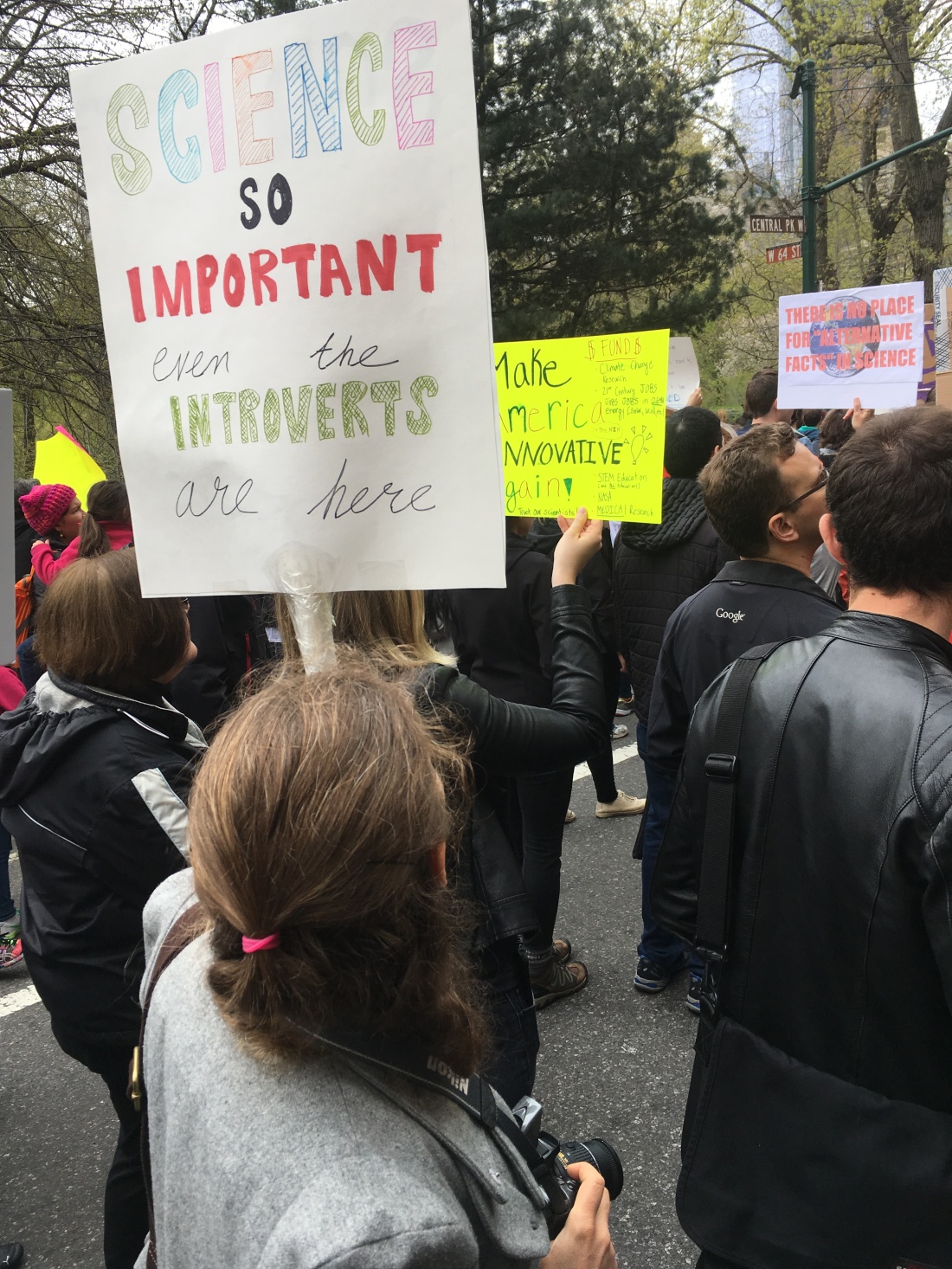
But despite my personal ambivalence about an ongoing and popular performance of solidarity — the notion that by simply showing up and being physically present with mission-aligned people, the important intersectional work of sustainable social change becomes inevitable — I ignored the same problems with diversity that plagued the March for Science by making it a point to get to the satellite March for Science in New York City on Earth Day last Saturday.

IMG_0460

The sense of resistance to inclusion resurfaced this week when I read about Rev. Lennox Yearwood Jr.’s encounter with police at the D.C. March for Science, which involved him being slammed against a food truck. He told ThinkProgress: “For me to go through that amplified what a lot of people of color have told me — that they don’t feel welcome in the environmental movement, or they can be singled out. I’ve been in the climate movement for a long time, and for the first time, I felt out of place. At that moment, I was just a black guy who was stopped by the police, harassed, roughed up, and let go.”

Rev. Yearwood went on to say in his HuffPost piece that broadening the environmental movement in particular, in terms of numbers or diversity, will only happen when meaningful things are put in place to do so. That includes the empathy that comes with knowing what it looks like to march as a person of color for science, for climate or any issue, for that matter.

It will mean going beyond performing the work of social change and solidarity.

Because I believe this, even though it’s sort of at odds with my status as an outgoing introvert, I forced myself out of my comfort zone on Saturday.


Part of why I was so invested in attending the March for Science is because I spent the better part of a year and a half at the end of the Obama Administration with a group of people I affectionately refer to as “the science nerds,” working as a deputy press secretary in the Office of Public Affairs at the Department of Energy. With a team of brilliant appointees and federal staff, I helped connect journalists to subject matter experts on energy efficiency, cybersecurity, wind and hydropower. I led the Energy Department’s coordination with the White House on initiatives related to deploying solar to low-income neighborhoods, broader incentives for electric vehicle adoption and more.

But my favorite part of each week was preparing a news briefing for former Secretary of Energy Ernest Moniz. Secretary Moniz is a tireless nuclear physicist, whose sharp wit and fast mind are as acute as his grasp and eloquence related to the vast auspices of energy — whether he is discussing coal, carbon capture technology, energy efficiency or nuclear fusion. He could — and did — hold court for hours on negotiating the Iran Nuclear Deal, the importance of investing in energy infrastructure — from the electrical grid to shoring up the country’s petroleum reserves.

What I knew about climate when I joined the Department of Energy would not fill half a page. But from the wise folks I worked with, I learned that simultaneously, the earth was warming and our energy infrastructure was falling apart, but there were ways we could mitigate these changes. We could be more mindful of how the ways we used energy contributed to harmful carbon emissions.

hurricane-katrina-4

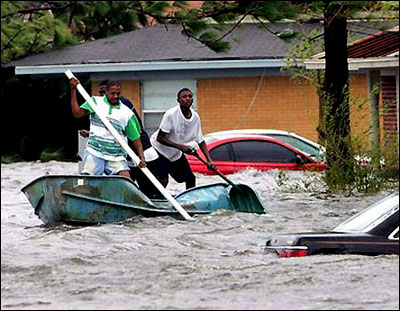
From the Paris Climate Agreement to Grid Modernization, the work I was a small part of seemed meant to not only make a meaningful contribution to climate in the near-term by fending off catastrophes like Superstorm Sandy or Hurricane Katrina, but in the long term, too, by calibrating the energy efficiency of appliances (to name just one example) to make them both affordable and less damaging to the environment. It was cool to imagine a world in which our federal government would be as invested in harnessing the natural abundance of wind, solar and hydropower in an effort to keep us from the disasters that are inevitable from the impact of climate change.

It was there that I also learned about climate resiliency and the lack of attention to how environmental racism impacts people of color and low-income communities. I learned more about how African Americans have already been hardest hit by climate change. How global warming has led to a climate gap most evident in poor communities.

Then there is the inconvenient evidence that throughout history, science has been leveraged to exploit people of color. That made it all the more ironic that the powerful HBO film based on Rebecca Skloot’s bestselling book, The Immortal Life of Henrietta Lacks, aired on Earth Day, the same day as the science marches were held. The film truncates Skloot’s recovery of the lost history of how the unauthorized use of Lack’s cells revolutionized science with a stunning performance by Oprah Winfrey as Deborah Lacks, Henrietta’s daughter.

I watched the film the day after the march, disappointed at the missing conversation around these two related events. I’m thankful that civic engagement and social change organizing continues to move forward, not just in North America but around the world. But the idea that performing solidarity simply by showing up with clever signs will change the fact that some bodies are protected and others are not (in theory or in practice) is flawed. As the People’s Climate March and May Day rallies approach, I wonder how this will begin to shift, if at all.