In the ’80s, my mom took night classes at Bronx Community College. She wanted to be a paralegal, and sometimes she could focus on it, but mostly her mania made it hard for her to pick one thing and see it through. But when she was present for her career ambitions, I went with her to class because she couldn’t afford child care.
Night classes at the college level were pretty boring, even as a nerdy kid. After being in school all day, by the time evening came, I’d have finished my homework. I was gifted, but my brain wasn’t that interested in case-law in second grade. It was obvious to everyone, including one of Mom’s classmates, who must have been a mom. She opened up a page in her loose leaf notebook after watching my eyes glaze over for about 20 minutes and said, “Wanna learn how to draw a doll?”
Now, in this era, I was obsessed with Rainbow Brite and Cabbage Patch dolls. Of course I wanted to learn! I nodded eagerly, quietly and sat, rapt with attention, as she drew a simple figure with a blouse and a skirt with a blue Bic ballpoint pen. She had a fashion magazine, too, and she let me borrow it so I could practice drawing what I saw.
It was the most fun I’d had in my life, drawing what I saw. Until then, I had only taken in the fast-moving world around me. I had not tried to interpret it in any way. This was my beginning as an artist, though I didn’t have language or confidence to claim that title. It felt distant. It felt white. Not mine.
In the years to come, I sketched on the margins of paper and of my life. When I came of age, the fashion designer Byron Lars was hot and the Village Voice was a plump pulp product I flipped through every Wednesday as soon as it was folded neatly and flat in the red plastic bins that seemed to appear on every Manhattan street corner. One week, I saw that Lars would be greeting people at Bloomingdale’s. It was my first real life meeting with someone Black who was living one of my dreams. I hopped the turnstiles from the Bronx and made the sojourn to shake his hand, to laugh shyly when he greeted me and encouraged me to keep drawing.
Sometimes, all our creativity needs is a cracked door. The door doesn’t need to open all the way, we don’t need to be flooded with light. You just need a sliver, like a plant. More light is better, usually, but really you just need to not be completely shrouded in your own darkness. Some part of the real you that needs feeding and nurturing — that needs the light.
I was thinking about this when I started drawing again at the end of last year with intention and sharing my work online, because I simply love it. I’ve always had a meditation practice (when I am disciplined) and a writing practice/discipline, which I center my life around. But taken together, these are all creative practices, like singing and dancing.
It took me decades to get back to that second-grade-self, the one who drew like no one was watching. I’ve spent the first couple of months of this year sorting out how to convey the importance, to myself and others, of holding on to that light energy, the feeling of creating something beautiful for the sake of creating it. Not to win fans or followers. Not to augment your brand, though these things are nice. But creating for the sake of feeding your soul, letting the light in: This is my wish for myself this year — and for those of you who make things, beautiful or in progress, or rough drafts or things that feel hard to get right — this is also my creative wish for you.
A drawing of my beautiful sister. I haven’t seen a lot of art featuring people with Vitiligo, but hope to see more!I draw regularly in a book called “Draw Every Day Draw Every Way: Sketch Paint & Doodle Through One Creative Year” by Jennifer Orkin Lewis. It’s so freeing.
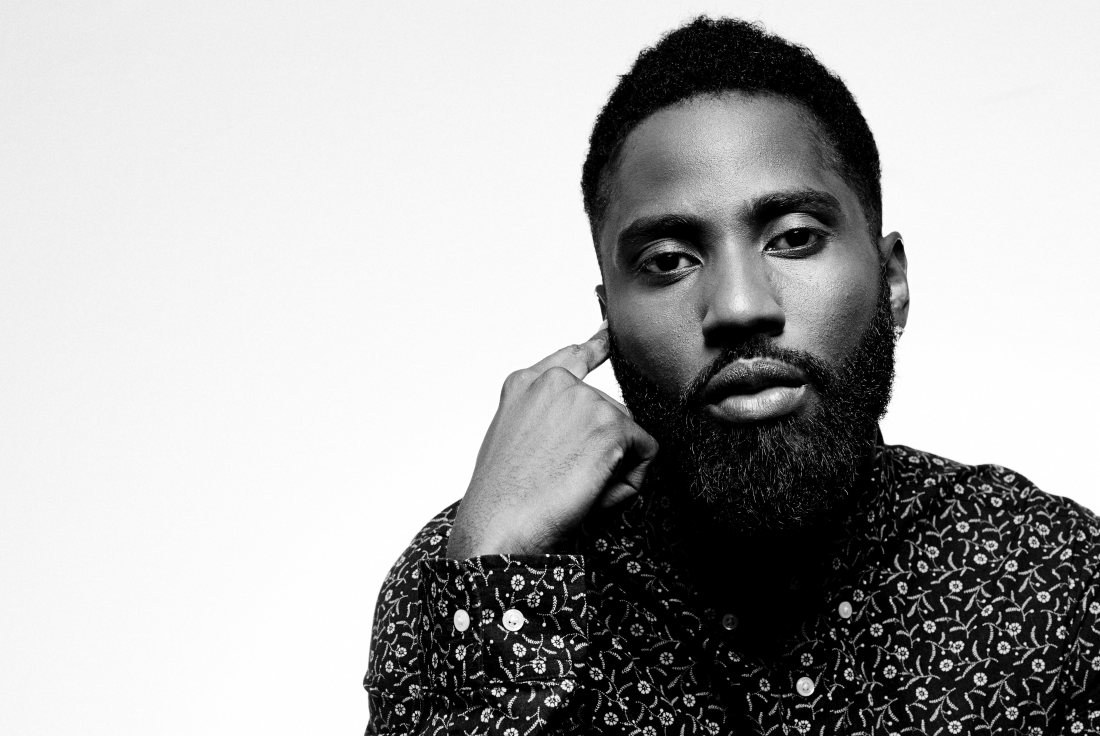
I loved talking about acting and craft with John David Washington for Backstage magazine in what I hope will be the first of many cover stories. He’s humble and wise, and I especially appreciate how thoughtful he is regarding process — how important it is to honor yours as an artist. It’s true for actors and true for writers. He’s also excellent as the leading man coming into his own in Black KkKlansman which is one of Spike Lee’s best.
John David Washington has been eyeing the big leagues for years.
First, it was the NFL. At Morehouse College, he received a full athletic scholarship and set records as a running back. Later, he would play for the United Football League and excel as an undrafted free agent for the then–St. Louis Rams. But even after two years of training with the pros, come Sunday game time, he’d still never touched the field. He had the chops, but never managed to move off the practice squad to reach the star-making level of a pro.
To be clear, Washington is not the kind of person who craves undue credit. He’s humble, driven, and, above all, enjoys doing the work. So when an Achilles tendon injury during a New York Giants tryout put an end to his football career—after a number of already ego-crushing rejections from the NFL—Washington decided to take his work ethic elsewhere. Surgery was an option, but the time out of commission had him on the brink of depression, and he had already cleared space in his mind for another industry: Hollywood. After this summer, it seems the switch will have paid off; Washington is on the path to being a bona fide star.
In case you wondered if we were making any progress on media diversity in entertainment criticism as storytellers, directors and actors of color in Hollywood start investing in a wider range of stories, the answer is no, according to a new USC Annenberg Inclusion Initiative report.
White critics authored 82% of reviews whereas critics from underrepresented racial/ethnic groups authored 18%. This point statistic is substantially below (-20.7 percentage points) U.S. Census, where individuals from underrepresented groups clock in at 38.7% of the population.
Looking at reviews through an intersectional lens, White male critics wrote substantially more reviews (63.9%) than their White female (18.1%) or underrepresented male (13.8%) peers. Underrepresented female critics only wrote 4.1% of the sample. The ratio of White women’s reviews to those of their underrepresented female counterparts was 4.4 to 1.
I wrote about this in my book in 2015, but it bears repeating: Diversity is a business imperative, not a moral imperative. It’s not just “nice to have,” it’s important to keep your business profitable.
I seek out the work of Wesley Morris and Hilton Als and Doreen St. Felix because they are talented writers and reporters and because I know they understand my worldview as well as the aesthetics and aspirations of the world builders who are working to center Black narratives. Bless Anthony Lane’s heart, I love to read his thoughts on anything else, but I give a damn what he thinks about Black Panther or Girls Trip or even Get Out.
The companies that hire and retain a diverse cadre of writers are the ones that will be around for the long haul. If most of the world doesn’t look like the critics who are supposed to be the experts on cultural products they don’t really get, how long do you think you’ll keep your audience?
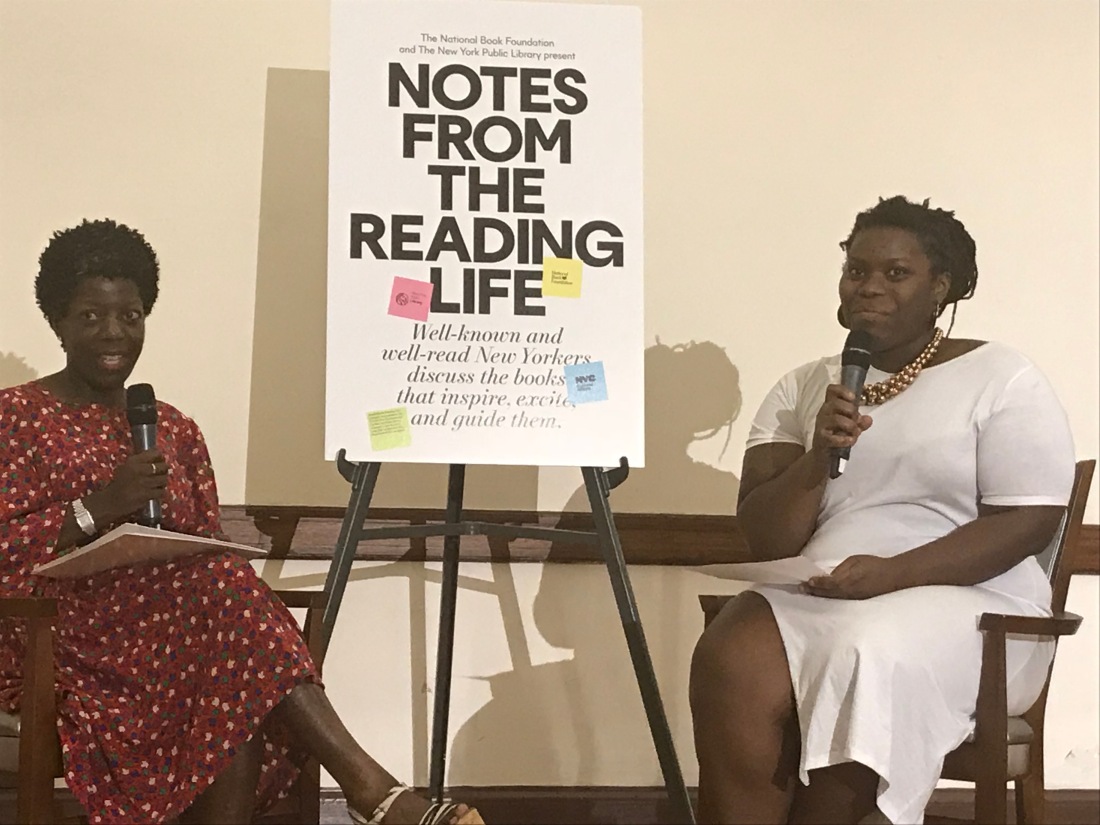
Last Friday evening, I was first in line at the Harry Belafonte Library in Harlem to listen to the first in a series of talks co-presented by the National Book Foundation and the New York Public Library called Notes from the Reading Life featuring two Black women I admire: Thelma Golden and Kaitlyn Greenidge.
Golden has been at the helm of The Studio Museum in Harlem for 17 years, and she is currently serving as Director and Chief Curator. Greenidge is the author of We Love You, Charlie Freeman (and, it must be said, has one of the best Twitter TLs in the game.)
It’s rare that I get to hear two Black women engage in a loving and wide-ranging conversation that centers a Black woman’s engagement with books and reading merely for fun. So of course, I took notes.
The value of attending talks like this is to remember how rejuvenating it is when Black women frame conversation and also how we view story versus how story is framed for us — and frankly, against us. Often, when others are charged with framing aesthetic conversation, in particular, they center themselves and put us at the margins.
For an artist, this makes it hard to invoke the imagination because you never spend any time in a rich, creative or fertile environment. But being in the audience for Golden and Greenidge was one such experience for me.
Golden started by saying she was excited about the renaming of the NYPL branch on 115th street where the talk was held on behalf of Harry Belafonte, and, “to walk in and see the photo of Langston Hughes, to be here in the Alvin Ailey community room — all cultural giants.” And then she underscored that it’s the work of the Studio Museum of Harlem to elevate such giants in ways that often aren’t.
Greenidge started by asking Golden who made her a reader. And Golden mentioned her father, who was born in Harlem, and worked in the building, actually, where the Studio Museum, now is, when it was a bank.
“Arthur Golden was a reader who loved literature. My mother was from Brooklyn. New Yorkers will understand this; when they got married, they compromised and moved to Queens,” she said, to my delight. (It’s hard enough trying to date someone from a different borough I can’t even imagine trying to marry one. Different blog for a different day.)
She described growing up in Queens in a house with what was then known as a den full of books from her father’s library, but no television. He was deeply interested in literature and encouraged her to read.
Her theory is that because she was born in 1965, when he was 40 — considered old for a parent in those days — he let her read anything. Or as she puts it, “We had a relationship to books that was very wide.”
She read both A Tree Grows in Brooklyn and Paule Marshall’s Brown Girl, Brownstones when she was as young as 11, noting with laughter that her mother was very early trying to recruit her to view Brooklyn as the best borough. She read the latter again when she was 16 and again when she was older.
Her mother was from Barbados and grew up in Brooklyn with her siblings in a house purchased by her family in 1926 where some of her relatives still live.
“It wasn’t until I re-read Brown Girl, Brownstones that I really understood my mother and her journey and her quirks,” Golden said. You can think you know about the life of your mother, that it may resemble something that you read in a work of fiction that feels real.
But by reading Marshall’s work, Golden said, “They were all of a sudden actual facts. I asked her later in life, ‘Why did you give me that book?’ She said, ‘I wanted you to understand me better.'”
I don’t imagine I’ll have children of my own, but if that ends up being the path, I imagine this would be such a profound experience…to learn more about the inner life of your mother this way, both in person but also via a book that she loves and gifts to you.
Greenidge said, “I think what you’re describing is the magic of reading for kids. Children can be kind of narcissistic. We think the first time we feel something is the first time its happened.” Golden agreed and expounded on the idea of thinking her experiences were singular and the power of learning they were connected to history.
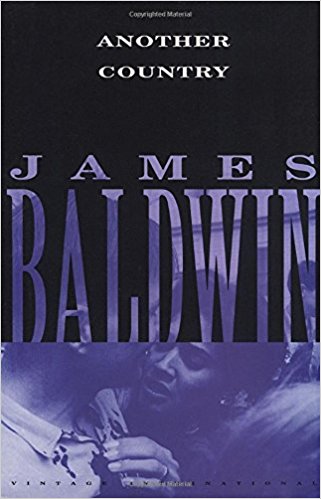
Which brought us to James Baldwin’s Another Country. (At this point, I admittedly got distracted from the bane of my existence and my lifeline to the world, my smartphone, but I believe I heard Golden said she took a seminar at Smith with James Baldwin when she was student) and he asked her who her favorite character in the novel was. And she said Ida, Rufus’ sister.
Baldwin’s 1962 novel explores the complex life and sexuality of Rufus Scott.
I came to quickly enough to hear this gem, “My father went to the same middle school as James Baldwin, and Countee Cullen was their teacher.” (!!)
I was so enamored of this because I have such generational envy for what Harlem was like during the time when Baldwin lived. I know I’m romanticizing it and it was probably as problematic and complex for Black women to navigate emotionally and artistically as every other space is today. But the richness, the products of the period, suggest that the magic had a power that provided at least some possibilities for transcendence. And that’s the part I love and very selfishly wish was still present/actively cultivated for Black writers, at least.
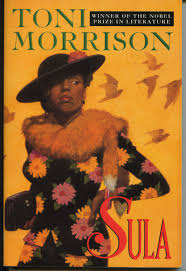
Walker is an example of what it means to be an exceptional living Black woman writer, much like Toni Morrison, the author of another Golden favorite, Sula.
Of all the luscious Morrison books I’ve had the privilege of savoring, Sula falls, for me, just slightly below the Scriptural supremacy and spiritual force in Song of Solomon. But Golden described Sula so poetically, noting that she loved reading it because it was “layered with all the things I know about the world.”
“I don’t want to make somebody else. I want to make myself.” Amen, Sula.
Golden said she never read The Bluest Eye, which is a statement I actually love. Although I did read it, and found that Pecola Breedlove’s envy of blond hair and blue eyes was actually quite resonant for me, I love a contrarian and this assertion (among others) gave me a sense of that streak in Golden. The spectacle of little black girls who hate themselves because they are not white is actually also not the healthiest or most edifying experience for young black girls, so I was happy for Golden, and envious, too, wanting to experience this vicarious liberation from thinking of my beauty in relationship to whiteness and having that praised even from the very beginning — of a life or of a career.
Still, Morrison is not only America’s greatest living novelist, but she is the originator of our current Black literary renaissance, insofar as writers like myself, readers like Golden and almost every Black woman writer I’ve ever known or met who perseveres through self-doubt and the other perils of the writing life have uttered and taken to heart Morrison’s words, “If there’s a book you want to read, but it hasn’t been written yet, then you must write it.”
“That informs my work as a curator, to provide room for so many artists of African descent, to make art to allow us into space,” Golden said. “Toni Morrison is, to me, a rigorous example of Black genius.”
The last of Golden’s favorite books she discussed with Greenidge were The Collected Autobiographies by Maya Angelou and Americanah by Chimamanda Ngozi Adichie.
It was nice to be reminded of Maya’s habit of keeping a hotel room in any city in which she visited, so that she could write without interruption, accompanied only with “two books, a bottle of sloe gin and a deck of cards,” Greenidge informed us.
Angelou’s work in memoir was the first instance of showing Golden, she said, “the stories we create of ourselves…the importance of the creation of our artistic selves. We get to make for ourselves a world that doesn’t make space for us.”
As for Americanah, Golden’s husband is Nigerian and lives in London. Along with the work that she leads and is invested in, she’s tied to Africa, then, “not just in the past, but also art, culture and ideas in the present.”
As a result, she said that she “felt profoundly seen,” by Americanah, in the same way she did by Zadie Smith’s On Beauty. “It’s what happens when outsiders look at your culture.”
Other notable aspects of the talk included the following:
When Greenidge asked Golden which book she would give to a small child if she had to, she mentioned Whistle for Willie by Ezra Jack Keats.
She recalled someone giving her a copy of Invisible Man and finding it formative. She mentioned that someone should write a biography of Ralph Ellison’s wife, Fannie Ellison — do your thing, Internet!
Since we were in Harlem, and Golden had made note of the pictures of Langston Hughes and other cultural giants of the neighborhood earlier, Greenidge mentioned the I, Too Arts Collective the literary nonprofit helmed by author Renee Watson that has continued to do God’s work preserving Langston Hughes’ brownstone and has transformed it into a site of community for writers of color. “I wish it had not been so hard. I wish it had been a natural act. So much of history is not in buildings. It’s in the neighborhood. I hope that while we continue to move toward our future, that we can continue to honor our past. This is a community with a deep and rich history. This wasn’t just a setting for great work. This neighborhood created opportunity for artists. I hope we can preserve that in ways that people will be able to touch and feel in the future.”
You should go to some of the future Notes from the Reading Life events if you’re in New York or if you’ll be in town for one that’s upcoming. Tonight, it’s a conversation between Tim Gunn & Min Lee. I’m so sad to say I’ll miss the conversation (in the Bronx!) between Desus Nice & Rebecca Carroll at the Bronx Library Center on June 15th — but you shouldn’t.
In 2004, when She Hate Me came out, I was assigned to write a story about Spike Lee for the San Francisco Chronicle, where I was a young features reporter at the time. The movie’s tagline was: “One heterosexual male. 18 lesbians. His fee…$10,000 each.”
Like a lot of Spike Lee’s work, I thought the concept was interesting, but I was worried about the execution. I missed one screening of the film, possibly two, and felt like my spirit was subconsciously trying to protect me from seeing the thing all the way through. (Roger Ebert, bless his soul, was probably the only person who wrote anything nice about the movie, which included animated sperm. )
The best thing about the movie was that it provided an opportunity for me to interview Spike Lee in person. His Malcolm X biopic is one of my favorite movies of all time. I wouldn’t see them until later, but When the Levees Broke and 4 Little Girls are two of the most important and beautiful documentaries ever made about black people in our country.
I respect Spike Lee because he has fought for and maintained against all odds complete and utter control of his artistic vision. He is not afraid to take risks, which makes me love him loyally and even more, because there is perhaps no bigger challenge for black artists in America than to take risks.
In the realm of creativity and imagination, black art is always cast as political, created in response to or because of oppression. Black art, like black genius, that is beautiful on its own merit, absent of political sensibilities, is not a concept that is understood, which is why most critiques of black cultural products that are not composed by people of color miss the mark. They cannot conceive of a blackness that is not self-conscious, reactive and that exists for its own sake or to encourage more of the same.
Anyway, even though I was intimidated by Spike, it was still an honor to speak to him and a very young Kerry Washington (also a Bronx girl). I rambled and he was patient but I had two burning questions:
Would he one day find the discipline to end a movie properly? (I was thinking of the basketball launch from prison out into the world at the end of He Got Game; the montage at the end of X; Bamboozled, Clockers…I mean, there are 30 years of movies here to assess at this point, so you get the point. But it doesn’t matter because I never got the courage to actually ask this.)
What did he think about criticisms that he only wrote one-dimensional female characters? (I did ask this: “Some people say that one of your flaws as a director is writing realistic female characters.” It could have been my imagination, but I remember him rolling his eyes at the first part of that question.)
There are likely some exceptions in Spike Lee’s work — of mothers, or sisters or women who are based on real-life characters — but by and large, women in Spike Lee’s films are rendered as caricatures instead of complex characters like male protagonists. It is always the men who have full and complete narrative arcs in his films, motivations that make sense, pragmatic drive and passion. Maybe because he is closer to them, he understands what motivates them, what they desire.
The women, though, tend to be caricatures. Troubled beauties. Whiny plot devices with a good line or two, amazing bone structure. This is them as love objects, as wives and lovers. As with all cultural products that are not meant to be humorous, maternal respect protects black motherhood from the same kind of flat rendering. But all other women are mysterious and odd.
When I asked Spike Lee about critiques of one-dimensional female characters in his films, he said that his wife and some time collaborator Tonya Lewis Lee helped him flesh out the women in his films. He didn’t say it but the look behind his thick framed glasses after suggested his answer should quell any critiques.
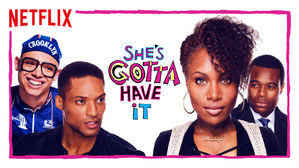
I thought about that again when I watched the She’s Gotta Have It Netflix series this weekend, for whom Tonya Lewis Lee is the show runner and for which there was reportedly a robust women’s writers room. This is the part you shouldn’t read if you haven’t watched it yet. SPOILERS BELOW.
The best thing about She’s Gotta Have It on the small screen is that it is beautiful to see. The actors are lovely. The soundtrack is amazing. The art is also lovely. (I loved so much of the influence of Art Consultant and Artist Tatyana Fazlalizadeh). The homage to black musicians and artists and blackness in Brooklyn is incredible.
The second best thing about this is that Spike Lee is brilliant on the small screen. I think this has something to do with giving his ideas a container in which to work. Sometimes the best writing is short because it requires economy and discipline; I think television and documentary work help him refine his vision and rein it in in a way that is only positive in the end.
In the span of 10 episodes, it’s clear that we are in a Brooklyn that is very different from the Brooklyn that Spike Lee has loved and grew up in his whole life. That informs the backdrop of the series in a way that isn’t distracting so much as it reminds you, regularly, that even though this a remix, it is very much a Spike Lee Joint. I’m not sure that’s a good thing. Is this about Nola Darling or is it about the male experience of Nola Darling?
To that point about who this Nola Darling/series is for, maybe I should have expected there to be a moment about Trump and the 2016 Election, but 1. I didn’t and 2. I wasn’t sure why it was wedged in here. It felt like Spike couldn’t wait for his next project to get it out — much like his feelings on gentrification in Brooklyn — so he amplified them here.
DeWanda Wise is wonderful as Nola Darling. She is beautiful and perfect and has great chemistry, especially with Anthony Ramos, who plays Mars, but really with each of her lovers. I appreciated the update for her as someone with a fluid sexuality. This is something that could have been a little more fleshed out.
There is an odd heavy-handed series of comments on her black dress that needed to be condensed, and a scene in front of her art with Me’Shell N’degeochello playing while she’s spinning around that goes on for too long.
Much has already been made and will be made about how delightful She’s Gotta Have It is for representation of black women and the complexity of it. I would argue that it is a good start (and even that is debatable because…it has been 30 years! Can you call yourself woke if you got up late?) but there are some pretty wacky missteps. The whole Shamekka/butt injection side plot and scenario leads to a narrative arc for that character that is obvious and literally messy on all kinds of levels. The whole time it was happening, it felt like a flashback, like a montage from another movie.
At some point Nola makes the point, paraphrasing another woman, that she’s found the man of her dreams and it is her. It creates a bit of cognitive dissonance for someone who is essentially queer — is this the language she would use, then, to declare her freedom? Besides, in the end, it doesn’t seem that it’s even true — but maybe that’s just a set up for the next season.
In the end, I enjoyed She’s Gotta Have It more than I expected, and I’m curious to see where it will go from here. If you’ve seen it, what did you think?
Nicole D. Collier, one of my favorite members of my virtual writing tribe, asked me to participate in the blog tour. Since I love to read and write about writing (in lieu, sometimes, of actually writing) and I’ve noted that some other writers I admire and respect, including Tananarive Due, Tayari Jones and Daniel Jose Older have all participated, I thought I’d add my humble thoughts and impressions to the mix.
1) What are you working on?
I am working on a book about how racism and sexism have contributed to the demise of traditional journalism and how people of color (and organizations, websites and companies that recognize their value) are changing the media landscape in important but often unacknowledged ways. I have also written a memoir in progress (excerpts have appeared inHuizache, Gawker and TED, among other publications) and every now and then, the poetry that I love comes back. I have worked for years on a short story that turned into a novella about the daughter of a train conductor and the graffiti artist she loves in the Bronx that I know will be published in some form someday.
2) How does your work differ from others’ work in the same genre?
This is an interesting question and frankly, not one that I think too much about. I am willing to admit that not thinking much about it might work to my detriment. Because there are so few people of color who are published and promoted well for work that is for people of color, in that we are the main audience and about people of color that also includes class diversity and is concentrated on the African-American experience, my creative writing and poetry are different from others’ in the sense that I am tacitly aware of internal and external geographies, their impact on how and when and where we tell our stories and how those stories are positioned or excluded from mainstream and popular cultural narratives about people of color — specifically black women. I hope that my reverence, appreciation and empathy for the intersections of my experience are reflected in the work.
The same is true for nonfiction. The main difference in my nonfiction writing is that I am fully aware of the power of the truth, or a truth, to change a life because it is how I was shaped as a young reader who dreamed of being a writer. I love that saying that the creative adult is the child who survived — that is the internal location or spiritual location I write from.
It helps that I have a wealth of traditional newspaper reporting experience, which gives me the power of knowing how to completely own a deadline and the discipline of structure while also giving me the confidence that comes with having failed and made mistakes and learned that failure, or whatever is subjectively considered failure is not the end of the world. There is always something more to write. I think my nonfiction is different from others’ who write memoir, essays and other nonfiction in that I seek to offer information for others to investigate or parse through instead of as a definitive statement or argument.I try to be authoritative without being obstinate and lyrical without trying too hard. I also try not to be too hard on myself when I fail at either of those.
3) Why do you write what you do?
One of the things that brought me a lot of comfort and joy as a young woman and a budding writer was reading elegant, beautiful and clear work about people of color who are traditionally not given models of ourselves in literature that have these elements. I write about women, women of color, the poor and working class and other people of color so that I can be a part of creating the beauty in the world that is otherwise missing when it comes to these groups. Perhaps because of postracial and postfeminist rhetoric, to some people it seems to be redundant and outdated to state and restate how important it is to be committed to writing about black women, especially those who are the least visible in classical or predominantly white canons, but I know how significant it was for me to read Alice Walker’s In Search of Our Mother’s Gardens, for instance, while I was self-parenting and supporting my mother in ways that were beyond my young years or to read bell hooks and Cornel West in seventh grade before I understood what they were even talking about in Breaking Bread. The same can be said of the multi-volume memoirs of Maya Angelou who showed me that while it took courage, confidence and grace to be a Renaissance woman (she was a tall black woman, too, like me — and Octavia Butler!) it was possible to overcome a lot of internal and external resistance to do so.
4) How does your writing process work?
I have multiple processes and I think all creatives do. I write all the time. I write on my phone. I write little notes in a notebook that I usually carry around with me. I prefer to write longhand, which is slower than typing, and to transcribe. I love to write longhand when something is particularly meaningful to me or requires the kind of granular detail that I need to retain. (The most recent example of one piece I did this with is this blog about leaving Austin.)
I don’t necessarily write everyday anymore but I used to, faithfully, for many years. I think you build writing time into your life in a way that is completely natural for you. Do it in a way that doesn’t make it feel like so much work. I actually love work and am addicted to work, so for me, working doesn’t carry a negative connotation in the same way that say, relaxation does (No pun intended, I am working on that. I realize that I ain’t like everybody that way.) But the main problem new and/or young writers seem to face related to process is that they associate writing with work. I say do whatever you need to do to get rid of that mentality and get out of your own way in whatever way you need to to go from being a person who has always wanted to write to being a writer…because writers write. I value my work and the luxury and privilege I have to do it so much that I approach the page as a way to share the gifts that were bestowed upon me and to honor the many different people I’ve known who wished that they had the luxury of sitting down at a page to write.
Writers write but they should also read. I read everything, which is a significant part of my writing process. I believe heartily in taking notes. For nonfiction, I take copious notes. Everywhere — in the book, in a separate notebook, on Post-Its.
I write at all hours, but my best writing gets done when I have the least distractions which is either early in the morning or in the middle of the night. I try mightily to get every last bit of doubt or concern about anything else out of my head while I’m writing a draft and then go back to it when I have some sense and some energy and I can revise. Revision is the heart of my work and the most enjoyable and the most irritating part of being a writer. I revise most things I write a half-dozen times — even blogs — before I am satisfied with word choice and structure and order. Outlines can be really helpful for big projects, but I am not wedded to them.
On June 9th, two of my favorite writers and favorite women are going to post on their blogs about their writing process. Both of these ladies are two of the sweetest people I’ve ever met and their support has helped to keep me writing during some of my lowest points. I hope you’ll read and share their work widely.
Jo Scott-Coe is a fantastic nonfiction author, fellow tall woman and excellent teacher.
Juanita Mantz and I met at VONA in 2012 and her work has been published at xoJane and elsewhere.

 In the years to come, I sketched on the margins of paper and of my life. When I came of age, the fashion designer Byron Lars was hot and the Village Voice was a plump pulp product I flipped through every Wednesday as soon as it was folded neatly and flat in the red plastic bins that seemed to appear on every Manhattan street corner. One week, I saw that Lars would be greeting people at Bloomingdale’s. It was my first real life meeting with someone Black who was living one of my dreams. I hopped the turnstiles from the Bronx and made the sojourn to shake his hand, to laugh shyly when he greeted me and encouraged me to keep drawing.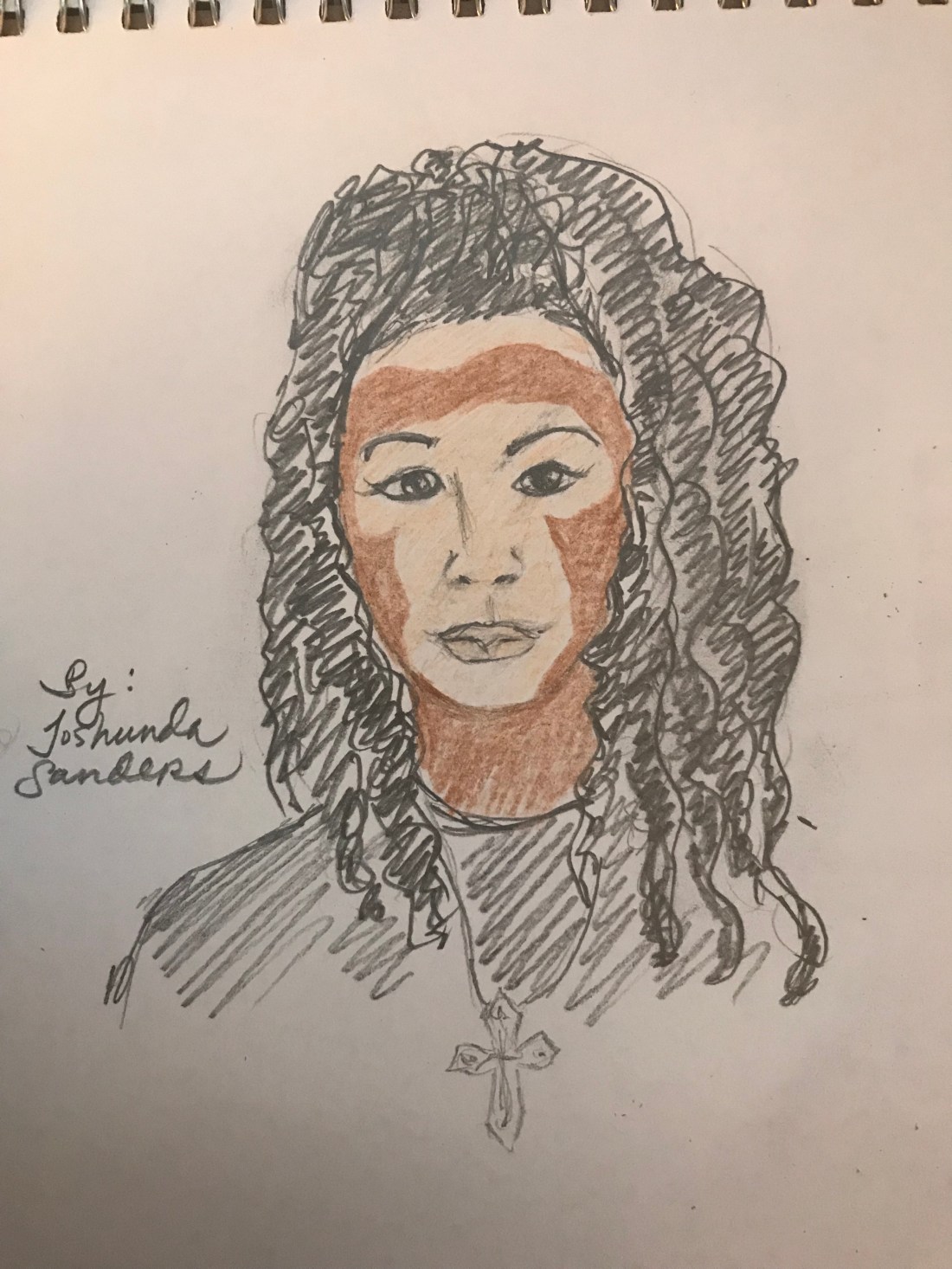


 Joshunda Sanders