Remembering bell hooks

One of things I’ve been doing lately is thinking about my legacy as a writer, as a person. It feels a little abstract to think about what your influence will be when you’re gone. And then someone you love dies. And it doesn’t feel so abstract.

My heart is still heavy thinking about bell hooks’ transition. I was honored, as someone who was profoundly shaped by her passion, her courage, her clear-sighted articulation of the things that keep Black women from soaring — and how to overcome them — were balm for me. She was really an iconic trailblazer. I tried to do her work and life and impact some justice for Oprah Daily. An excerpt is below. You can read it here, or here. I hope she is resting well.

Mourning bell hooks—who died on December 15, 2021, at age 69 after giving us four decades of trailblazing feminist scholarship—means celebrating everything she taught us about what it means to be a Black woman in love with herself and the world, and with the life of the mind. With her passing, there will be one fewer pair of hands holding up Black women—all women—as inherently valuable. For decades she has helped me in my journey to become myself; her legacy will live in my bones, and in the minds and hearts of all she awakened and inspired.

Born Gloria Jean Watkins in Hopkinsville, Kentucky, in 1952, hooks honored her matrilineal line by taking her maternal great-grandmother’s name as her nom de plume in a lowercase version to emphasize “the substance of books, not who I am.” She influenced several well-known luminaries and writers to adopt the same practice. Let us defer to the work of our hands and pay tribute to our elders instead of bowing to tradition and capitalizing ourselves.

Maybe honoring her elders and ancestors played a role in enabling her to speak and write her fame into existence, to hear her family tell it. Like most Southern towns, Hopkinsville, Kentucky, was stratified by race and class; hooks’s father was a janitor, and her mother a maid. “Gloria learned to read and write at an early age and even proclaimed she would be famous one day,” her family said in a statement. “Growing up, the girls shared an upstairs bedroom, and she would always keep the light on well into the night. Every night we would try to sleep, but the sounds of her writing or page turning caused us to yell down to Mom to make her turn the light off.”

Her family went on to say that Gloria always had at least 10 serious books she was reading simultaneously, whether Shakespeare, Little Women, or other classics, which quenched her “great thirst for knowledge, which she incorporated into her life’s work.” Against the backdrop of the great civil rights struggles, she graduated from a newly integrated high school. Her intellectual acumen and writer’s gifts were apparent early, and she majored in English literature at Stanford University, then earned her MA from the University of Wisconsin and her PhD from the University of California at Santa Cruz, where she wrote her dissertation on Toni Morrison.
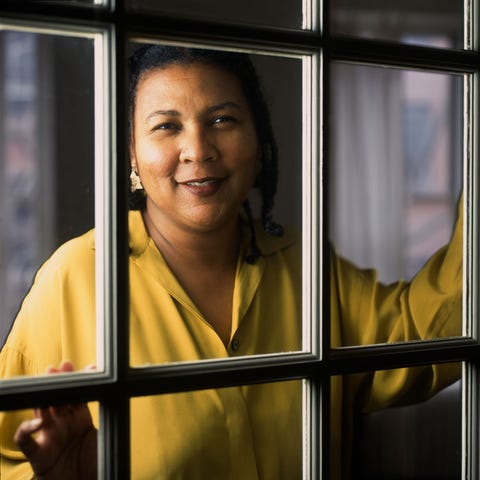
bell hooks
Karjean Levine, Getty Images

She thrived in the classroom, and her criticism and charisma quickly acquired a following both in and beyond academic circles. I first encountered her during one of my many trips to my local New York library at age 13 and was instantly in awe. Hooks wrote with confident wisdom and ease about topics I had never read from a Black woman’s perspective; she seemed so like me, even if she was from a different part of the country and a different generation. We were kindred spirits.

My dog-eared copy of Sisters of the Yam: Black Women and Self-Recovery was the gateway to reprogramming myself. The microaggressions, the confusing pauses and rudeness that came my way because of my dark skin and natural hair—bell hooks helped me understand that these were the manifestations of social constructs she interrogated, not figments of my imagination. Her writing about writing, the way she mined the role of self-love and self-care: All these things and more marked her as a visionary. Radical, yes, for her positions on racism and patriarchy and capitalism. Radical, too, for attending to the hearts of Black women. For saying that we were not just our work, but we deserved, as much as anyone, our own affection and tenderness. The world would not give it to us, not without a fight.

A Black History Month Reading List, Part 2

DSC_0015


So you may have already seen my other list of recommendations, but if not, here’s Part I. Part 2 is not meant to be exhaustive or comprehensive, because there are many lists of books about Black history and culture that you can check out for even more recommendations, including the Zora Canon of 100 best books here, this Penguin Random House list of 25 contemporary fiction and nonfiction  or this Electric Literature list of 10 books about Black Appalachia and then there’s Goodreads and Twitter and a dozen other places.

I realized when I was thinking about some of my favorite works of history or of historical significance about Blackness that they were across genres.

For instance, for colored girls who have considered suicide when the rainbow is enuf by Ntozake Shange was actually the second or third book of hers I read. Before that, I was in love with Liliane, Sassafrass, Cypress & Indigo, her poetry collection, The Love Space Demands. But what I loved most about for colored girls — which was recently a sold out production in all of its glory at The Public Theater — was that it showed Black women in our multicultural context. As being in relationship to Latinx, Caribbean and African spiritualities, dreams and aspirations. It showed our love and joy and pain as being Diasporic like a lot of Ms. Shange’s work.

In this way she was definitely a part of the literary tradition of recovering the wholeness of Black womanhood in the way that Zora Neale Hurston did in Their Eyes Were Watching God, one of my favorite novels of all time.

Much has been said about the beauty and timelessness of Their Eyes Were Watching God; to understand more about the life of Zora, however, an essential text is Valerie Boyd’s Wrapped in Rainbows. It is a classic example of the ways Black women’s lives are cherished in unique ways when we have Black women biographers to attend to the beautiful and brutal details of our lives.

Speaking of the unique beauty of having a Black woman author reflecting the details of Black women writers, bell hooks’ work has been foundational in helping me decode and externalize internalized biases that get in the way of my work. This includes everything from Sisters of the Yam, Writing About Race (a book in which I was surprised to find myself cited!!) to one of her most important books to me, Remembered Rapture: The  Writer at Work. I often talk about this book because it was the first time I read a respected black woman author say that no Black woman could write too much; that we are always writing against time because of the illnesses that take us out, because our ancestors were silenced and we don’t have to be and much more.

I have not mentioned one of the most important writers in my development and understanding of the myriad possibilities for Black writers and intellectuals on a global scale yet, James Baldwin, in part because the book by which I was introduced to him is no longer in print. I had the great fortune to pick up a thick book, The Price of the Ticket, a collection of Baldwin’s essays in the early 1990s. Published in 1985, it represents some of his most powerful writing from 1948 to 1985. I read it in seventh grade and kept the book with me, somehow, across a lot of moves to a lot of different places. It reads to me like sacred text, and its beautiful cadences and nuances, the confidence and fear, the anger and disappointment, all elegant and alive, helped me really see America for the country that it is instead of the country I believe most of us want it to be.

A Black History Month Reading List, Part 1

Some of you have been kind enough to follow my musings about individual books on my new YouTube channel, Black Book Stacks. This is a natural endeavor for me, to find, devour and support books by and about Black people, who I define as people from throughout the African Diaspora. This is an evolving definition, I guess; I was reading David Yoon’s Frankly In Love, which is an addictive YA book that delves into interracial dating and intraracial friendship, including with his Black friend Q. Frankly In Love is a good, recent example of the kind of book that blends a lot of different kinds of diversity and that was part of what thrilled me about it.

I forget who I was talking to who said this, but it stuck with me: Black people in this country do not have the luxury of having as long a literary tradition as any other group in America because of the legacy of slavery. Because of being forbidden to read or write. To me, that makes it that much more important to lift up books that recover and restore us to ourselves; that expand what we know of ourselves and our lineage, real and imagined. Anyway, here is the beginning of a list of some essentials of Black history, to me, anyway, that can be a good resource and are some of my favorite books that filled in important gaps for me along my reading journey:

  1. (New) Daughters of Africa: An International Anthology of Writing by Women of African Descent, edited by Margaret Busby | I have the great fortune of having both a copy of the original Daughters of Africa, and the newest addition, which just expands the important, vast collection of significant work to include 200 writers. A classic.
  2. Sister Outsider by Audre Lorde | “Poetry is Not A Luxury,” “Uses of the Erotic,” and many other seminal works by Audre Lorde were first written or delivered as lectures in the 1970s. Like the Combahee River Collective as a whole, she was integral to giving us language to describe and express the interlocking oppressions we know now as an intersectionality framework.
  3. How We Get Free: Black Feminism and the Combahee River Collective by Keanga Yamahtta-Taylor | I was not familiar with Dr. Yamahtta-Taylor’s work until I taught it at the New School, and hearing first hand from the likes of Barbara Smith, Barbara Ransby and Alicia Garza helped contextualize not only a lot of what we’re seeing now in terms of how Black women are dismissed or lifted up, depending on the community, but also how much has happened behind the scenes along the way.
  4. At the Dark End of the Street: Black Women, Rape, and Resistance — a New History of the Civil Rights Movement from Rosa Parks to the Rise of Black Power by Danielle L. McGuire | No disrespect to Rosa Parks, but I did not know the name of Claudette Colvin until I read McGuire’s book, of my own volition, long after undergrad, where I had Africana Studies as a minor and learned a good deal, just not enough.
  5. The Warmth of Other Suns: The Epic Story of America’s Great Migration by Isabel Wilkerson | It’s hard to believe that 2020 is the 10th anniversary of this book’s publication (!) but what an incredible work of scholarship, recovery and re-membering from Wilkerson, who, if memory serves, interviewed thousands for this book, including a young pre-presidential hopeful named Barack Obama. No list of important Black historical texts is complete without this one.

Words of Fire is another underrated anthology of Black Feminist thought; Black Skin, White Masks has always haunted me, and Sisters of the Yam, by bell hooks, was the beginning of my understanding of wellness and self-care.

I’d love to hear what your thoughts are on these books if you’ve read them, or what books you consider essential to learning about Black history are.

Roses for the Living

122517-news-erica-gardner-on-life-support

Roses for the living.

I was thinking of this saying when I first heard that Erica Garner had a heart attack and we were all hopeful for recovery. I was surrounded by my family, and my sweet nephew led us in prayer for her, and my thoughts were consumed with her and her family, what they had been through and the burden black women are asked to constantly carry.

When I was first starting my newspaper career, I wrote for a time almost exclusively about black death and black pain, whether it was killing in Oakland or incarcerated mothers with families trying to sort through how to live without their needed matriarchs. I didn’t fully appreciate then, because no one had ever told me to, the notion of taking care of myself. I did not think that I was sensitive in any particular way to the harrowing and depressing work of being a witness, of being an advocate and especially of straddling the worlds between corporate journalism, where I had to translate the working class and middle class black experience, and the worlds of black folk.

I’m sure it was someone during this time who first used this phrase, to remind me and to remind others that we should give roses and praises to the ones that we love, the ones that are doing the work, while they are still here.

I was also thinking of another ProPublica piece, this one about black-serving hospitals where black mothers have been dying because of substandard care, a reality that could easily be corrected by improving care for them and making it equal to that which white women receive.

My answer to grief and fear and rage, to emotions I can’t name and want to understand or run away from at the same time, is always the same: I pray. I meditate. I read. Then, I try to write.

I looked to Dorothy Roberts’ Killing the Black Body and The Gloria Anzaldua Reader and Evelyn C. White’s The Black Women’s Health Book and Audre Lorde’s Sister Outsider and even bell hooks’ Sisters of the Yam: Black Women and Self-Recovery. I wanted to lean on the words of someone wiser than myself, someone who has lived this harrowing closeness to death and daily destruction, who understands the weariness of spirit that emerges when you just feel like you don’t know how else to ask the world to stop being willfully reckless with black women’s lives and hearts.

I found some passages that were connected. Some statistics, though we are more than numbers and metrics. Maybe I didn’t find the right words because I am supposed to write them, because they were stuck in my throat.

The only housewarming gift I gave to myself in 2017 was a Molly Crabapple print which is a painting of Audre Lorde with a quote, “Your silence will not protect you.” I put it up in a prominent place in my apartment so that I always have to consider it, so that I never forget. What I most respect and love and admire about women who step forward to fight the battles of their lives as Erica Garner did is that they understand this in a visceral, frontline way. It is not theoretical.

It is easy to feel that if we say nothing, that we are protected. That the suffering of the world, the tyrannies that obstruct justice will forget us. But reading from the full lecture that the quote is derived from, delivered a little more than exactly 40 years ago from a paper published as “The Transformation of Silence into Language and Action” helped me to remember why it is important to remember to continue to resist the temptation to clam up:

I was going to die, if not sooner then later, whether or not I had ever spoken myself. My silences had not protected me. Your silence will not protect you. But for every real word spoken, for every attempt I had ever made to speak those truths for which I am still seeking, I had made contact with other women while we examined the words to fit a world in which we all believed, bridging our differences. And it was the concern and caring of all those women which gave me strength and enabled me to scrutinize the essentials of my living.”

I had forgotten that this quote talked about how breaking silence gave Audre community, how it gives me, gives us, gave Erica, community even if community is not always enough to save us. Audre wrote this, too:

In the cause of silence, each of us draws the face of her own fear – fear of contempt, of censure, or some judgment, or recognition, of challenge, of annihilation. But most of all, I think, we fear the visibility without which we cannot truly live. Within this country where racial difference creates a constant, if unspoken, distortion of vision, Black women have on one hand always been highly visible, and so, on the other hand, have been rendered invisible through the depersonalization of racism. Even within the women’s movement, we have had to fight, and still do, for that very visibility which also renders us most vulnerable, our Blackness. For to survive in the mouth of this dragon we call America, we have had to learn this first and most vital lesson – that we were never meant to survive. Not as human beings. And neither were most of you here today, Black or not. And that visibility which makes us most vulnerable is also the source of our greatest strength. Because the machine will try to grind you to dust anyway, whether or not we speak.”

That visibility which makes us most vulnerable is also the source of our greatest strength. 

This resonates, and feels true, but also we know from the death of Kalief Browder’s mother, Venida, and now Erica, that the vulnerabilities that come with being visible while fighting the good fight often don’t make us feel strong at all. People praise us with their mouths, but outside of public view is where the real war is – with keeping a life together, with staying healthy, remembering to rest, remembering to grieve, remembering that if there are no roses given to you that you can seek your own — but that too comes at a cost.

As Erica’s mother, Esaw Snipes said, “The only thing I can say is that she was a warrior. She fought the good fight. This is just the first fight in 27 years she lost.”

I tried to not write this at all. I had some down time. I was doing other work and I made myself stop being productive to take care of myself, so that I wasn’t spending an entire day during the last hours of the longest year in modern memory thinking of how many broken hearted black women have died while a complicit nation apologized and watched and then proceeded to kill another one.

I took a friend’s beautiful book of poetry with me to the great continent of Brooklyn for a birthday party, had a couple of drinks, met some great folks, had a good meal and came home, haunted, exhausted, near tears in the wee hours of the last day of 2017. I will not be defeated, not while I’m living, not by racism, not by sexism, not by silences or complicity. Or, at least, I can say I will keep trying not to be.

I do not know how to give myself the luxury of looking away when the world is too much, though, and it is often too much. Zora said there are years that ask questions and years that answer. I hope that 2018 has answers for us.