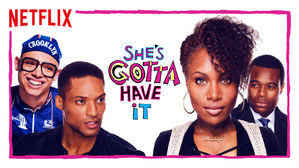
She’s Gotta Have It

In 2004, when She Hate Me came out, I was assigned to write a story about Spike Lee for the San Francisco Chronicle, where I was a young features reporter at the time. The movie’s tagline was: “One heterosexual male. 18 lesbians. His fee…$10,000 each.”

Like a lot of Spike Lee’s work, I thought the concept was interesting, but I was worried about the execution. I missed one screening of the film, possibly two, and felt like my spirit was subconsciously trying to protect me from seeing the thing all the way through. (Roger Ebert, bless his soul, was probably the only person who wrote anything nice about the movie, which included animated sperm. )

The best thing about the movie was that it provided an opportunity for me to interview Spike Lee in person. His Malcolm X biopic is one of my favorite movies of all time. I wouldn’t see them until later, but When the Levees Broke and 4 Little Girls are two of the most important and beautiful documentaries ever made about black people in our country.

I respect Spike Lee because he has fought for and maintained against all odds complete and utter control of his artistic vision. He is not afraid to take risks, which makes me love him loyally and even more, because there is perhaps no bigger challenge for black artists in America than to take risks.

In the realm of creativity and imagination, black art is always cast as political, created in response to or because of oppression. Black art, like black genius, that is beautiful on its own merit, absent of political sensibilities, is not a concept that is understood, which is why most critiques of black cultural products that are not composed by people of color miss the mark. They cannot conceive of a blackness that is not self-conscious, reactive and that exists for its own sake or to encourage more of the same.

Anyway, even though I was intimidated by Spike, it was still an honor to speak to him and a very young Kerry Washington (also a Bronx girl). I rambled and he was patient but I had two burning questions:

  • Would he one day find the discipline to end a movie properly? (I was thinking of the basketball launch from prison out into the world at the end of He Got Game; the montage at the end of X; Bamboozled, Clockers…I mean, there are 30 years of movies here to assess at this point, so you get the point. But it doesn’t matter because I never got the courage to actually ask this.)
  • What did he think about criticisms that he only wrote one-dimensional female characters? (I did ask this: “Some people say that one of your flaws as a director is writing realistic female characters.” It could have been my imagination, but I remember him rolling his eyes at the first part of that question.)

There are likely some exceptions in Spike Lee’s work — of mothers, or sisters or women who are based on real-life characters — but by and large, women in Spike Lee’s films are rendered as caricatures instead of complex characters like male protagonists. It is always the men who have full and complete narrative arcs in his films, motivations that make sense, pragmatic drive and passion. Maybe because he is closer to them, he understands what motivates them, what they desire.

The women, though, tend to be caricatures. Troubled beauties. Whiny plot devices with a good line or two, amazing bone structure. This is them as love objects, as wives and lovers. As with all cultural products that are not meant to be humorous, maternal respect protects black motherhood from the same kind of flat rendering. But all other women are mysterious and odd.

When I asked Spike Lee about critiques of one-dimensional female characters in his films, he said that his wife and some time collaborator Tonya Lewis Lee helped him flesh out the women in his films. He didn’t say it but the look behind his thick framed glasses after suggested his answer should quell any critiques.

I thought about that again when I watched the She’s Gotta Have It Netflix series this weekend, for whom Tonya Lewis Lee is the show runner and for which there was reportedly a robust women’s writers room. This is the part you shouldn’t read if you haven’t watched it yet. SPOILERS BELOW.

  • The best thing about She’s Gotta Have It on the small screen is that it is beautiful to see. The actors are lovely. The soundtrack is amazing. The art is also lovely. (I loved so much of the influence of Art Consultant and Artist Tatyana Fazlalizadeh). The homage to black musicians and artists and blackness in Brooklyn is incredible.
  • The second best thing about this is that Spike Lee is brilliant on the small screen. I think this has something to do with giving his ideas a container in which to work. Sometimes the best writing is short because it requires economy and discipline; I think television and documentary work help him refine his vision and rein it in in a way that is only positive in the end.
  • In the span of 10 episodes, it’s clear that we are in a Brooklyn that is very different from the Brooklyn that Spike Lee has loved and grew up in his whole life. That informs the backdrop of the series in a way that isn’t distracting so much as it reminds you, regularly, that even though this a remix, it is very much a Spike Lee Joint. I’m not sure that’s a good thing. Is this about Nola Darling or is it about the male experience of Nola Darling?
  • To that point about who this Nola Darling/series is for, maybe I should have expected there to be a moment about Trump and the 2016 Election, but 1. I didn’t and 2. I wasn’t sure why it was wedged in here. It felt like Spike couldn’t wait for his next project to get it out — much like his feelings on gentrification in Brooklyn — so he amplified them here.
  • DeWanda Wise is wonderful as Nola Darling. She is beautiful and perfect and has great chemistry, especially with Anthony Ramos, who plays Mars, but really with each of her lovers. I appreciated the update for her as someone with a fluid sexuality. This is something that could have been a little more fleshed out.
  • There is an odd heavy-handed series of comments on her black dress that needed to be condensed, and a scene in front of her art with Me’Shell N’degeochello playing while she’s spinning around that goes on for too long.
  • Much has already been made and will be made about how delightful She’s Gotta Have It is for representation of black women and the complexity of it. I would argue that it is a good start (and even that is debatable because…it has been 30 years! Can you call yourself woke if you got up late?) but there are some pretty wacky missteps. The whole Shamekka/butt injection side plot and scenario leads to a narrative arc for that character that is obvious and literally messy on all kinds of levels. The whole time it was happening, it felt like a flashback, like a montage from another movie.
  • At some point Nola makes the point, paraphrasing another woman, that she’s found the man of her dreams and it is her. It creates a bit of cognitive dissonance for someone who is essentially queer — is this the language she would use, then, to declare her freedom? Besides, in the end, it doesn’t seem that it’s even true — but maybe that’s just a set up for the next season.

In the end, I enjoyed She’s Gotta Have It more than I expected, and I’m curious to see where it will go from here. If you’ve seen it, what did you think?

On Zadie Smith & The Missing Black American Woman Expert

Zadie Smith, New York City, June 2016

It is easy to be smitten with Zadie Smith, as I think I am. She has freckles and I love freckles. She can sing. She has a lovely accent. She is witty. She writes well.

Actually, she’s brilliant. I’m a fan of her nonfiction, and I was smitten more with Changing My Mind, her book of essays, than with On Beauty, which was fine but not my fave. Same with Swing Time, which I just finished before I happened upon this complicated essay, “Who Owns Black Pain?” in Harper’s Magazine.

It starts with a very interesting look and assessment of “Get Out”, which I have seen three times. I have yet to read (not saying it doesn’t exist but I’m busy and read a lot but also miss things) the take from a black woman that I want to read which is: That is exactly what black men who dismiss black women and our beauty GET. What is? Get Out is. Rose is.

Erika Alexander brought me all of the joy in the world in that movie. All of it. (The only other movie I have seen three times, by the way, is the Ten Commandments, but that’s because my mother had both tapes when I was a kid and I couldn’t help myself. [Charlton Heston was kind of fine as Moses.])

I’m burying the lede, here. My point is not to catch up on the critiques I didn’t share the first three times I watched “Get Out” but to elaborate on something I’ve said before. Something I deeply believe and am troubled by: We live in a culture that prefers to hear about the lived experience of black women from everyone but black American women.

I will not name check them all. But I will say from personal experience and observation that there seems to be a vested interest in hearing from well-known British, African and other “Exotic” women of the African Diaspora about the pain experienced by Black American women. The only thing our culture loves more is to hear from Black men about the ways in which we are undeserving of their love, affection, desire or attention.

The problem is that none of these people are experts in the black American experience because they cannot clearly, definitively or expertly explain the purview or perspective of Black American women. Let’s look at some data.

Years of Census data show that black women are a little over half of the black population in the U.S. and have been for a long time. A recent report released by the National Domestic Workers Alliance explains that 80 percent of us are the breadwinners in our families. We are the majority perspective in our communities, even though people would prefer that it was otherwise. We are the bellwether for what is experienced by our sisters — yes, especially our white sisters — even when folks would rather not hear it.

So it is understandable that some of us — and for the purposes of this blog, I mean me — had a visceral reaction to reading these words from Zadie Smith (italics mine):

“To be clear, the life of the black citizen in America is no more envied or desired today than it was back in 1963. Her schools are still avoided and her housing still substandard and her neighborhood still feared and her personal and professional outcomes disproportionately linked to her zip code. But her physical self is no longer reviled. If she is a child and comes up for adoption, many a white family will be delighted to have her, and if she is in your social class and social circle, she is very welcome to come to the party; indeed, it’s not really a party unless she does come. No one will call her the n-word on national television, least of all a black intellectual. (The Baldwin quote is from a television interview.) For liberals the word is interdicted and unsayable.”

To me, this paragraph simply means that Zadie has not been paying attention.

Yes to the lack of progress for the most part since 1963.

No to the fact that the physical bodies of black woman citizens are not reviled.

Hello, Serena Williams — apparently a naked black pregnant body means that the celebrity pregnancy photo shoot has jumped the shark. Hey, Kodak Black: This dark skinned black woman doesn’t want you, either. I could go on and on for days and days: Black women are most likely to be victimized by Intimate Partner Violence. In Seattle, a mentally ill black mother was shot by police in front of her children. Twitter has been ablaze with the justification of infidelity because Jay Z and Beyonce have wisely monetized the challenges of black love.

In any event, this is not what love looks like.

Also, a college professor who defended Black Lives Matter on Fox News was fired from her job simply because she expressed her personal opinion during her free time. This is not the same as someone calling her a nigger on air. But it is today’s equivalent. Let us not forget the government employees who called First Lady Michelle Obama an ape before she and Barack were even out of the White House yet.

So I thought these things, or I felt them and let them sit with me. Then I read some more of Zadie’s piece:

(On Dana Schutz’ painting of Emmett Till): “Neither of us is American, but the author appears to speak confidently in defense of the African-American experience, so I, like her, will assume a transnational unity. I will assume that Emmett Till, if I could paint, could be my subject too….Now I want to inch a step further. I turn from the painting to my children. Their beloved father is white, I am biracial, so, by the old racial classifications of America, they are “quadroons.” Could they take black suffering as a subject of their art, should they ever make any? Their grandmother is as black as the ace of spades, as the British used to say; their mother is what the French still call café au lait. They themselves are sort of yellowy. When exactly does black suffering cease to be their concern?”

Listen. The definition of blackness in America is like everything else: It persists from slavery times. The persistence of hypodescent, better known as the “one drop rule”, means that actually whatever you are in America, whether you are pledging transnational unity to us or anything else, if you have a drop of black blood in you you are considered black. I don’t have kids. I don’t give parents parenting advice because who am I do to that? However, honey, blackness is not about complexion, it is about blood. Black suffering will always be the concern of your kids, at least on this side of the Atlantic. If you think this is a philosophical question, I invite you to actually talk to some Black American mothers about that.

Speaking of Black mothers:

“I stood in front of the painting and thought how cathartic it would be if this picture filled me with rage. But it never got that deep into me, as either representation or appropriation.”

It must be very nice to gaze upon an artistic representation of Emmett Till without experiencing rage or connection, especially in these times. Here is some data and anecdotal evidence compiled by African American women and scholars on the very real experience of Black women who exhibit symptoms associated with PTSD as a result of their exposure to the violence that has been waged against black children since before and after Emmett Till’s lynching. What is missing here, in this passage and in this piece overall, is a confrontation with the privilege that comes with viewing black pain from a cultural remove informed by geographical framing if not racial difference.

They might as well be the same.

“…I found I resented the implication that black pain is so raw and unprocessed—and black art practice so vulnerable and invisible—that a single painting by a white woman can radically influence it one way or another. Nor did I need to convince myself of my own authenticity by drawing a line between somebody else’s supposed fraudulence and the fears I have concerning my own (thus evincing an unfortunate tendency toward overcompensation that, it must be admitted, is not unknown among us biracial folks). No. The viewer is not a fraud. Neither is the painter. The truth is that this painting and I are simply not in profound communication.”

Again, this is a privilege that Zadie does not recognize in herself. The issue of Dana Schutz’ painting was covered with far more nuance in the New Yorker perhaps because Calvin Tompkins did not have the same penchant for overcompensation. Zadie is allowed to resent whatever she wants about black pain, but if she’s not in communication with a painting about a seminal Black American moment — politically, psychologically and emotionally — that is because it is not a moment that has any meaning for her. That moment or cultural reference point does not require her to feel authentically black. But it also doesn’t mean that she has expertise in how black pain should or should not be processed or how to define it.

Finally, let us discuss this:

“But in this moment of resurgent black consciousness, God knows it feels good—therapeutic!—to mark a clear separation from white America, the better to speak in a collective voice. We will not be moved. We can’t breathe. We will not be executed for traffic violations or for the wearing of hoodies. We will no longer tolerate substandard schools, housing, health care. Get Out—as evidenced by its huge box office—is the right movie for this moment. It is the opposite of post-black or postracial. It reveals race as the fundamental American lens through which everything is seen.”

Which collective voice is this, exactly? From where does it speak? Who agreed? Is this meant to be satirical, or is it real?

We have been moved. We are being moved. We are being suffocated. Not only are we being executed, but the police who are doing so are being acquitted. They walk and we continue to mourn, our black pain exposed and unprocessed. Over and over and over again.

I agree with Zadie on one thing: “Get Out” was cathartic, but not because it is the opposite of post-black or post-racial. Both terms were always fictive. It was cathartic because without its alternate ending, it provides relief from the reality in which we live. Its horrors were amusing to me because they are totally plausible and not at all inconceivable. I was reminded that black bodies, even black women’s bodies, are wanted for what they can offer in terms of plots or potential solutions, but they are never considered the meat of the story. In “Get Out,” as in Dana Shutz’ Emmett Till painting, as in Zadie’s assessment of black pain, there is a distance from the reality of black American women who are the beating heart of what it is to be a black American. That means that an entire core of expertise and authority go missing. Their absence is the real horror.

The answer to who owns black pain is always black women. It lives in us. We sing from it. We die from it. Our identities, our bodies are shaped by it. No one ever asks us what it feels like to never be free of this historical torment and heartbreak, but it might just be that that’s part of being an authority in your own agony.