Grand Dames

I spend a lot of time with women who are older than me, so it took me a little while to stop joking about feeling old and realize that I actually was starting to feel like one of them.

This mingling with the older crowd started when I was very young. They gave me comfort, guidance. My mother was well past middle age when she had me, and she mustered all the love she had when she could be both physically and emotionally present, but the convergence of those two things only happened infrequently. So I found other ways to get the nurturing I needed.

I found the gaps filled especially by other crones, or elders just a few years older than me. I somehow sensed all along that they were my sister outsiders. At dinner parties or orphan Christmases or birthday gatherings or memorials, to this day, I still find the oldest people in the room to talk to. They settle my spirit, calm my nerves, even when they are chastising me for something or complaining. I am especially in awe of black elders, because it is a miracle to grow elderly and serene and black in America, to thrive and smile and be well, despite the weariness of the years.

I always want to know from them how they got over, how they got through, what they love most about this life they keep living. My heart is always curious about the survivors.

While my mother was older when she had me, her mental state rendered her younger in practice and in practical things like keeping a house, raising a kid, finishing college. The older teachers, strangers and angels I met as a girl and a teenager filled in most of the blanks, as did my older sister, Rita. They gave me, in no particular order: love and life advice, books, encouragement, warm smiles, money for coveted Choose Your Own Adventure or Judy Blume paperbacks at book fairs, used clothes, food for weeks when we didn’t have any in the house, hugs, kisses and a deep, expansive faith in the potential for joy to be a prayer of nourishment that we can live and embody.

They became bridges from despair to hope and faith. Even when I temporarily stopped believing in bridges for awhile. One of the dangers of being self-parented and self-directed, even when you have an old soul, is that you don’t know what you don’t know. The loneliness and alienation, even when it is self-imposed, feels like it could kill you. It is not unlike being a writer and a journalist, this self-direction, in that you are always gathering and storing information to use later.

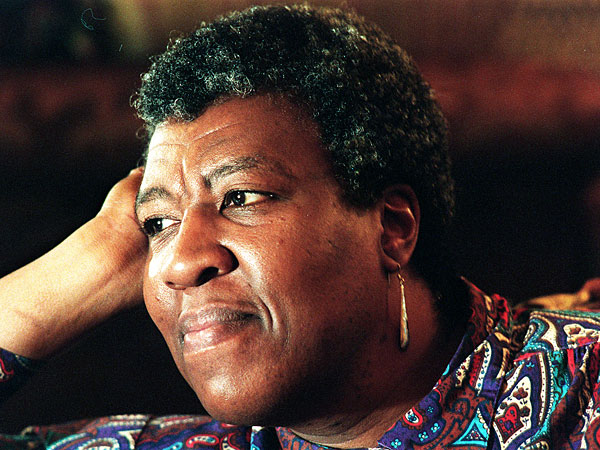
My faith in bridges has always been restored by mentors: Evelyn C. White, Octavia Butler who I adopted as a mentor unbeknownst to her after I interviewed her in 2004 and she told me how much she disliked the phrase ‘Grand Dame’ because it made her sound old and on and on and on. One of the biggest blessings of my life was the ability to say to Alice Walker during and after interviewing her that In Search of Our Mother’s Gardens gave me some important guidelines on how to live, how to be fearlessly myself, how to place my hands in the earth and be restored when I was uncertain about anything else.

These women and many others called behind their shoulders to me on the path and shared the potholes to swerve around: Jealousy, sexism, intimidation, racism. Remember where you came from but know you don’t have to go back; Indeed you may not be able to. Remember how you got here and remember to keep moving forward. Cherish the present. It is all you ever really have.

But the eldest of my mentors, real and imagined, was Amanda Jones. Jones, 109, was the first person I met who made me re-examine what I thought I wanted my life as an elder to be like. When I was younger, I sometimes believed I had all the wisdom I’d need to garner from others, enough to tide me over for the rest of my life. Jones ended my delusion.

She was the granddaughter of slaves and sharecroppers, born just after slavery was outlawed. In the throes of Reconstruction, through witnessing voting rights awarded to women, then blacks, to that moment in which we sat in her tiny living room in Bastrop, Texas, crowded in by the certificates and family photos on the wall that display a life well-lived and well-loved when she could make one of her last efforts on earth to cast a ballot for our first Black President.

I wish that she had said something profound, but the truth is, she was tired. One of her great-granddaughters spoke on her behalf and translated a lot of what she said. This was a woman who slept until 11 a.m. each morning and retired early, too. I smiled, when she grew weary and I thanked her. “I understand,” I added. “If I were 109, I wouldn’t feel like talking much, either.”

What stayed with me most about Amanda Jones was that she had survived so much with her resilient, sweet spirit intact. I saw in her example a woman who had been fully engaged in a life without letting hardship or adversity shape her. I think about her often now, as often as I think about my other friends and mentors, because — as Evelyn once said to me —  the older we become the more complex things seem to be.

I saw in her a vision of the old woman I wanted to become — a person whose fundamental nature could not be altered by the overwhelming demands of change or brutality or injustice. I learned from her, too, that such a life, such a presence, did not require anyone’s sign off or approval, merely the understanding that the strength and grace of Black womanhood  could serve as an example to the ones coming after us of how powerful one life can be.

Self-care in a time of racial terror

A friend and I were discussing the heroics of Bree Newsome this weekend when I ran out of things to say. Driving in the rain, attending to the life chores that are demanded of us, I was at a loss for how to describe the light that filled me when I saw the video of her climbing that flag pole, descending with Scripture on her lips, calmly informing the irritated men on the ground that she was prepared to be arrested.

The image of her holding on to that flag like a New Age Lady Liberty gave me chills. But it was something else. It felt like permission to breathe after a series of stories in the news that have left me breathless. It was not unlike President Obama’s eulogy for Rep. Clementa Pinckney in Charleston, which was not only one of the most beautiful speeches I’ve ever heard, but also a pointed affirmation of the power of black love to restore back to us our humanity.

In a world where black women are too often invisible, Bree Newsome was and is a symbol of renewal. She gave me life with her act of rebellion, a symbol of how the resilience of black womanhood sometimes eclipses detrimental symbols of hatred. The echo, was “She did it herself.” #WeHelpOurselves, indeed.

Has it been a year, or several months, or an eternity that these headlines have been assaulting us? In the aftermath of Charleston, Dylann Roof, Rachel Dolezal, McKinney, Michael Brown, Eric Garner, Marissa Alexander, Rekia Boyd, and the other names of the dead, dying, racially infused, racially polarized or racially symbolic, I have found myself more weary from the news than ever.

There was a time when I felt adrenaline coursing through my veins logging on to social media, to see what news the day or night had brought. Now, I feel a sense of dread and mourning on first glance and it only takes a few minutes for me to feel like I should crawl right back into bed and forget the day.

I have, for all of my adult life, been tethered to the news as a journalist and a writer. Newsrooms were my first sense of community, after the context of classrooms and schools. Even before I became a journalist officially fifteen years ago, I inhaled newspapers and sometimes local TV news in the Bronx. When I was just a consumer, I had the leisure of controlling my consumption. I could put down the paper or magazine; I could turn the TV off. I could create some distance.

I still have that choice but the game has changed. Writing is not just who I am and what I do but it is how I survive in the world. To be a writer, now, is to also be considered a journalist, especially if you are a black writer. These are not problems in and of themselves, but they present special challenges.

When I was researching my new book, I read a line from a journalist of color who said that she was expected to be both a witness to the struggles in her community and an interpreter for her white editors. Though I no longer work in a newsroom, I experience this same conundrum, along racial and political lines. Reaction is considered reporting.

My friend told me what she had read about the Confederate flag, about Dylann Roof, too, and she started to share. I appreciated getting the filtered version from her, I said, but I told her that I had stopped reading the glut of information that came in. Because it was painful. It was too much. I needed time to process and to feel and to see my own emotions, to grieve. To regain some sense of power. To breathe.

Research affirms that black women react differently to witnessing traumatic events than other groups and that includes experiencing the news. There is something about our double jeopardy, our doubly oppressed status that triggers a response in us that is similar to Post Traumatic Stress Disorder. We lose our appetites. Our sleep is disrupted. We feel anger, fear, despair.

I thought about this again when I watched What Happened, Miss Simone? which chronicles the life and demise of Nina Simone, the high priestess of soul who was not only undone by manic depression but also her political expressions of rage against racism and racial terrorism. In the film, you can see how systemic racism squelched not only her voice but her spirit.

What black women know, what we feel, at all times, is that there are multiple prices to pay for acknowledging our truth and speaking it. We have seen it over the decades. Strange fruit, swinging from the trees. Literally, figuratively.

As a black woman writer, I pay two tolls when news of racial terrorism breaks: the first is the impact it has on my body and spirit; the second is the weight of expectation that I perform my reaction, that at the very least, I publicly process the act of witness, making that more of a priority than reconciling a deluge of images, commentary and reporting over my internal, personal processing.

To be black in America is to know that few people care about your health or safety or well-being.

It is to live daily with the reality of a horrific, skyrocketing suicide rate among little black children who do not have the luxury of believing we care about a future that affirms their lives.

It is to be told outright or by silence that even when you have nothing to say, even when you are too tired to react or respond, you stand in the gap. But for grace, you might be dead now, so speak, in spite of weariness or fear or dread.

There is truth in that. It is also true that self-care is a political act. An assertion of worth. An assertion of the belief that you deserve silence and time. You deserve your love and attention as much as anything or anyone else.

Sometimes, when I am silent, it is not because of apathy, but an abundance of feeling. An acknowledgment that I need to step back before lashing out. To rediscover joy. To heal. To witness. To hold symbols of hate in my hands and work to dismantle them while praying the consequences that unfold will not destroy my life.

Learning to be Big

I left work completely devastated and in a lot of emotional pain.

I was in a season of severe self-doubt, mired in worry. This was about business, about a professional transition, but it was more than that. I was feeling like I was doing something and I had done something that is all too familiar and damaging to my writing life.

I was in so much pain because I was trying to be small.

As it usually does, it took my best friend’s observation to get me to stop with the ugly crying and chest heaving.

“You are always trying to be small and I don’t understand it,” she said. “But literally nothing about you is small.”

Nothing about me is small.

I have a big laugh, a big smile. I have big feet, a big heart, and a big gift.

This is obvious to so many people, but until now, it has not been at all obvious to me. I don’t take these things for granted as much as I have been so busy thinking of other things that I haven’t allowed myself space to think about this.

My first thought was of Marianne Williamson, because this quote has been a part of my life since I was a teenager. It was my dear friend Portia, when we were pen pals (remember those?) 20 years ago who transcribed it in her remarkably beautiful penmanship in purple ink:

Our deepest fear is not that we are inadequate. Our deepest fear is that we are powerful beyond measure. It is our light, not our darkness that most frightens us. We ask ourselves, Who am I to be brilliant, gorgeous, talented, fabulous? Actually, who are you not to be? You are a child of God. Your playing small does not serve the world. There is nothing enlightened about shrinking so that other people won’t feel insecure around you. We are all meant to shine, as children do. We were born to make manifest the glory of God that is within us. It’s not just in some of us; it’s in everyone. And as we let our own light shine, we unconsciously give other people permission to do the same. As we are liberated from our own fear, our presence automatically liberates others.

These are nice words and I like them and I loved to read them. I read them many times over the years. Each time, I felt the recognition of their truth but I didn’t  own being a child of God. Not really. I talked about it. I wanted desperately to believe it. But I also wanted to hide my lamp under a bushel, even if Scripture is pretty plain about why that’s not a good Standard Operating Procedure.

It is our light, not our darkness that most frightens us. When I was a kid, I was literally smaller. Well, thinner. But I longed to have girth and heft, to be seen, to be a force like my mother, who was physically solid, strong.

The thing about visibility for women, for black women and girls, is that when you are seen, you are also a target. My bookish nerd brain decided, once in the Bronx, where most of us are invisible by default, and again when I entered the workforce, that the best way to keep from being a target of anything was to shrink.

This is where being mildly introverted comes in handy. It allowed me to fold myself and my personality up and tuck it quietly between the pages of a book. This presents to others as a feminine virtue, I think, as modesty and humility. Perhaps I also have some of that, but primarily, this was about survival.

Because God has a sense of humor, my height was always the main inconvenience on this front. Except for the random times when they were lining us up in reverse size order during elementary school — once a year! — I was the last or second to last person in a size order line.

Always visible from the front.

Always subject to someone’s question about my nonexistent basketball-playing ability.

Never ready for the attention.

I think some of this comes from not being used to having things. I wonder if that’s why it has taken so long to accept and to grow into the power of presence that my height has given me or the gift of writing. After all, the natural reaction to being unaccustomed to having things is to give them away.

I gave my power and gifts away in so many ways as a girl and a younger woman that it is impossible to recount them all, and merciless to try. The main reason I wanted to shrink is because of a feeling of deep guilt about succeeding in my life where my mother had failed. She wanted so much for her dreams to come to fruition she repeated them daily until she got sick. She chased them until she decided she was ready to move on to the ultimate dream.

I carried, while Mom was alive, this feeling of both wanting her to have everything that I earned and knowing that I needed to keep what was mine. She had raised me, she had given me this wellspring of compassion and empathy — for all of the difficulty that had come with it. Someone should compensate her for the hard life she had lived, I thought, even though I realized that some of the hard living was her choice.

She said she was jealous and that she wanted me to soar. What I took from those two statements was a rejection of anything I did because she couldn’t have the things she wanted most.

So to believe in my own expansion or expansiveness felt like a betrayal of her. Our mother is the beacon whose every word and action sets our moral and emotional compass. I found myself longing to move out from under my discomfort by undermining and sabotaging myself. Becoming flat. Quiet. Discreet. It seemed there could be only one big woman between us.

I let her be the sun and the sky. I was content to be a shadow, even a few years after her death.

The weird thing about grief is that it can set off in you a series of unconscious reactions. When you lose your footing, when you lose ground, the first thing God sends you is a reminder of what is familiar. You can chose to cling to the blanket or toss it aside for more discomfort in order to grow.

I clung to the blanket. I met people who reminded me so much of my mother; they displayed her ambivalence about how I should be in the world more than anything else. It happened in friendships, new and old, that had run their course for too long. It happened at work and in love, when I was least aware of how my playing small was at the core of so much suffering.

They assured me in one breath that they could nurture me and help me shine. In another, they helped me sabotage myself with manipulation and envy. Even when I was trying so desperately to be small, I was still, apparently, a threat.

It took falling apart in my best friend’s kitchen for me remember myself, to begin to see myself as others see me.

It has always been unfortunately comfortable for me to feel as though my success as a writer has come at the expense and inconvenience of others; That by becoming bigger, becoming my full self, unfolding the fullness of God’s gift to me, I would somehow be stepping on someone else, taking more than I am worthy to have. Being what the world often tells black women we are: Too big for my own britches.

It turns out that I have, in this way, been my own worst enemy. I’m forgiving myself for that, for the fact that I have never really loved myself enough to believe that it is enough to believe in my own expansion.

It is enough to give yourself permission to divest yourself of the opinions and reactions and feelings of others. You can feel and be as limitless as the horizon if you are willing to allow yourself to have all that you are capable of having and become all you are capable of becoming.

I am stepping into the big shoes that have always been mine to fill, at least I am working toward that. Life is too short to settle for a corner, for a side part, a dark shadow. At least, that’s what I’ve been told and it’s what I’ve seen. It is scary but beautiful and necessary to stand in the light or — even better — to become a brighter sun.