How We Show Up: A Q&A with Mia Birdsong

My friend and radical visionary Mia Birdsong has written the new necessary and inspiring new book, How We Show Up: Reclaiming Family, Friendship, and Community (Hachette Go, June 2, 2020) I contacted Mia about her book a few weeks ago, hoping to share her words in a broader forum. My humble blog is as broad a forum as I have, so I hope you find her words about alternative forms of care, especially community care, as  therapeutic as I did. I was struck by examples of how Mia, who is partnered and has children, shows up for her single friends like Mariah, which is what frames the first question.

I love the attentiveness and care you mention in the book related to Mariah and her managing diabetes as a single person. The model of attending to her needs outside of coupledom feels like one we need to adopt, especially now. What did you learn about attending to your friend in this way that might be helpful for others as we try to connect virtually now?

Being in Mariah’s life in this way meant that both of us had to push back against some deep American socialization. For me, it was claiming the truth that my loved ones are my business. That means I can butt in if I see a need, gap, place that needs tending to. I was definitely worried about being intrusive, sticking my nose in where it didn’t belong, overstepping, but I also knew that if I pissed her off with unwelcome meddling, we could talk about it. I also thought about how hard it is for people to ask for help, especially when, in this case, the support I was thinking of wasn’t about addressing an immediate need or a crisis, but establishing a long-term, committed kind of support. Ultimately I decided that all the worse-case scenarios of me not butting in were worse than the possibility of pissing her off.

On her end, she had to wrestle with the way we, especially as Black women, are taught to handle shit ourselves, to be super women, and, frankly, to not be dependent on anyone because they might fail you. When you’ve lived your whole life being extraordinarily competent, independent, and excelling at everything you do the way Mariah has—all while managing a condition that could totally kill you and the racism and sexism of America—it’s super hard to allow yourself to lean on someone in such an intimate way.

It’s not like she couldn’t survive without me or the other folks who have become part of her care circle—she has been for her whole life– but she shouldn’t have to. I think that is a critical realization that a lot of us need to come to terms with—just because we can, doesn’t mean we should.

Our practice opened a new way for us to think about care and she’s built more around that that I’m learning from. Having a handful of people instead of one is really powerful. One night when her blood sugar not adjusting, two of us were in touch with her and then in touch with each other. We get to build relationships with each other too.

Now that Covid Times are here, she has actively reached out to the circle of folks that she’s gathered up around her to talk about how to get food, to vent about people not physically distancing properly, to share the latest info, to freak out, to laugh. It’s been a gift to all of us.

Having this practice with Mariah meant that when Covid Times hit us, I was more comfortable with the idea of inserting myself into the lives of my people who live alone, especially if they are high risk. I have a handful of folks that I check in on a few times a week, I bring them food or whatever. And I check in with our friends in common about them to see if I’m missing anything and to encourage others to insert themselves as well. I have a friend with whom I talk about what he wants to happen if he dies, what of his stuff he wants various people to have, where his documents are, etc. That’s a totally new conversation for us.

I guess all of that is to say, I think we need to be brave right now about thoughtfully pushing ourselves into the lives of our loved ones and asking for our loved ones to tend to our wellbeing in ways that might be uncomfortable. We ought not assume that our folks who have lots of friends, or our folks who present as strong and having all their shit together, or our folks who seem ok on their own don’t need our presence and support.

It feels more evident to more people that our racialized capitalistic society and healthcare system has failed us and COVID-19 response (or in some cases, lack thereof) underscores this. What practices, processes or alternative frameworks inspired by and/or explored in How We Show Up: Reclaiming Family, Friendship and Community do you think can help us to respond to this disappointment and collective trauma — individually and collectively? 

I’ve been so heartened by the way folks have shown up for each other as soon as it became clear that we are all we have when our systems (which function as they were designed) are failing to care for us in the ways they should. And I worry about our ability to sustain our mutual aid networks and also hold our government accountable for not doing the work we are now doing. Right now we are trying to fill in for failed systems and we can’t just be cool with that.

One of the things government can’t and shouldn’t do that I see folks doing for each other is creating space to process, to grieve, to connect, and to celebrate. My women’s circles—Tough & Jolly and Black Women’s Freedom Circle—are meeting twice as often now to hold space for ourselves. Having those opportunities to be in our feelings and hear from each other has been life giving. My friend Mac started what is essentially Sunday church. We check in, and every week a different person leads us in song or reflection or meditation.

The other thing I’m loving is the dance parties. I interviewed my therapist a couple of weeks ago because I wanted to understand trauma more. It was clear to me that everyone of us is experiencing trauma. It may hit differently, but it’s universal. She explained fear cycles and what happens when they get interrupted and where people are getting stuck. She also talked about how we can hack our system to make sure we reset it regularly. One of the things she’s recommending to her clients is that they dance every evening. Celebration lets our system know that we are OK—if we’re dancing, we aren’t in immediate danger. So all those DJs on Instagram are helping us reset our system so we release some of the trauma.

How do you imagine reclamation of our communities, family and friendship in the after times – what some call the new normal – will shift in light of the global pandemic, if at all?

This is such a hard question. I’ve been sitting with the fact that while the arc of the moral universe may bend toward justice, the arc of the material universe doesn’t care about whose fault it is that we have a global pandemic or that our systems were designed to disadvantage Black and Indigenous people, people with disabilities, queer folks, unhoused people, etc. The virus is not out here trying to eliminate the polluters and oppressors. It is going to kill the people with the least power, the weaker immune systems, the least money and access to health care.

So I’m horrified by the thought of what that means for who is getting care now, who will get access to a vaccine when we finally have one and who will be left in a few years when this comes to some kind of conclusion. It feels inadequate to say “we’ve got us,” or “build community” when the forces in power conspire to exploit this moment for profit and continue to leverage their power for their own gain.

This is all on top of the fact that even after they “open up the country,” we are still not going to be able to hug each other, to hold hands, to share meals in each other’s homes, to gather to worship, celebrate, plan, protest, and just be together for a painfully long time. It’s demoralizing and heartbreaking. And at the same time, it’s still absolutely true that we’ve got us. We are already figuring out how to be with each other, support each other, celebrate with each other, feed and nurture each other. And I imagine we will figure out ways to be together that are safe and support our emotional wellbeing—like maybe we’ll have to plan dates, dinner parties, and small gatherings far enough in advance that everyone can quarantine for a few weeks before getting together. (That is not a recommendation.) Maybe we will have to really do the work of dealing with our own wounds and damage and building grown-ass relationships with excellent boundaries and explicit communication and expressed desires and needs so we can cultivate the kind of trust that would be necessary to gather like that.

Get your copy of How We Show Up here. You can book Mia Birdsong to speak by way of my amazing friends at FRESH Speakers

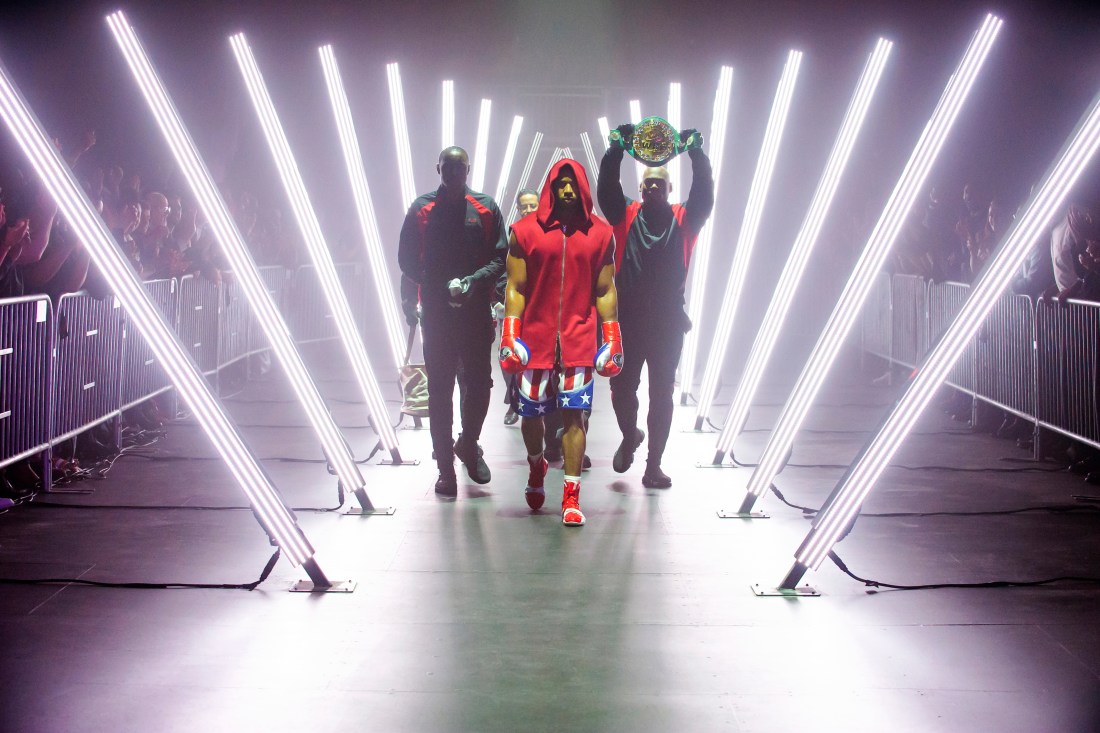
Creed II is not your average boxing flick

I have, finally, written a review that doesn’t have spoilers in it. Whew, that was hard. Sequels are tricky – you want to get the past right but you don’t want to dwell. The pitch and the tone here was perfect.

All of us have some nostalgia for parts of the past that also have painful trauma that keep us stuck in a painful pattern of some sort that it feels like we can’t rewrite. Creed II helps us ask ourselves if we are really fighting to write a new story or if we like the old one better. In this way, it’s deeply satisfying because it evokes memory and tradition while also keeping an eye on the future.

Boxing, after all, is a fight against another person, but before that, it’s a battle with your heart and mind for the soul, for the self to be whole, to be free.

CREED II
Credit: Barry Wetcher / Metro Goldwyn Mayer Pictures / Warner Bros. Pictures © 2018 Metro-Goldwyn-Mayer Pictures Inc. and Warner Bros. Entertainment Inc.

Five Years Since

Dear Mom:

It has been five years since we said goodbye, that word you hate, the one that still gets stuck in my throat.

There are days when it feels like it was last week and days when it feels like a decade has gone by.

This is, usually, a season of joy and reclamation, of hibernation and reflection. I want to forget my loneliness and grief, but in some ways, trying to forget it feels like forgetting you and I can’t.

The number five makes me think of you for so many reasons.

I was five when I was leaving foster care, remember, and you tried to bring me a gift of green plastic jewelry to my pre-school in Philly but the guards took you away because you weren’t allowed to see me because you were the reason I was in foster care on account of the burning me with a straightening comb. They did leave your gift, which I wish I still had, but which time and too many moves took away from me.

When I see five dollar bills, I think of the jubilant look on your face when you would find money on the street – something that has never happened to me once in New York, not ever, not since you were alive.

And I think of the Christmas Day five years ago when I knew it would be the last time I got to hold your hand. My heart breaks for any daughter who survives her mother who has to write a sentence like that, who has to reflect on surviving the person who bore her, who taught her how to live, or who at the very least tried. The trying, itself, is not so easy.

The grief is not so much because I needed you to be my mother, although we all need one. I had given up on that part. I knew it was hard for you, harder than most. It was that I wanted our story to be so much happier. I wanted us to get to the good part together. I did not want to get to the good part alone.

You were so proud of me, of my writing. You modeled shine theory before I knew it would be a thing. You did not talk about an after you were gone and so there’s a way in which I was not ready for that emptiness. It was as if you would keep on living, cheering.

I still view my solitude as a gift. It is the way of an INFJ, an ambivert with a book addiction, enamored of the characters that wake me up and nudge me to my computer or notebook. But it has an edge to it that has lonely, Marguerite-sized craters into which my spirit falls.

Loneliness kills. There is research and data and I have read it, horrified, desperately afraid. Because I am used to having something urgent to worry about, when there is nothing — and there really aren’t that many things like this that come up anymore now that you and Dad are gone —  I worry about the lethal nature of my loneliness. My heavy heart is one that only I carry, being the only child of you and him. It is my unique burden to be missing you in this particular way, without someone to remember with me what it was like to laugh in the midst of our darkness and to cry out in the midst of our shared pain.

Even being the only keeper of our memories has not hardened me, not the way I have wished for over the years, as you can see. I have avoided writing about you now for weeks, if not months, knowing that it would feel like ripping open a wound and pouring salt water into it by the gallons. I was not wrong, but that wasn’t the full truth of the thing.

We spent so many cold winters without in New York City, in the Bronx especially, including that very first one in 1984, when we were mugged crossing a bridge from Harlem to go to the Roberto Clemente shelter. But Mommy, I have more than enough now. Enough space, enough time, enough food, enough warmth.

As alone as I feel in my grief and my missing of you sometimes, I am deeply and widely loved by people who are so gifted and dynamic and sweet. They fill in the gaps. They remind me that you would want deep belly laughs for me in this season and all the others, the laugh you gave me which is one of my most prize inheritances, the one that jolts people awake, that clings to ceilings, that rattles the nerves of those who only know the end of this story, but not the beginning, not the middle, none of the transitions.

This big complex heart of mine receives and mirrors back the joy of those who know what to do with it. I have more than enough, enough to give back, to give away, so that I don’t have to hoard. It is not enough to fill the void of a mother. It is not enough to keep me from crying over missing you. It may never be. Maybe that is the point.

But the gift of missing you is that it helps me to remember that is what the depth of love is. That when someone you cherish, who has shaped you and touched you is gone, you weep because they have had an impact. Sometimes the gift of someone’s love is in the way they reach you where no one ever has and maybe never will.

Merry Christmas. I’m going to be with our beloved family.

Yes, I will tell them you love them.

Better: I will do my best to keep showing them.

Love always,

Your baby girl.

All City: A Novella

All City Kindle Ready Front Cover

Little Ray knows the Bronx better than anyone. He has been a proud train operator for many years. But while the Bronx has always held memories of his mother, Gloria, and his daughter, Lorraine, it also reminds him of the pain of losing the love of his life.

Jasmine Castro was the woman of Little Ray’s dreams. Beautiful and brilliant, she wouldn’t let anyone define or control her. But Jasmine does end up being controlled by something: her addiction. Now the vibrant woman Little Ray fell in love with is hardly more than a ghost. Little Ray is determined to raise their daughter on his own.

When Lorraine meets the impulsive street artist Jason, who’s determined to go “all city” with his work, she has to make her own decisions about life and love.

In this ode to the romantics and artists of the world, Joshunda Sanders has crafted a beautiful testament to the power of family. You can buy it here.

Opening Gifts

There is almost nothing now that I want or need that I do not have. The gratitude I have for that is deepened and underscored by your absence.

During seasons like this I wonder what you would have made of abundance. I like to imagine that where you are you know what it is to revel, to be of good cheer, to adorn yourself with fine raiment and tinsel and reindeer antlers. I am hoping that there is some good Donny Hathaway playing, followed by Stevie Wonder since I know you favor sharp shifts in emotional altitude, for your spirit to slink then soar.  I know you are drinking egg nog, but I wonder what you’re spiking it with.

Three years to the day, I said goodbye to you and, for the last time, you corrected me. You wanted me to say See you later because you hated that word goodbye so much. I’m not much of a fan of it myself.

You are the person who knew me best in the world and that may never change. This is the year I let myself rest in the reality of that and surrendered the need to change for the sake of anyone else. You were such a good model, just like my sister, of self-possession and strength. I have no idea what took me so long.

It feels like so much time has passed since you left and, at the same time, like time only kept picking up speed. Since then, I discovered how hiding from myself and others prevents real love and joy from finding me. I learned that sometimes missing the chaotic parts of us makes me seek out insanity that I only tolerate as a placeholder for the memories we survived. Gradually and then, all at once, I remembered that my life goes on — or it can — if I let it. I realized that I do not have to suffer or tolerate because I know I can handle it. Strength is neither shield nor sponge. It is a pose and a position and mostly, a choice.

You know that saying about time healing all wounds? I don’t know if I believe it. I think time gives you space from what maimed your heart so that if you can’t keep yourself from being wounded again, at least you have perspective on how to grieve with honor, while loving and living. Love and loss are not mutually exclusive.

This was the year that all of the cheerleading you offered me reached a fever pitch in the back of my mind and played like an anthem in the background of my daily life. This was the year I heard all the things you tried to tell me. This was the year that I believed that I was worthy of the big, broad blanket of love for me you unfurled and let hang from your shoulders like a superhero as long as I tried to know you. This was the year that I understood that it is ok to just miss the reality of you and the tangible motherly things you shared: that laugh, that smile, the long unfiltered list of impossible dreams that you were always ready to recite like the rosary you cherished.

This is the year that I can finally wrap gifts again for the ones I love and listen to Christmas songs and sing along. The tears are willful and come when they want, but I don’t fight like I did before. I let the sadness in for tea and whatever comfort food I can find so that it can have some space to be. I learned, too, this year, that after awhile, sadness politely will excuse itself and leave me to my efforts to celebrate the season, whatever season it is or whatever the season wants to be. This, too, is a gift.