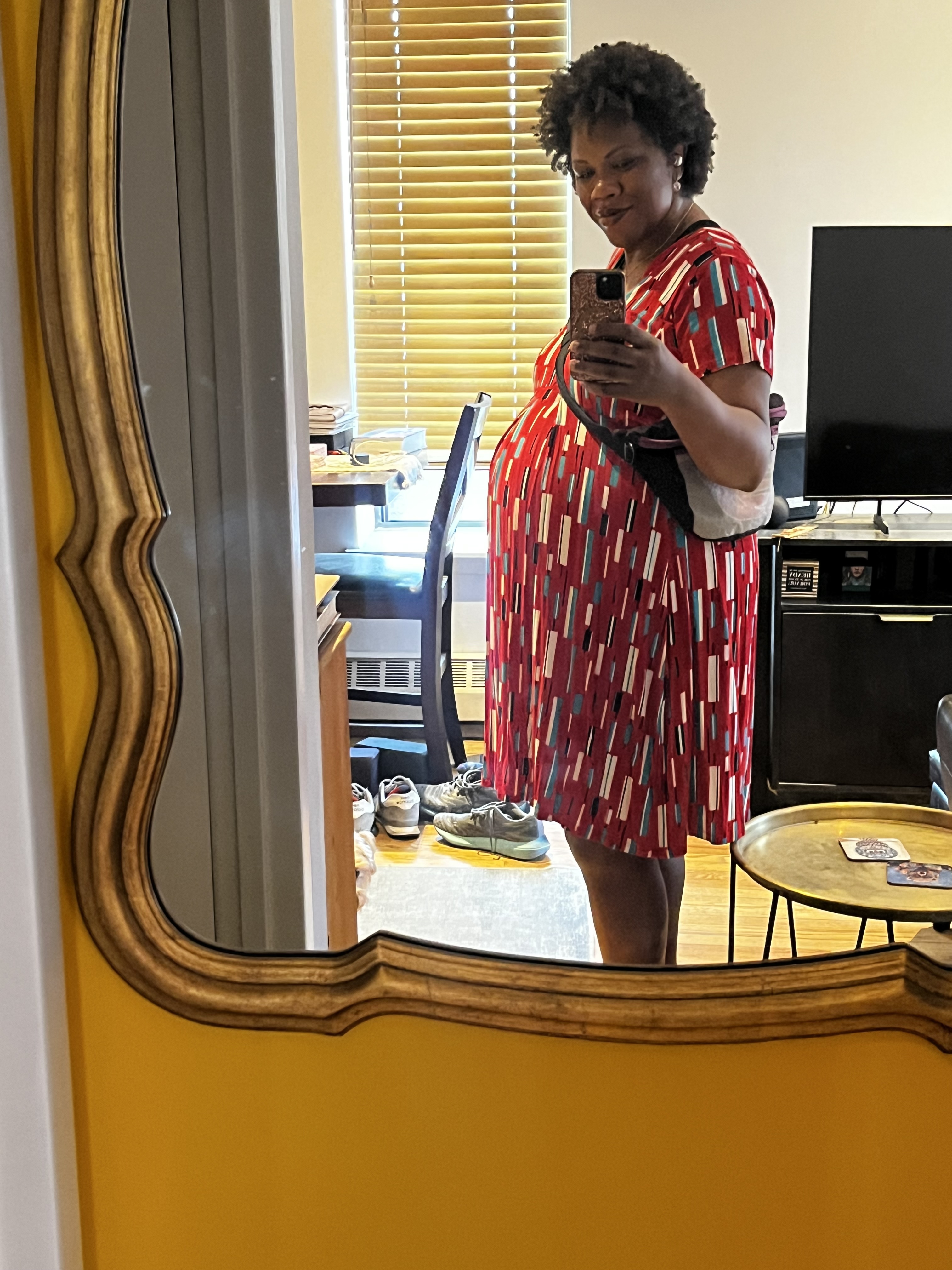
On Becoming a Mother, Part I & II

Dear baby girl,

I wonder how old you will be when you finally read this. I wish I had a letter from my mother when she was carrying me, so I could understand a little better what her world was like, what exactly she carried me through, and what brought her joy while she was doing it. I also mainly identify in the world as a writer, and this is how I process everything, by trying to move feeling into language.

That’s part of why I’m writing to you. It is April 2025, a chilly spring that is having a tough time shaking off winter for good. The sun is shining, the family dog is curled up next to me on the couch. I have checked all my email accounts no less than five times today, worked hard at the job I adore, which is also my career, done some work to prepare for when you come into the world – I do a little bit every day — and napped because at six months, you make me more tired than usual, which is how I know you’re healthy and strong. 

The world is chaotic right now, or it feels that way. The person leading our country has done so in the past, but the way he is doing it now is led by revenge, greed and an appetite for historical destruction of things I love, things I believe make this country what it is: stories of struggle and flourishing movements, the true stories of Black women and men who looked like you and me who led those movements. Most days I worry we are moving further away from progressing toward a place that will not just see you in your full humanity, but also celebrate you in it, which means you will be more likely to live through the full span of a Black girlhood into adolescence than me or the Black girls before you. That our country will become a place where you have the luxury of growing old, maybe having your own babies if that is what you want.

Before I expected you, I took the inevitability of the world as it is for granted, as a place I have had little power to shift, even as I dream of leaving a positive footprint behind. Yes, I reveled in important milestones for Black humanity and flourishing, but I shrugged off questions of the future. I have been a meditator for many years now, and it’s easy to talk myself into the spiritual virtual of tunnel vision on the present. Let some other generation worry about all that future stuff, my work is here and now. I told myself that no part of me would live in the future except for my books, my legacy. Maybe some kind librarians and citizens would preserve my digital footprint in the Internet archives/Wayback Machine.

But you will be here now in less than three months, God-willing. Now that I am becoming a mother and I can feel you kicking, moving around inside of me, coming alive, what also grows is the abiding hope that you will grow up in a world that is not too altered. I try to meditate and breathe my way through the twin terrors that you will have so much to fix alongside the fear that some of it is beyond repair.

I want to believe that committing my near and far-term future to nurturing and caring for you is also an act of resistance, a kind of blind faith; that bringing a good human here will also add light to what feels like an endless dark tunnel fraught with danger and uncertainty. But I’m writing these as I start my third trimester, and there is still so much to tell you before we get to the future.

II.

Mother’s Day is coming this weekend, and I thought it would be different at seven months pregnant with you, that I would feel less of an ache than I have felt all my life as this time rolls around. But it has been thirteen years since your grandmother died, and while it hurts less than before, I still feel the ambivalence of a motherless child when it comes to marking this Hallmark holiday. I still feel tender, raw and protective of the little girl in me that mothered myself while I also took care of my mom, with her broken heart and her traumas and her bipolar and borderline personality disorders.
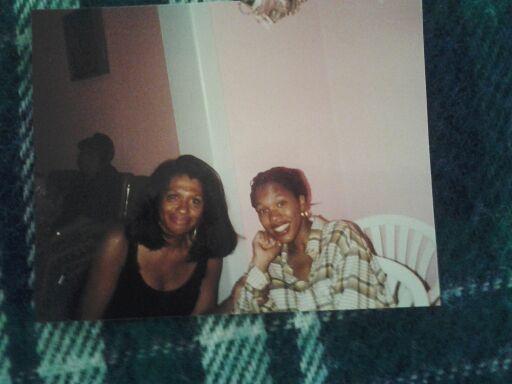
Me and Mom in the 1990s (in case you can’t tell the era from the shirt I’m wearing.)

Even though I tried to heal much of the unresolved pain of my childhood at your grandmother’s bedside when she was physically alive, in the six months between her diagnosis of late-stage cervical cancer and when she died a week before my 34th birthday, the grief of what I missed while she was physically living layered on the grief of what I lost for good when her body died is a weight I will spend my life trying to ensure you never feel.

Instead of more straightforward feelings now, my emotions are all over the place. Some of it has to be the hormones. But some of it is also simple: I am sad because I wish you could have met her. Even with all the things that kept her from living a full, unencumbered and thriving life, your grandmother was a bright beam of love. We should all be so blessed to have a beam like that shine on us, no matter how brief.

Her manic depression kept her restless, so she was always up. I do not remember a lot of times where I saw her truly at rest. Even when we sat still to eat or watch Jeopardy! She seemed to be forever in motion, buzzing.

Mom loved the phone. She loved to call me as early as possible on Mother’s Day and Father’s Day, since she alone was responsible for the fact that I survived my childhood – another thing that you will not have to endure, since your father and I have a big community around us waiting for you with eager hands to catch you should one of us fall or need a break. Your grandmother was the only person I let shorten the shortened version of my name.

“Shan, I love you,” she would start. “Wish me happy Mother’s Day.”

You will learn this about me, baby girl, but sometimes I do silly things. Like when I know the sun is not up and it’s too early to argue, I would still look for a clock or check the time on my phone to point out to my mother what she already knew – that it was too early for her to call me.

“Maaa,” I would whine, my face still in my pillow. “It’s so early.”

“Wish me happy Mother’s Day and you can hang up and go back to bed, but you should be up already.”

“Happy Mother’s Day. I love you,” I would say and I while I told you I do silly things, I’m not disrespectful, and I know my mother so I did not hang up immediately.

“Did you send a card?”

“I did not, I’m sorry,” I lied, because I was not always sorry when I “forgot,” I was being spiteful. It’s hard for me to imagine you may feel this type of way about me some day but I know it’s coming. The big payback, as it were.

“It’s OK, I know you’re a busy career lady. OK, go back to bed,” she would giggle, knowing that I probably couldn’t. “I love you, call me later.”

You won’t be able to imagine this, my love, but in the times before the Internet, before cell phones and all these apps that connect us to each other all the time, a phone call was a lifeline to get everything you needed. Growing up, I spent a lot of my free time on the phone with my friends, most of whom were poor like me and couldn’t afford cable when it first came out. We would spend hours talking, on the phone, or in person. I can’t even tell you what we talked about – probably boys we liked, silly gossip about who was going out with who, dances we wanted to try from the music videos we watched on Channel 36, public access television, which aired Video Music Box most days afterschool at 3:30 p.m.

Your grandmother had a hard time working, because she did not take medication for her manic depression, and that meant that the rapid cycling of her moods — from euphoric, Queen of the world to violent, physically abusive temper tantrums — made her unsuitable for most workplaces. But she was always reaching for work, she was always trying to fend for us. It never worked out for long, but she was always gone.

One way of looking at that was that it gave me plenty of time to develop what a therapist would later call “a rich inner life” – turns out to be helpful if you want to be a writer, which is what it turned out I wanted more than anything. Another way of looking at spending a lot of time alone as a child, then as a teenager, is that my loneliness was an invisible wound. I knew it was there, and I nursed it best I could, but I needed my mother to tell me that just because I was physically alone didn’t mean that I was uncared for. I needed my mother to tell me that even though her love did not translate into nurture, it did not mean I was worthless, it only meant that she had also not been taught by her mother or any of the women around her, how to keep me from picking at the wound, how to keep it from getting bigger.

I learned from my mother that someone could say they loved you, and they could do their best to show you, but there was no real substitute for being nurtured by a mother’s love. At this age, I know now that my mother could not offer this to me because it was never offered to her.

I found it other ways, especially as I got older, as I healed myself, as I took ownership of being my own mother, of collecting a council of elders and peers I looked up to who served as surrogates, many of them without knowing. What I hope to show you when you get here, what I hope to leave to you and pass on, is a compilation of what I think I learned in the process of mothering me, trying to mother my mom as a kid and trying to apply that patchwork of lived experiences to being the best mom to you I can be.

Only time will tell, baby girl.

In the meantime, wish me a Happy Almost Mother’s Day (see what I did there?)

Love,

Joshunda

Coping with Father’s Day as a Suicide Survivor in 2018

I self-published my memoir The Beautiful Darkness: A Handbook for Orphans in October 2016 after spending more than 20 years working on one version of the story or another. The book’s name comes from two sources.

The concept of being an orphan, particular in the Black community, may seem jarring. We are, after all, known for taking care of one another even when we’re messy.

But even before my parents died – my father by suicide in 2010, my mother from cervical cancer in 2012 – I had been orphaned by them in many ways, largely because of untreated mental illness.

In Mira Bartok’s The Memory Palace, she wrote:

The Sami call the period from mid-November to mid-January the Dark Time, or Skabma Dalvi — the Beautiful Darkness. Most of the day, the sky is a deep indigo blue, even in the morning. It is so hard to know when to wake up, when to work, when to eat a meal.

The phrase the Beautiful Darkness stayed with me for a number of reasons: I’m a winter baby; I prefer cold weather to warm; I last saw my mother alive and forgave her for our hard times together during this time and it was the season in which she also made her transition.

The Beautiful Darkness, for me, is also a way of thinking about grief that has been helpful. It’s a time that can be disorienting in the way that Bartok describes, so that you feel lost. This can also be a gift, a way of learning new way.

These days, this season reminds me that we learn these things in order to share them.

Continue reading “Coping with Father’s Day as a Suicide Survivor in 2018”

‘A life of spectacular promise undone by demons’

Trigger warning for the trauma of homelessness and mental illness 

This beautiful New York Times profile of Nakesha Williams, a Williams College graduate who died homeless on the street at the age of 46, was the first thing I read yesterday. My friend Amy sent it to me, saying it reminded her of the story I tell in my memoir, The Beautiful Darkness. Maybe I should have waited, knowing that, but I’m glad I didn’t.

I have written about the poverty and homelessness I experienced as a child — mostly as a result of my mother’s untreated bipolar and borderline personality disorders — mainly because for much of my life, and much of my mother’s, no one else wrote these stories. I imagined that I was alone in my experience. That made it all the more painful, lonely and difficult.

I had books, and writing, and education. I have been lucky, I have worked extremely hard, I have been writing my heart out for so many years. And yet, it feels like reading this story was reading my story, or the possibility of a future to my story yet to come. That is the legacy of experiencing the trauma of homelessness or being exposed to these adverse childhood experiences as a kid. They never leave you.

There are so many parallels between Nakesha and I, but more between her and my mother. We both love books and reading, we both sang in gospel choirs. I nearly went to Williams instead of Vassar.

I chose the latter because when my mother was still alive, I decided on college the way I decided on everything else: Based on its proximity to her. Attending Vassar meant I could get to Grand Central more quickly (and for less money) in case Marguerite had a manic episode. In case she ended up in a psych ward. In case she got evicted again, as she did my sophomore year, and I needed to drop everything and go to where she was and try to fix things that were beyond my years to fix.

Nakesha’s story is my worst fear for my life, though I am far from the little girl who had to watch my mother refuse medication, or fail to pay the water bill or negotiate not having enough money to buy food for days any more. Grace has kept me — along with writing — sane. But the kind of trauma that mental illness and then homelessness can inflict will never leave my body. It is a battle scar. A deep wound I am learning to befriend.

When I read Nakesha’s story, I was reading about my mother again. I kept, and still have, the lipstick imprinted letters of my mother, along with the emails that she sent me (like Nakesha) from libraries in New York and Philly. Because her life had so much potential, had so much life and joy and darkness that also taught me about beauty, I included some of these emails in my book.

At the core of this story about Nakesha, though, is the mystery of how the love, attention, resources poured out from others somehow failed to reach her. This is the part that resonated with me about the unknowables on the journey with someone who is mentally ill. This was my greatest heartbreak, the title of this blog, a line from the story about the realities of there not being a simple solution to the complex realities of homelessness and in particular, not a simple answer to the question of what happened to Nakesha.

There is no accounting for the demons, the silences, that can overtake us. All we can do is try to avoid them, try to keep going, try not to let them take us under. But maybe this story was so deeply moving for me and disturbing because this means there will continue to be many people like her and many women like my mother, and not as many people like me, who can profess, with not just a little bit of remaining survivor’s guilt, that we were spared somehow.


Self-care in a time of racial terror

A friend and I were discussing the heroics of Bree Newsome this weekend when I ran out of things to say. Driving in the rain, attending to the life chores that are demanded of us, I was at a loss for how to describe the light that filled me when I saw the video of her climbing that flag pole, descending with Scripture on her lips, calmly informing the irritated men on the ground that she was prepared to be arrested.

The image of her holding on to that flag like a New Age Lady Liberty gave me chills. But it was something else. It felt like permission to breathe after a series of stories in the news that have left me breathless. It was not unlike President Obama’s eulogy for Rep. Clementa Pinckney in Charleston, which was not only one of the most beautiful speeches I’ve ever heard, but also a pointed affirmation of the power of black love to restore back to us our humanity.

In a world where black women are too often invisible, Bree Newsome was and is a symbol of renewal. She gave me life with her act of rebellion, a symbol of how the resilience of black womanhood sometimes eclipses detrimental symbols of hatred. The echo, was “She did it herself.” #WeHelpOurselves, indeed.

Has it been a year, or several months, or an eternity that these headlines have been assaulting us? In the aftermath of Charleston, Dylann Roof, Rachel Dolezal, McKinney, Michael Brown, Eric Garner, Marissa Alexander, Rekia Boyd, and the other names of the dead, dying, racially infused, racially polarized or racially symbolic, I have found myself more weary from the news than ever.

There was a time when I felt adrenaline coursing through my veins logging on to social media, to see what news the day or night had brought. Now, I feel a sense of dread and mourning on first glance and it only takes a few minutes for me to feel like I should crawl right back into bed and forget the day.

I have, for all of my adult life, been tethered to the news as a journalist and a writer. Newsrooms were my first sense of community, after the context of classrooms and schools. Even before I became a journalist officially fifteen years ago, I inhaled newspapers and sometimes local TV news in the Bronx. When I was just a consumer, I had the leisure of controlling my consumption. I could put down the paper or magazine; I could turn the TV off. I could create some distance.

I still have that choice but the game has changed. Writing is not just who I am and what I do but it is how I survive in the world. To be a writer, now, is to also be considered a journalist, especially if you are a black writer. These are not problems in and of themselves, but they present special challenges.

When I was researching my new book, I read a line from a journalist of color who said that she was expected to be both a witness to the struggles in her community and an interpreter for her white editors. Though I no longer work in a newsroom, I experience this same conundrum, along racial and political lines. Reaction is considered reporting.

My friend told me what she had read about the Confederate flag, about Dylann Roof, too, and she started to share. I appreciated getting the filtered version from her, I said, but I told her that I had stopped reading the glut of information that came in. Because it was painful. It was too much. I needed time to process and to feel and to see my own emotions, to grieve. To regain some sense of power. To breathe.

Research affirms that black women react differently to witnessing traumatic events than other groups and that includes experiencing the news. There is something about our double jeopardy, our doubly oppressed status that triggers a response in us that is similar to Post Traumatic Stress Disorder. We lose our appetites. Our sleep is disrupted. We feel anger, fear, despair.

I thought about this again when I watched What Happened, Miss Simone? which chronicles the life and demise of Nina Simone, the high priestess of soul who was not only undone by manic depression but also her political expressions of rage against racism and racial terrorism. In the film, you can see how systemic racism squelched not only her voice but her spirit.

What black women know, what we feel, at all times, is that there are multiple prices to pay for acknowledging our truth and speaking it. We have seen it over the decades. Strange fruit, swinging from the trees. Literally, figuratively.

As a black woman writer, I pay two tolls when news of racial terrorism breaks: the first is the impact it has on my body and spirit; the second is the weight of expectation that I perform my reaction, that at the very least, I publicly process the act of witness, making that more of a priority than reconciling a deluge of images, commentary and reporting over my internal, personal processing.

To be black in America is to know that few people care about your health or safety or well-being.

It is to live daily with the reality of a horrific, skyrocketing suicide rate among little black children who do not have the luxury of believing we care about a future that affirms their lives.

It is to be told outright or by silence that even when you have nothing to say, even when you are too tired to react or respond, you stand in the gap. But for grace, you might be dead now, so speak, in spite of weariness or fear or dread.

There is truth in that. It is also true that self-care is a political act. An assertion of worth. An assertion of the belief that you deserve silence and time. You deserve your love and attention as much as anything or anyone else.

Sometimes, when I am silent, it is not because of apathy, but an abundance of feeling. An acknowledgment that I need to step back before lashing out. To rediscover joy. To heal. To witness. To hold symbols of hate in my hands and work to dismantle them while praying the consequences that unfold will not destroy my life.