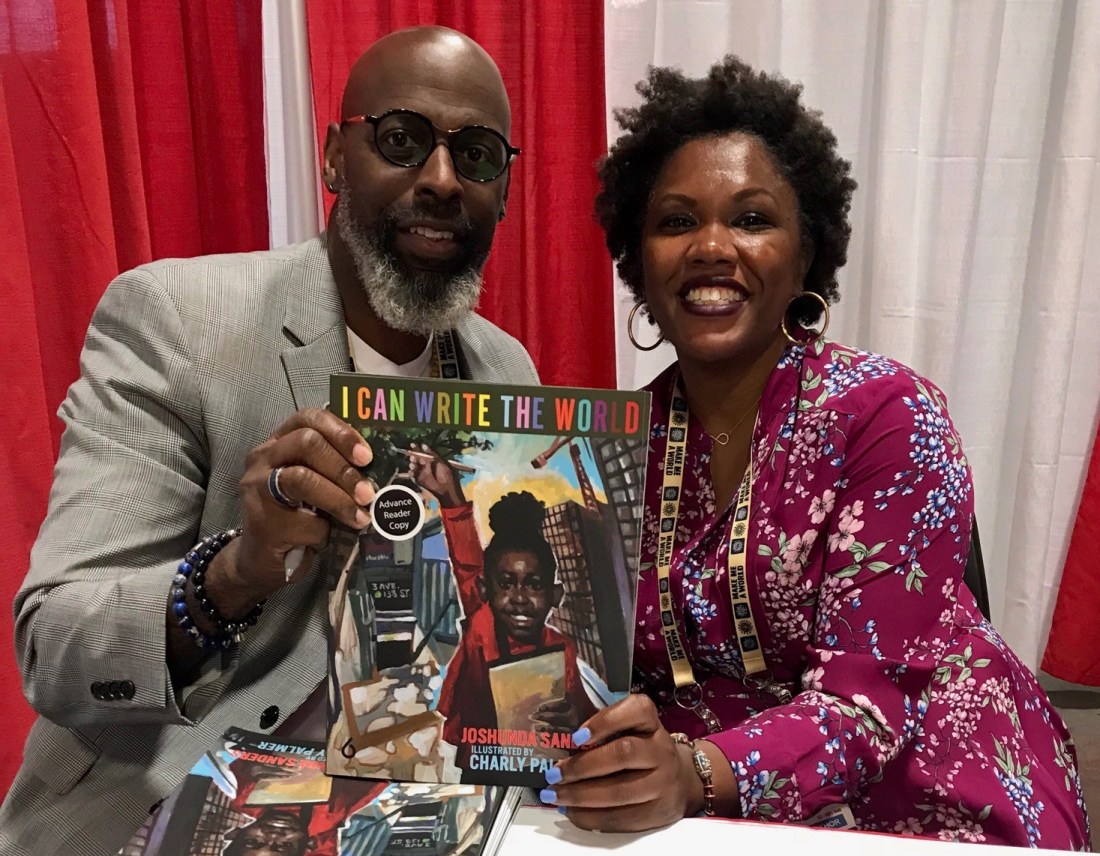
Charly Palmer, the wonderful illustrator for I Can Write the World with me at the Ingram Signing Table
We were out of books within 30 minutes – Librarians are incredible!
Sandra held us down when she volunteered to moderate us – Thank you!
I can’t believe my baby is in the world and being received with such love
Chul R. Kim, Publisher of Six Foot Press, with Charly Palmer
Jamia, my hero, & me & Ava
Alison Miner, my Emma classmate & rock star
I had a whirlwind weekend launching I Can Write the World at the American Library Association Conference in D.C. Librarians, teachers and others were so receptive to the book that I was the first author in my cohorts to run out of books both on Saturday night at a lovely Ingram reception at Spire and on Sunday afternoon after a great panel discussing the importance of representation in Children’s books. I even got to see a former library professor who popped up in the signing line (thanks for coming by, Stan!).
The most common question librarians had is one that most people ask me, which is “What is this book about?” This comes up right after they say, “Wow, the book is so beautiful!” Which makes my heart sing.
The answer is that I Can Write the World is about 8-year old Ava Murray, who lives in the South Bronx. She is named after the brilliant filmmaker Ava DuVernay and the incredible legal scholar, Episcopalian priest & poet Rev. Dr. Pauli Murray, who created the legal precedent known as Jane Crow and, were the world ready for her in her time, might have had a much easier time accepting what we would call her trans identity in this time.
In I Can Write the World, Ava notices the beauty of the Bronx that she knows and loves is at odds with how journalists often depict her world. On the news, a little girl about her age is fined for tagging, which confuses Ava because she sees the colorful murals around her as making the city more beautiful. Her mother, Kim, explains that journalists are like the window frame around their living room window and they shape what we see when we look out of it. Ava decides that she wants to become a journalist so that she can be just like them and shape the world they see.
The first book in the series has Ava exploring more of hip hop culture and how it came to be through a prose poem. I’m honored to say that one of my writing heroines Jacqueline Woodson has called I Can Write the World, “Lovely and timely.” I hope you will find it to be the same. Thank you so much to everyone who has pre-ordered and shared your thoughts with me about the book. I’d be so grateful if you could also write reviews and spread the word. You can find the book on Amazon, Barnes & Noble and several other outlets.
Next stops for I Can Write the World signings are the Children’s Institute (Ci7) & PrideFest on Sunday — which includes a book giveaway for the first 100 kids.
Last night, I was watching Brene Brown’s The Call to Courage and so much of it resonated with me because what writers do, all the time, is meet risk and vulnerability with courage. We have this in common, of course, with other artists: Actors, visual artists, musicians. I spend a lot of time wondering about the paradoxical nature of how our culture both obsesses over creation and art and devalues it, simultaneously. It has become part of my personal and spiritual practice to do what Maya Angelou is quoted saying in Beyonce’s film, “Homecoming” which I’ve seen three times now (and is definitely another Netflix film for you to watch, which is “Tell the truth. To yourself first.”
To that end, I wrote about a trend I’ve watched emerge in recent years online for Topic about Black spirituality particularly among young black women. The TL; DR version of this is that traditional church institutions (not unlike government, I might add) have tried to suppress and belittle women’s sexuality, personhood and desires for centuries. I think that seeing the perverse ways in which the negation of people’s true selves manifests — in pedophilia in the Catholic Church, in homophobia and transphobia that warps relationships in similar ways in the Black Church — has led thousands of Black women and many others to choose a different way. In some ways, creating individualized spiritual practices for oneself is nothing new. But I believe it’s become more popular because we are seeking more control over our worlds and our lives. And it’s just too painful to hand over our personal power to patriarchal systems that fundamentally ask us to remain faithful to systems that make us feel shame for wanting to be free.
TO UNDERSTAND WHAT nontraditional Christianity looks like for many black millennials, we have to, perhaps unsurprisingly, turn to the internet. There, one can find a robust community of black and Afro Latina women leveraging social media to gain followers and clients—the majority of them also black women—while offering free guidance about how to use the energy of the cosmos to their benefit.
Over the past seven years, I have noted, with some delight, a growing and powerful group of young people, primarily women, preaching messages of self-empowerment, intuitive guidance, and ancestral reverence. They are everywhere, from Twitter and Instagram to YouTube and the crowdfunding platform Patreon.
It makes sense: in a world where young people’s attachment to smartphones has become one of their most intimate relationships, it would follow that divinely inspired messages of empowerment would reach us via our devices, like everything else we think has meaning. (No judgment—I used to sleep with my phone, too.) And because most social media is used predominantly by women and people of color, there’s a natural synchronicity to digital interactions that allows for seemingly disparate groups to connect to alternative forms of faith.
So that piece was the most vulnerable I’ve been about my faith journey pretty much ever and it gave me a gigantic vulnerability hangover of the sort that is probably tiny compared to what Brene Brown describes in her special. Nevertheless, it was with so much joy that I watched “Homecoming” again and again and got back all of the energy that was expended over ten revisions of the Topic piece, which I kind of loved every minute of. I was tweeting about the fact that Beyonce is the best entertainer of all time and thankfully one of my former colleagues (thank you, Omar!!) suggested me as a writer who could attempt to slay writing about “Homecoming” for Book Plus Film.
Beyoncé is the greatest entertainer of our era and one of the quietest, most silent workers in the game. But she’s a lot of other things, including a scholar. She doesn’t talk about it; she is about it. Her references make evident her awareness and respect for history. She wields silence strategically, working behind the scenes until she’s ready for you to see what she’s been doing. This, along with other methods evident in Homecoming, connects her to a tradition of Black women guarding our sacred inner lives–what historian Darlene Clark Hine calls a “culture of dissemblance.”
In the Reconstruction Era, the Historically Black Colleges and Universities to which Beyoncé pays homage directly in Homecoming offered alternatives to Black people in the South who had no other outlet for edifying themselves spiritually and intellectually. Black women perfected the art of protecting their inner lives through performing personae of intimacy and vulnerability. The damage slavery wrought to our spirits, bodies and position in American popular culture meant the broader world considered us worthless.
But we reclaimed our value and worth through the important, necessary alchemy of consorting with and among ourselves to transform ugly stereotypes. We would never be protected like white women, or valued in the same way, but we had ourselves. We had one another.
“Without community, there is no liberation,” Audre Lorde said.
“The most disrespected woman in America is the Black woman,” Malcolm X said.
A Modern-Day Nefertiti
A little Black Girl Magic in Beyoncé’s Homecoming.
The truths that unfurl in “Homecoming” flip what most people thought they knew about Black Girl Magic into a two-hour spectacle of reunion pageantry, Black Boy Joy intersecting with a Texas Bamma steeped in the glory of her abundant, glorious Black womanness.
Throughout the athletic and awe-inspiring performances that make up Homecoming, Beyoncé as always, does multiple things at once. She channels a spiritual clinic on how to birth one’s singular vision while also allowing us, as viewers, to project our dreams onto her everywoman canvas. She signifies with subversive and overt joy, refracting and projecting light that’s illuminated by a pulsing, alive darkness.
Beyoncé summons us in Homecoming to witness an intimate-looking, vulnerable and considered return to herself. This, she tells us, is her homecoming, too. We feel that without her having to say a word as the show begins. A Black woman drummer commands the camera’s attention with a ferocity that every living being on the stage will soon match. A modern-day Nefertiti saunters her way to her pyramid of vibrantly clad dancers, singers and a Black orchestra, a swelling, uproarious band that aptly represents the pinnacle of swag.



 Joshunda Sanders