Three Ways to Help Alleviate Hunger

I do a lot of talking to my students and others these days about the importance of being specific in writing and in life. One of the things that’s hardest for me to be specific about, both in terms of cultivating self-compassion around the trauma it brings up to write about it, but also the ways that our society stigmatizes black female experiences of poverty, is hunger — in the physical sense, but also in the emotional and mental sense.

I always say that fall is my favorite season. I love the delicious feeling of the air cooling in New York City, the way the leaves transform from green to marigold. I break out my new boots, my favorite sweaters & my best turkey chili slow-cooker recipe.

But autumn also brings a familiar, old ache in my body, somewhere between my heart and my stomach. My heart longs for what I imagine families or couples or people who belong to broader fabrics are preparing for, but that’s not the whole story of this ache.

Some of the story is that Thanksgiving calls to mind my great-grandmother Patty Randolph, who was Cherokee in South Carolina long before I was even an idea in anyone’s concept of the future, though I’m not certain if she was listed on anybody’s official tribal rolls because of our connection to blackness. (It is, apparently, another inheritance of mine to be a perpetual outsider and I may forever belong to the tribe of misfits.)

Nevertheless, I’m grateful to have inherited her high cheekbones and the scarlet blood that runs hot right beneath the undertones of my skin. I carry her imprint on my face, in my eyes, in my flesh, the same way my mother did.

What I know, what I have learned is that Native Americans have a different view of what harvest looks like, of what the Thanksgiving meal looks like, or should. Still, tradition and ritual are the arms we wrap around the narratives we prefer to inform our legacies in the world. Put another way, at the end of my life, I imagine I’ll look back on moments and highlights and collect the holidays at tables with chosen and/or biological family as those defining moments in which I became more whole. When I found another part of myself that fell away from me when I was young.

To say these parts fell away, too, is a bit passive, even; but to say they were stripped is too harsh. Like I said, the specificity of it is hard.

It’s one thing to tell people that when you were a child you sometimes didn’t eat for days, or that you were homeless sometimes, but what I’ve found is that you can never really explain to another person what it means not to be able to eat three meals a day because there just isn’t food in the house. It’s one thing to say that the UN estimates that 820 million people in the world suffer from chronic undernourishment.

It’s another to explain that if you live at a shelter as a kid with your single mom, you eat when meal times are. If you miss the meal times because the train was late or your mom’s appointment with her social worker ran later than she expected, you might just have juice because meal time is now over. Also, meal time can mean a cold sandwich on a cold day andan ice cold drink.

James Baldwin said it was expensive to be poor. This is what he meant.

I experienced hunger like this: drinking water and sleeping and listening to music and reading books to quiet my thoughts and fantasies and longing for food, wondering about when the next food pantry day would be at the nearest church. Those were the days, between checks or public assistance or money Western Union-ed from my brother, that made the real difference.

Beggars, they say, couldn’t be choosers. I was always grateful, truly. Thankful.

When other people donated food, though, we got whatever was second or third best – canned creamed corn, or canned peaches, or green beans. Mixed vegetables. Canned pork in a silver can with a pig drawn crudely on it. Corn Flakes. It was not for us. It was for some hungry desperate family of two and we happened to be the receptacles, like garbage, which is exactly how I felt for many years.

I can’t even tell you how often I was hungry in this desperate way as a kid – probably two, three times a month from the timeI was five until I went to boarding school on scholarship when I was 15. If we didn’t have money to travel to see our family for Thanksgiving, we went to a Catholic church, a soup kitchen, a Salvation Army with people who only had it slightly worse than we did, since sometimes we were actually living in an apartment when we had our Thanksgiving meals with other homeless people – but sometimes we didn’t.

I mention all of this because the reason I’m a proud member of the Junior Board at the New York Common Pantry is not necessarily because I like the way it sounds, or because I am affluent enough to remain on the board without stressing out a little bit about it, honestly. I volunteer and evangelize onbehalf of the New York Common Pantry because hunger and poverty are like so many other problems in our world — it’s much easier to see and talk in generic terms about what other people should be doing on other continents. But here, in the U.S., in your state, perhaps in your very building, on your block, maybe in your family, there may be someone who can’t afford to buy groceries for Thanksgiving. Maybe there’s a single mom with a little girl nerd like yours truly, and they are living a story just like mine, but they are too proud, too ashamed, too close to the ache to say anything.

The best thing about growing into a different narrative, or many different narratives, is that I can write my story in the service of action. I can do my small part to make sure others don’t go hungry. if you’re reading this, the same is true for you. If it is, here are some ways you can help alleviate food insecurity for some of the 1.4 million New Yorkers who rely on emergency food assistance every year:

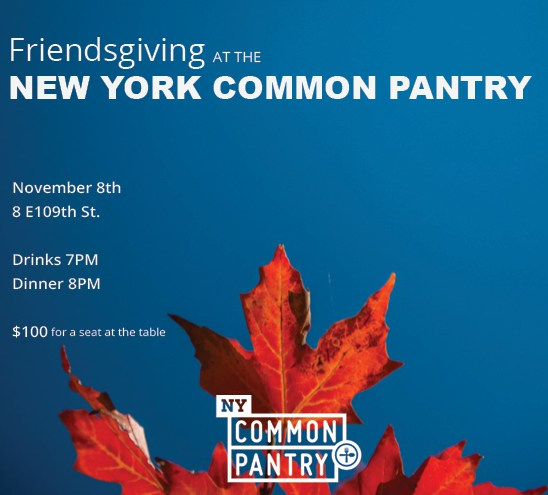
  • The Junior Board is holding its third annual fundraiser, Friendsgiving, on November 8th. Tickets are $100 for a meal at the New York Common Pantry headquarters.
nycp invite 0918_3

  • You can also enter to win baskets that include high quality experiences like tickets to performances at Carnegie Hall or the One World Observatory or Gospel Brunch at RedRooster. (Thank you very much to the generous sponsors/donors who have donated to us, especially the ones who responded to my awkward emails — I hate asking for money but I will definitely do it if it means more people have food in the city I love, so thank you for bearing with meand even more important, thank you for your generosity!) Whether you want to attend the dinner (it will be delish!) or just want to give a donation, please list my name in the “In honor of” section: https://ycp.ejoinme.org/MyPages/JuniorBoardFriendsgiving2018/tabid/1003286/Default.aspx
  • From now through November 9th, the New York Common Pantry is hosting a food drive. You can shop and send food items to the New York Common Pantry that are most needed directly online from this link: https://yougivegoods.com/shop?drive=7972
  • You can arrange to have items from your company or organization’s food drive picked up by November 14th by filling out the Google Link here: http://nycommonpantry.org/2018-thanksgiving-food-drive/

Finally, if you will be in New York this Thanksgiving, or if you have been in the past, and you know of valuable ways to commemorate the third (?) Thursday in November, I’d love to hear them. I’d love to volunteer on Thanksgiving morning or make a new tradition — possibly involving my slow cooker to serve others — but maybe something else I haven’t yet imagined.

On necessary anger & discomfort

It’s not easy reading, but it needed to be said. On Medium:

What will become of the white women who say they want the world to be better for all of us, but will not gather their white sisters or relatives at the dinner table when they say deeply racist things because they are all bound up in the comforts of the patriarchy that oppresses us all? How will we reconcile the addictive nature of comfort and how comfortable narratives keep us stuck in the lie of solidarity?

Are we willing to be angry with one another in the service of understanding that discomfort might be the thing that saves us?

Audre Lorde also said this back in 1981: “But the strength of women lies in recognizing differences between us as creative, and in standing to those distortions which we inherited without blame, but which are now ours to alter. The angers of women can transform difference through insight into power. For anger between peers births change, not destruction, and the discomfort and sense of loss it often causes is not fatal, but a sign of growth.”

Writing Yourself Well

It makes sense to me that writers don’t agree on whether writing is therapeutic.

For me, it always has been, but for some, writing is just hard and grueling. Writing  has always been a site of pleasure even when I was writing about pain. It has offered me sanctuary and escape, transformation and beauty, solace, comfort and more.

As I’ve gotten older and grown in confidence and experience, writing has started to also offer me joy.

For Black women, especially, who are expected to do so much emotional labor and work in different contexts in this country, joy is a revolution. It is an act of resistance to decide to be well, and to choose joy.

This was hard to do this week, especially. I argued with myself about it, somewhat publicly on Twitter, briefly. I wrestled, privately, with whether I should be sharing. I have been writing, in no particular order, about the historical trauma and chronic stresses that Black women hold in our bodies due to racism; the long and ignored history of Black women’s political participation in this country since before the Nineteenth Amendment; fiction and poetry at the intersection of police violence, mental health, and Black Christian resistance to the full range and humanity of queer identities that literally kill Black women with silence — directly or indirectly.

When I finally stopped; when I realized I was triggered and needed to step away, there was more to be done but there was also a historic spectacle centered on the devaluation of women and patriarchal resentment — where a respectable woman was speaking bravely and an angry, livid, entitled white man was lashing out angrily and I just could not be a witness. I could not do the work of being a witness because I was tired.

I say this not because I want anyone to play any tiny violins for me — my life is wonderful and full and I have privileges that I have been both blessed with and I have worked my ass off for. I say this because I wish when I was younger I would have read, seen and heard more Black women say and model for me what to do when you are depleted.

We have seen with the very public suicides of celebrities what happens when people suffer privately with their demons; but there’s another choice to overwhelm. There’s a proactive answer to overwhelm, to fatigue, to the stress of burnout: Go some place quiet. Fill yourself up. Do what you want to do, for as long as you can, for as long as you can afford to. Do not die, literally or figuratively, at the mercy of what you think other people expect you to perform of your pain.

I’m thankful to have friends and loved ones to affirm me and to affirm this. They save my life. Every day. Every hour. Every moment — often without realizing it. They are constant reminders that I don’t have to expose myself constantly to things that are triggering and nor do you.

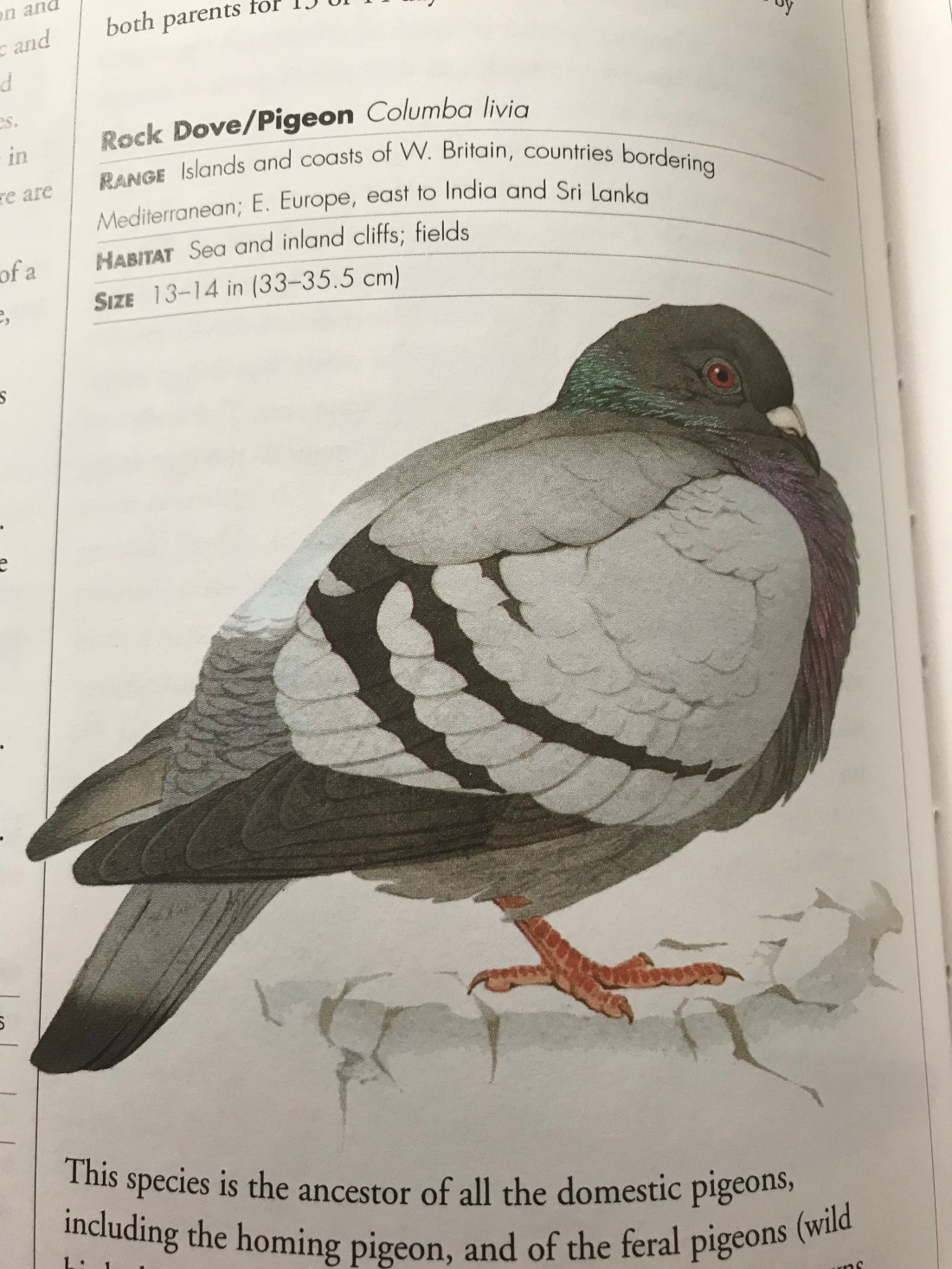
That is a long, precious set up for this essay about pigeons, which I know will seem so random and is a bit different for me. I wanted to laugh and humor myself after exposure to hard things and a ton of hard work, so there you have it.

Yes, hard things are happening, and there is work to be done. But I can still claim joy in some of these moments to write myself well. And you can, too.


Serena & The Humanity of Black Women

It was a gift, especially as I teach the Combahee River Collective statement from 1977 and remind folks that we have been fighting for a long time on behalf of our own freedom not just for the sake of ourselves but so that everyone else can be free, too, to write this for Mic.

It’s more convenient for white sports fans, of course, to turn the healthy, justified rage of black bodies gazed upon for money-making sport into a weapon formed against us. But like Colin Kaepernick, Serena is a generosity. She won’t let anyone or anything make her flat or less complex. Like Shirley Chisholm, she is unbought and unbossed. She contains multitudes. She can be both livid and kind, distraught and sweet, within the same hour.

What audacity, what nerve, that black girl with the big hair and the strong legs and amazing body has, showing up, demanding to be seen as human. What a gift, in this time, in this void of regal reckoning for black or brown bodies anywhere but fictitious worlds, that we get to witness Serena’s humanity unfurl, unedited.

Kirkus Reviews Feature| Carol Anderson’s One Person, No Vote: How Voter Suppression is Destroying Our Democracy

When I spoke to Carol Anderson for Kirkus Reviews, it felt like we could have talked for hours. Her book, One Person, No Vote, is an important read for anyone who cares about what’s at stake for the midterms and for 2020. What stayed with me most about what she said when I asked her about her call to action in the book is that voting is essentially the only remaining lever of power available to most people in our Democracy. I know folks feel various levels of indignation about the suggestion that anyone should be telling you to vote, but opting out combined with the steady erosion of the Voting Rights Act of 1965 will set us back farther than anything you can imagine — for generations.


In his 1951 novel, Requiem for a Nun, William Faulkner wrote the oft-quoted line, “The past is never dead. It’s not even past.” This is true now, it seems, of so many things, but it’s particularly resonant for the fight against voter suppression.

As much as immigration or Supreme Court picks have dominated conversations about the Trump Administration, political power in the United States begins and ends with the vote. Acclaimed historian Carol Anderson’s latest book, One Person, No Vote: How Voter Suppression is Destroying Our Democracy, scheduled for publication on September 11th, situates current truncated discussions, exaggerated rhetoric and lies about voter fraud and suppression at the polls meant to disenfranchise voters in a past that feels eerily like it never became history.

Jeff Sessions, for example, when he was Alabama U.S. attorney, referred to the Voting Rights Act of 1965 as an “intrusive piece of legislation,” then “rounded up twenty elderly blacks and had Alabama state troopers drive them away from their community into a predominately white area to be fingerprinted, photographed and grilled before a grand jury” to intimidate them out of voting, Anderson writes. There are troubling and astounding stories like this throughout One Person, No Vote from Anderson, the Charles Howard Candler Professor of African American Studies at Emory University. She said the idea for her latest book emerged when she was on tour for her 2016 book, White Rage, which won the National Book Critics Circle Award for Criticism along with a host of other accolades.

“During the Q&A on the road, I often got a question about the part of [White Rage] about voting, ‘How hard is it to get an ID?’ Because headlines about voter fraud became the shorthand mantra,” Anderson says. “So you begin to talk about which IDs voters need. African Americans and poor people often don’t have the kinds of IDs that you need. I wanted to demonstrate how difficult it is to get those IDs.” She also details the combined effectiveness of voter ID laws combined with the lie of voter fraud, found by law professor Justin Levitt to amount to “31 voter impersonation cases out of one billion votes nationwide” cast between 2002 and 2015 and a “powerful and effective ‘political weapon’ wielded against minorities, youth and the poor.”

You can read the whole feature here.

Come hear me sing & read at Literaoke, a Brooklyn Book Festival event, Sept. 13

KP-Literaoke-NYC_WEBslide-670x502I’m so excited I’ve been asked to read in the company of these talented writers for a Brooklyn Book Festival event. If you’re in town (or you’re a New Yorker who will be looking for a place to party after you VOTE in the PRIMARY ELECTION THAT IS WAY MORE IMPORTANT THAN ANYTHING ELSE I COULD WRITE HERE *ahem*) please stop by —  I’d love to see you! I have some poems to share with you I hope will make you laugh & maybe gasp.

I’ll leave the song I’ll sing a secret until I get there — No one who’s done  karaoke with me is allowed to guess the artist I’ll be singing (If you were in BK with me this past weekend Village Voice crew, no, that’s not the one!) but I bet y’all can figure it out. There’s only one way to know for sure though!

Thursday, September 13, 2018 7:00pm
112 W 27th St Ste 600
NY, NY 10001

Here’s the Kaya Press listing — Many, many thanks to Kaya Press for inviting me to read. & here’s the Facebook event.

Kirkus Feature: Jacqueline Woodson

“Our community is such a community of survivors and resisters and resilience. We’ve been like water when we have also wanted to be a bridge. Day by day, I have to find a way to figure out a way to do self-care. Writing is very cathartic for me; creating worlds where people end up OK is very helpful. Whatever’s happening now is happening for a reason, the thing that happens when there’s a big, big shift coming.”

Jacqueline Woodson on her latest books, Harbor Me and The Day You Begin

Farewell, Queen Aretha

This summer was the second in a row I got to teach writing with one of my favorite groups on earth, Young Women Empowered. Y-WE Write has educated me about what it means to foster brave space with young people, how to be vulnerable as a creator and writer and teacher, how to find my process through explaining it, which parts of my story are most beneficial to share with this generation of young writers now. It has been held at Whidbey Institute, on Whidbey Island, which is also home to the writer’s residency Hedgebrook. For this reason, the Pacific Northwest has become my healing sanctuary, place where I have been shielded from hard things in recent years.

So it was with a heavy, heaving heart that I peeked at the news to take note of Aretha Franklin dying while I was there. I got there almost two weeks ago Sunday, and spent the full week waking in the morning to some of my favorite songs, trying to articulate what she meant to my life. Before she died that Thursday, one of my students asked a question about how you keep from feeling like so many people are writing about something or someone that anything you write might be inferior — and I could hear their voice in my head as I read and bookmarked long articles and obituaries for Aretha, wondering what, if anything there was left to say.

When I was done showing up for the young women I came there to teach, as we mourned and celebrated Aretha together; after I cried leaving them and they offered me such sweet, adoring words of affirmation and I flew to Newark on a red-eye, landed, drove 2.5 hours to the middle of Pennsylvania for a two-day workshop to discover a really significant shift to my work in progress that will make it soar in a way that I could have never found on my own (Thank you Highlights Foundation!!) drove 2.5 hours back to New York City after being away from home 10 days, attended an all-day faculty orientation the following day that left me with just enough mental energy to finish writing what I needed to, I was able to write this piece about Aretha Franklin and what she means to me, and what I believe she means for Black women, in particular.  It was important to write not because I felt like I needed to write about Aretha because other people were writing about Aretha, but because I wanted to read work about Aretha that centered what I know other Black women would want to read and see lifted up about the Queen of Soul as we prepare for her homegoing.


A review of Black KkKlansman featured on Medium

Happy Summer Friday!

At Cannes Film Festival, Black KkKlansman got something between 7 and 10 standing ovations — the industry magazines literally could not agree on how many times the folks at Cannes broke out in applause between the credits and the end of the movie — and they were well-deserved. If you’ve been reading my work for awhile (thank you! you’re the best!) you know that I’m not a gusher. I don’t do a lot of hyperbole, and I certainly don’t do it in the summer when it’s hot like this and I need to conserve my energy.

But I liked Black KkKlansman so much that I took time away from some other writing to share some thoughts about it because I think it’s important to watch and be in conversation about.

I wrote a review from my notes back in June which is featured on Medium, which is also exciting because I’ve been contributing to Medium for awhile and my work hasn’t been featured on the platform before.

If you’re the kind of person who reads reviews before you see a film, let me know what you think — but I’d be interested in hearing your thoughts anyway, if you see it. (You should also read one of my favorite critics, A.O. Scott, who educated me about that opening shot; I obviously blocked out huge swaths of “Gone With The Wind” but learned a great deal about cross-cutting and “Birth of a Nation” in his review.)

But even if reading reviews isn’t a thing you do, you should see Black KkKlansman because it’s Spike Lee at the height of his potential. Because it’s John David Washington stepping out of his father’s shadow (at least in his own mind and maybe for others who don’t yet know him but certainly will, and he has some exciting additional projects outside of Ballers coming up later this fall) and into his power as a humble but exciting talent to watch as a leading man. It’s also rare for the Black community to have this generation of creatives who have parents and mentors who paved a way for them to take on dynamic roles like this which have nuance and substance.


Did someone say Book Lovers Day?

It makes total sense that Book Lovers Day would fall right in the middle of the hottest days of summer, when there really isn’t anything better than sitting in front of the air conditioning (or some other cooling device) and reading. As it happens, as I’ve been in the homestretch of finishing a work in progress for young adults, I’ve also been immersed in reading books for young readers of color by writers of color — like a message of love from the universe. Here are some of the books I’ve read & been reading lately that have won my heart:

  • Fresh Ink: An Anthology: I got a sneak peek at this one (Oh, the rewards of being a book nerd are few, but feel so enormous sometimes…) since the pub date is next week, on August 14th. I love the color, and adore the mission of We Need Diverse Books, cofounded by the anthology’s editor, novelist Lamar Giles. Here, he’s compiled fresh, and beautiful short stories by a constellation of YA’s strongest voices. I’m not all the way through, but stand-outs so far are “Why I Learned to Cook” by Sara Farizan, (whose third novel, Here to Stay, is incredibly timely and comes out this fall) Walter Dean Myers’ “Tags,” a one-act play that’s previously never been published and Melinda Lo’s (adorable) “Meet Cute.” I can’t wait to dig into the rest of the collection, especially stories from Daniel Jose Older & Melissa de la Cruz and Nicola Yoon.  This is a collection that isn’t to be missed — it fully represents the world in which our youth live, which is what makes it so fresh. There are parts of Eric Gansworth’s “Don’t Pass Me By,” that are laugh out loud funny, and other moments of regular ‘ol teen angst that show that stories in own voices are also universal stories of kids who are just kids. The book is a relief.

  • Courage: One of the things that’s inspiring about talking to writers who write for a young audience and particularly for children of color (who often don’t see themselves reflected in literature, so get turned away from books at a young age) is that they often have such an interesting path to get to the page. Barbara Binns is one such author — and I interviewed her for Kirkus about her first middle-grade novel to be published by a large press, Courage. After other careers, Binns took a brief foray into romance writing for adults before she learned that the Black boys, in particular, are often resistant or struggling readers because no one really writes for them. She’s written to try and fill the gap for years, and Courage is another, larger step in that effort. It’s the story of 12-year-old T’Shawn, who is navigating the loss of a parent, the homecoming of a formerly incarcerated older brother, a crush and being the newest addition to his swimming team.


  • Proud: Young Reader’s Edition: “People think that there are limitations to what women and people of color can achieve,” Muhammad said when I interviewed her for Kirkus Reviews. She made history in spite of a number of odds as the first woman to compete in hijab, and more adversities that she describes in both the adult and young adult versions of her memoir. “It’s part of my life’s work to break through that box people try to put you in.”

I’m reading some other books, of course, but I’ll save all that for another time. What are you reading this summer? How are you liking it? What’s your favorite?