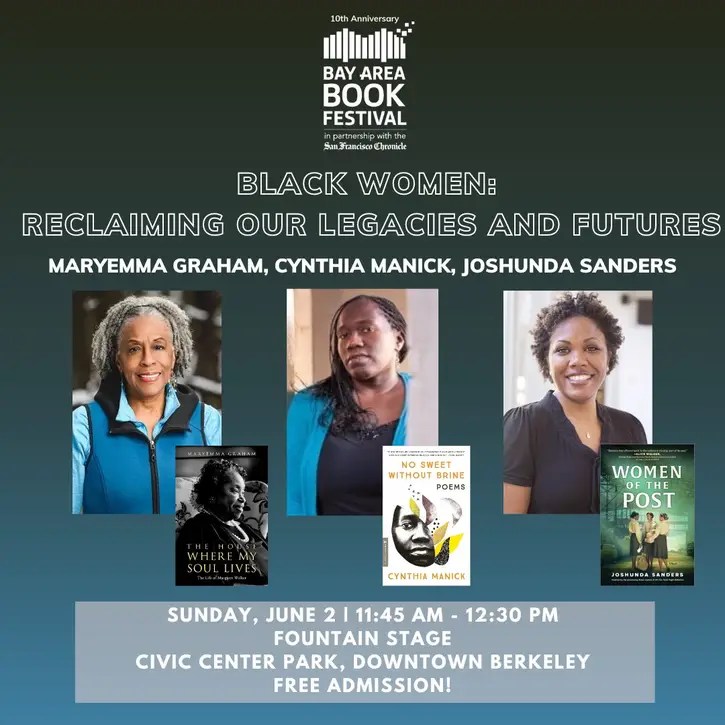
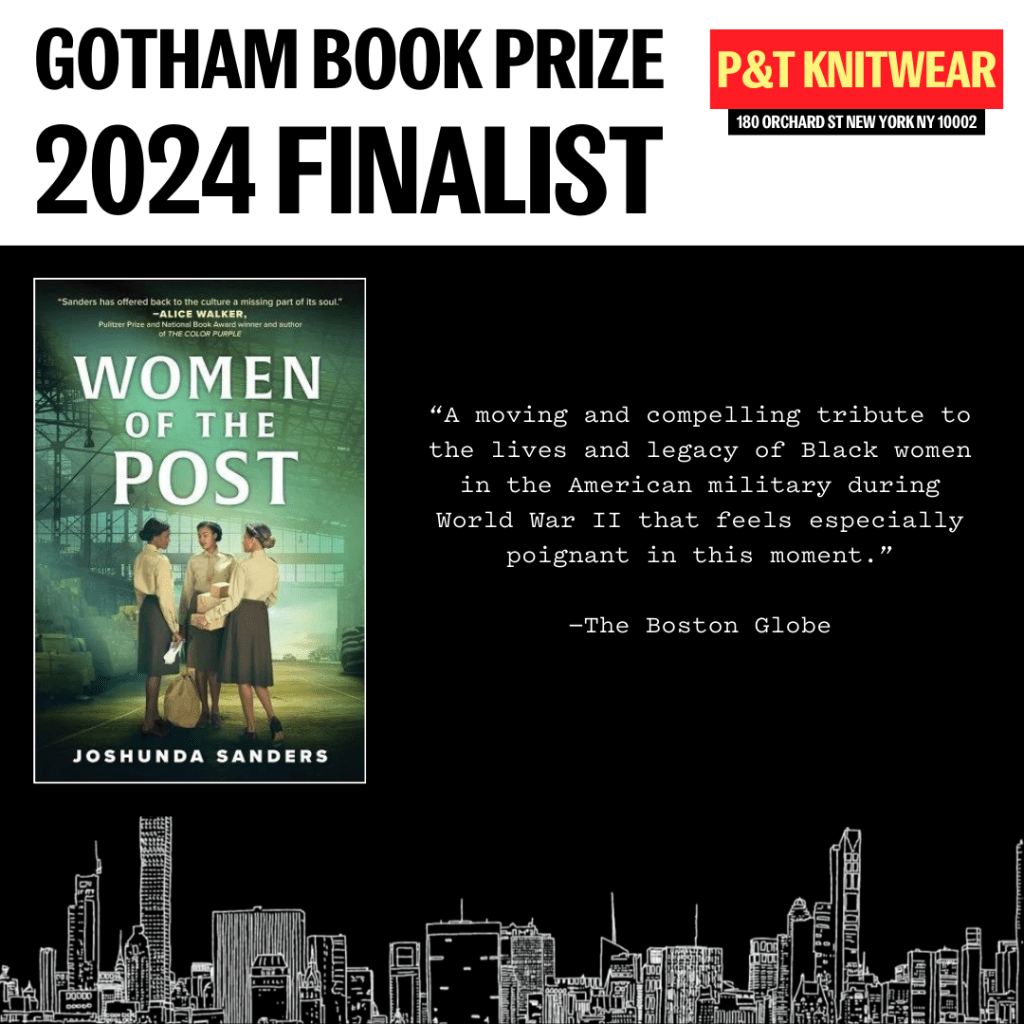
Women of the Post is a Gotham Book Prize Finalist & the 2024 Bay Area Book Festival, June 1-2

Thank you for your ongoing patience with me as I navigate a full and busy life. I’ve been gushing all over social media about the news that Women of the Post is a 2024 Gotham Book Prize finalist. The winner will be publicly announced next week, but in the meantime, here’s a little history about the prize, and why it’s such an honor to even be nominated.

And I would be remiss not to mention that I’m headed back to the Bay Area for the 10th Anniversary of the Bay Area Book Festival to speak on a panel with some brilliant Black women, which is basically my favorite thing to do in life. Come visit if you’re at the festival!

Finally, in case I haven’t mentioned it enough, I spend most of any imagined free time I have writing reviews and other things at my Substack, Black Book Stacks. Here’s what I thought about Great Expectations by Vinson Cunningham, and what I’m reading now.

Black Book Stacks on Substack

Before I was a journalist, my favorite non-fiction writing and non-journaling activity was to attend readings or lectures featuring Black authors and take copious notes. So it is a kind of coming full circle that I’ve started a Substack newsletter focused on book reviews related to books for and by Black people, Black Book Stacks. (About a year ago, I started a YouTube channel of the same name, which you can view here and if I have a Bookshop store you can find here.)

I always had the innate sense that being a writer was not just about putting words to paper and hoping that others would read those words. I was always searching to put the words I wrote into a tradition. Writing was another way of trying to belong and to solidify a place for myself in a world that seemed bent on my erasure or destruction.

I have vivid memories of a small royal blue Mead notebook that was thick as a brick. I carried it with me to the old Barnes & Noble on Astor Place, through Washington Square Park, up to Emma Willard and Vassar. I had the privilege of listening and trying to absorb the wisdom of Jamaica Kincaid, Gloria Naylor, Janet McDonald, Elaine Brown and so many others. I was a careful collector of Black women writers’ quotes, usually because I couldn’t afford to purchase books of my own and I didn’t not want to vandalize library books. Quotes were the happy compromise; they were short enough for me to carry wherever I went. These were the breadcrumbs and manna they left for me in a trail to who-knew-where but I gobbled them up. Every nugget was a jewel in my crown.

As I made my way in journalism, it became harder and harder for me to give myself permission to keep up this witnessing practice in the same way. Mostly because of time, but also because I realized that such forums and opportunities to hear Black writers and share space with them were fewer in other states and cities. It just so happened that reading the work of Black women in particular was my self-paced MFA program. Sometimes, I had the opportunity to profile, interview and write about them, as was the case with Octavia Butler in 2004 and Alice Walker around the same time. But mostly, I was just glad to have their work to sit with and revel in.

Over the years, I’ve continued to focus my attention on the work of Black writers because, as more of the world knows now, we live in a world where white supremacist capitalism means that what is considered valuable is everything but Blackness or real intimate discussions of all its flourishing contours in spite of and beyond the gaze of the consumption of white people. What I mean to say, I think, is that Black literature has always been a miracle to behold. In part because it comes from a people who have a shorter lineage in the Americas of thriving in literature because of the legal restrictions that forbade them to read and write. Our resilience and perseverance and faith, all bound up in the Word, continued both in an oral tradition and on paper.

The overcorrection here, I’ve found, is that when it comes to fair critique or evaluation of the work of Black writers, is that our books are either ignored, as if they never happened, especially beyond the date or week of their publication, or they are elevated as neutral objects for sale without a real analysis of them and their context. That’s what my new newsletter is aiming to help create in the world. I hope that if that sounds of interest to you, that you’ll subscribe. Looking forward to seeing you on the list.

Book Review: The Office of Historical Corrections

Danielle Evans’ sophomore collection of short stories with a timely, prescient eponymous novella is a delightful follow up to Before You Suffocate Your Own Fool Self, whose title alone you have to love.

In The Office of Historical Corrections, we meet Black women who are sexy, dispassionate, cerebral and astute. They come from money and status; the Jack and Jill set, if they wanted to join, but generally, they’re not that interested in what you think of them. From Alcatraz to Wisconsin to the D.C./Maryland/Virginia trinity, these characters traverse the physical landscape while tromping on the generally limited and boundary-laden universes into which they are typically crammed or altogether absent.

One of my favorites in this collection is “Boys Go to Jupiter,” told from the perspective of the clueless white girl Claire who becomes a lightning rod for controversy when she dons a Confederate-flag printed bikini and posts carelessly about it online. In less skilled hands, the story would veer towards tropes that don’t truly vindicate the Black women who are often unheard in these narratives. In Evans’ hands, though, we understand Claire’s indignation clearly, and we know that it is her right to do what she wants as a kind of blind participation in white privilege that of course has come to the fore in public life more recently.

Pub date is November 10th 2020

The eponymous novella, however, featuring two frenemies united in their noble profession or recovering or literally re-membering aspects of Black history that are often intentionally lost, is beautiful, timely and thought-provoking. Novellas are still unfortunately rare, but I really love the form and Evans showcases its best features here, underscoring how convenient forgetting can be even for the most conscientious among us. I hope you’ll pre-order the book from my affiliate page on Bookshop.org. I also made a short video review on Black Book Stacks, which you can see here.

Book Review| Memorial Drive : A Daughter’s Memoir by Natasha Trethewey

Memorial Drive

I barreled unexpectedly through Natasha Trethewey’s beautiful and painful memoir, Memorial Drive: A Daughter’s Memoir. I was compelled to finish it quickly the way we are taught to rip Band-Aids off our wounds to ensure that we won’t prolong a stinging sensation, so that we can get on with the healing part and rush through the grief. I explain a little more, too, in my video review on YouTube.

It is not so easy to recover from wounds that involve our mothers, particularly when they do not survive the failings of the world — the world that’s supposed to protect them.

Memorial Drive is the story of Trethewey’s mother, Gwendolyn, through the past and present lens of her daughter’s keen, writerly eye. No detail is spared, which includes transcripts of recorded phone conversations between Gwendolyn and Trethewey’s former stepfather Joel, a haggard, menacing Vietnam War veteran who continually threatens the uneasy peace that opens the book and remains a question mark throughout its pages.

Poets are gifts to us in times of happiness and relative ease but particularly in times of despair, I think, because they can distill what we would normally couch in euphemism down to its essence. In short, they remind us that events are not only what happened but our histories are our active destinies. We can shape them as we wish, but the facts — comforting or not — well, those remain. For women and Black women most of all, there is a way that this power of witness can override the willingness and tendency of others to forget us.

The ache in my heart spread and flourished every time I read a new detail of Joel’s torment of Trethewey, his disregard for her mother or her brother. His manipulation was a knife, twisting and turning with every page; at one point, he breaks the lock to Trethewey’s new gold-edged diary and the violation the poet felt then and perhaps every moment after she had “found her audience,” was so visceral I had to stop reading.

Part of my reaction to the book, of course, is remembering my own mother’s experiences with abuse; the cavalier way in which she would recount having her nose broken by an ex-husband, the way we fled similar boyfriends and sought shelter in homes for what were then called domestic violence shelters. When I posted a review on Instagram, someone mentioned, too, that one of the other aspects of the global pandemic in this moment has to do with a common feature of disasters, which is a rise in intimate partner violence.

The neglect to which my mother succumbed was very different and, besides, you can’t compare one mother’s death to another’s. But what feels the most true here is that I understood that no one was listening to my mother, even when she documented her experience, even when I was a witness. From this, I learned that women were not considered the authorities of their experiences; that even if they were hunted and pursued until they were broken, they would likely not be deemed worthy of protection under the law.

This is a belief I would rather be convinced is untrue. It’s not really in my nature to give into despair. And yet, here is what happens in Memorial Drive, here is what takes the poet three decades to begin to approach & even now, with great suffering and agony: After many attempts to document the abuse and violence and to escape it, Gwendolyn was murdered by her estranged husband in June 1985. Like so many people who have experienced intimate partner violence, she could have been saved — there were so many people warned, so many signs, documented evidence of his threats to her life — and yet, she wasn’t.

This is devastating on so many levels, but especially in Memorial Drive because Trethewey composes the poetry of her extraordinary experience with clarity, grace and generosity while also compiling detail by way of utilizing the economy of every word to perfect effect. As a result, Memorial Drive reads like a classic memoir of grief, like a tragedy in slow motion, the narrative arc, already known, lingers over the text like a set of strings.

Book Review: When You Were Everything

BB8836E2-6B2B-41D7-A0D7-61B4A45BD6D9
Book Cover for When You Were Everything, a novel by Ashley Woodfolk

I have been desperate for stories and narratives that have nothing to do with pandemics, so that’s part of the reason it took me less than a week to tear through this sophomore effort by Ashley Woodfolk. The other part is that it is really, really good and it’s a topic that is almost never raised in literature, which is sad — the topic of friendship break ups.

The story at the center of When You Were Everything is essentially this: Cleo and Layla have been friends for a long time. Layla has a speech impediment (she stutters) and Cleo is, for the duration of their friendship, generally encouraging and supportive of Layla being brave enough to tackle things like school musicals and other environments where she knows her friend can shine, impediment be damned. But then, things start to shift. Layla needs Cleo a little less when she encounters the Chorus Girls, a group of musical nerds at their high school. The adults start acting weird too, and suddenly, Cleo’s parents are separating and her father, a librarian, transfers to a different school. There’s a hot guy named Dominic Grey — yes, even his name is hot — who mostly distracts Cleo from all the chaos, but romantic love is not a salve for losing your best friend to a bunch of snotty choir brats. At least, it’s not always; not at first.

So I won’t give away much more of what happens in the book, but I had so many emotions and feelings almost from the opening pages. ( I say a little bit more on my book tube channel, so you can listen to me go on about my feelings here, if you’d like.) First, like most people, I have plenty of ex-friends who come to mind immediately. Female friendship is one of those intimacies and sisterhoods that can feel even deeper than any romantic bond because of how sacred and sweet it can feel when it’s good. The emotional wreckage, though, feels arguably worse than any romantic break up, too, because weirdly, it feels like you can always replace a romantic partner but a friend of your soul and spirit? A little, tiny bit harder to do, no?

Woodfolk puts this well in the book, when Cleo tries to describe what happened with her and Layla:  “The hurt feels so much like when my parents decided they didn’t love each other anymore that I can feel a shift in my breathing. ‘We…broke up.’

Dom snorts. ‘It’s not like it was a relationship,’ he says, and I frown, annoyed at his reaction. Perhaps he doesn’t know how it feels…to break in this particular way. Or perhaps it’s different for boys? But girls cling to their friends for dear life as they wade through the rough waters of learning who they are while everything around and inside them is changing minute by minute. And aren’t we all a little bit in love with our best friends?”

One of my first published essays was in an anthology called “Secrets and Confidences: The Uncomplicated Truth About Women’s Friendships,” published by Seal Press in 2004. It was about the shifting, challenging dynamics of a middle school best friend who, sadly, did not remain my best friend for too long into adulthood. At the heart of parsing out the whys and the hows of a deeply intimate and close friendship ending was the core of what makes When You Were Everything so beautiful and helpful to have, particularly for young adult readers: We all change and grow. Sometimes the people we love the most change and grow in different ways, or they don’t at all, and that’s somehow more heartbreaking. Our culture of loose ties has made it seem like the norm to stay “friends” with people from your past indefinitely by giving them and everyone else unilateral access to the performance of our lives and happiness online. But the truth is, sometimes it’s the healthiest thing for a friendship to have its season in our lives and be over. You might shed some tears over that sentiment and certainly while reading this book, but it’s good for the soul, I promise — on both counts.

A Black History Month Reading List, Part 2

DSC_0015


So you may have already seen my other list of recommendations, but if not, here’s Part I. Part 2 is not meant to be exhaustive or comprehensive, because there are many lists of books about Black history and culture that you can check out for even more recommendations, including the Zora Canon of 100 best books here, this Penguin Random House list of 25 contemporary fiction and nonfiction  or this Electric Literature list of 10 books about Black Appalachia and then there’s Goodreads and Twitter and a dozen other places.

I realized when I was thinking about some of my favorite works of history or of historical significance about Blackness that they were across genres.

For instance, for colored girls who have considered suicide when the rainbow is enuf by Ntozake Shange was actually the second or third book of hers I read. Before that, I was in love with Liliane, Sassafrass, Cypress & Indigo, her poetry collection, The Love Space Demands. But what I loved most about for colored girls — which was recently a sold out production in all of its glory at The Public Theater — was that it showed Black women in our multicultural context. As being in relationship to Latinx, Caribbean and African spiritualities, dreams and aspirations. It showed our love and joy and pain as being Diasporic like a lot of Ms. Shange’s work.

In this way she was definitely a part of the literary tradition of recovering the wholeness of Black womanhood in the way that Zora Neale Hurston did in Their Eyes Were Watching God, one of my favorite novels of all time.

Much has been said about the beauty and timelessness of Their Eyes Were Watching God; to understand more about the life of Zora, however, an essential text is Valerie Boyd’s Wrapped in Rainbows. It is a classic example of the ways Black women’s lives are cherished in unique ways when we have Black women biographers to attend to the beautiful and brutal details of our lives.

Speaking of the unique beauty of having a Black woman author reflecting the details of Black women writers, bell hooks’ work has been foundational in helping me decode and externalize internalized biases that get in the way of my work. This includes everything from Sisters of the Yam, Writing About Race (a book in which I was surprised to find myself cited!!) to one of her most important books to me, Remembered Rapture: The  Writer at Work. I often talk about this book because it was the first time I read a respected black woman author say that no Black woman could write too much; that we are always writing against time because of the illnesses that take us out, because our ancestors were silenced and we don’t have to be and much more.

I have not mentioned one of the most important writers in my development and understanding of the myriad possibilities for Black writers and intellectuals on a global scale yet, James Baldwin, in part because the book by which I was introduced to him is no longer in print. I had the great fortune to pick up a thick book, The Price of the Ticket, a collection of Baldwin’s essays in the early 1990s. Published in 1985, it represents some of his most powerful writing from 1948 to 1985. I read it in seventh grade and kept the book with me, somehow, across a lot of moves to a lot of different places. It reads to me like sacred text, and its beautiful cadences and nuances, the confidence and fear, the anger and disappointment, all elegant and alive, helped me really see America for the country that it is instead of the country I believe most of us want it to be.

A Black History Month Reading List, Part 1

Some of you have been kind enough to follow my musings about individual books on my new YouTube channel, Black Book Stacks. This is a natural endeavor for me, to find, devour and support books by and about Black people, who I define as people from throughout the African Diaspora. This is an evolving definition, I guess; I was reading David Yoon’s Frankly In Love, which is an addictive YA book that delves into interracial dating and intraracial friendship, including with his Black friend Q. Frankly In Love is a good, recent example of the kind of book that blends a lot of different kinds of diversity and that was part of what thrilled me about it.

I forget who I was talking to who said this, but it stuck with me: Black people in this country do not have the luxury of having as long a literary tradition as any other group in America because of the legacy of slavery. Because of being forbidden to read or write. To me, that makes it that much more important to lift up books that recover and restore us to ourselves; that expand what we know of ourselves and our lineage, real and imagined. Anyway, here is the beginning of a list of some essentials of Black history, to me, anyway, that can be a good resource and are some of my favorite books that filled in important gaps for me along my reading journey:

  1. (New) Daughters of Africa: An International Anthology of Writing by Women of African Descent, edited by Margaret Busby | I have the great fortune of having both a copy of the original Daughters of Africa, and the newest addition, which just expands the important, vast collection of significant work to include 200 writers. A classic.
  2. Sister Outsider by Audre Lorde | “Poetry is Not A Luxury,” “Uses of the Erotic,” and many other seminal works by Audre Lorde were first written or delivered as lectures in the 1970s. Like the Combahee River Collective as a whole, she was integral to giving us language to describe and express the interlocking oppressions we know now as an intersectionality framework.
  3. How We Get Free: Black Feminism and the Combahee River Collective by Keanga Yamahtta-Taylor | I was not familiar with Dr. Yamahtta-Taylor’s work until I taught it at the New School, and hearing first hand from the likes of Barbara Smith, Barbara Ransby and Alicia Garza helped contextualize not only a lot of what we’re seeing now in terms of how Black women are dismissed or lifted up, depending on the community, but also how much has happened behind the scenes along the way.
  4. At the Dark End of the Street: Black Women, Rape, and Resistance — a New History of the Civil Rights Movement from Rosa Parks to the Rise of Black Power by Danielle L. McGuire | No disrespect to Rosa Parks, but I did not know the name of Claudette Colvin until I read McGuire’s book, of my own volition, long after undergrad, where I had Africana Studies as a minor and learned a good deal, just not enough.
  5. The Warmth of Other Suns: The Epic Story of America’s Great Migration by Isabel Wilkerson | It’s hard to believe that 2020 is the 10th anniversary of this book’s publication (!) but what an incredible work of scholarship, recovery and re-membering from Wilkerson, who, if memory serves, interviewed thousands for this book, including a young pre-presidential hopeful named Barack Obama. No list of important Black historical texts is complete without this one.

Words of Fire is another underrated anthology of Black Feminist thought; Black Skin, White Masks has always haunted me, and Sisters of the Yam, by bell hooks, was the beginning of my understanding of wellness and self-care.

I’d love to hear what your thoughts are on these books if you’ve read them, or what books you consider essential to learning about Black history are.