Nicole D. Collier, one of my favorite members of my virtual writing tribe, asked me to participate in the blog tour. Since I love to read and write about writing (in lieu, sometimes, of actually writing) and I’ve noted that some other writers I admire and respect, including Tananarive Due, Tayari Jones and Daniel Jose Older have all participated, I thought I’d add my humble thoughts and impressions to the mix.
1) What are you working on?
I am working on a book about how racism and sexism have contributed to the demise of traditional journalism and how people of color (and organizations, websites and companies that recognize their value) are changing the media landscape in important but often unacknowledged ways. I have also written a memoir in progress (excerpts have appeared in Huizache, Gawker and TED, among other publications) and every now and then, the poetry that I love comes back. I have worked for years on a short story that turned into a novella about the daughter of a train conductor and the graffiti artist she loves in the Bronx that I know will be published in some form someday.
2) How does your work differ from others’ work in the same genre?
This is an interesting question and frankly, not one that I think too much about. I am willing to admit that not thinking much about it might work to my detriment. Because there are so few people of color who are published and promoted well for work that is for people of color, in that we are the main audience and about people of color that also includes class diversity and is concentrated on the African-American experience, my creative writing and poetry are different from others’ in the sense that I am tacitly aware of internal and external geographies, their impact on how and when and where we tell our stories and how those stories are positioned or excluded from mainstream and popular cultural narratives about people of color — specifically black women. I hope that my reverence, appreciation and empathy for the intersections of my experience are reflected in the work.
The same is true for nonfiction. The main difference in my nonfiction writing is that I am fully aware of the power of the truth, or a truth, to change a life because it is how I was shaped as a young reader who dreamed of being a writer. I love that saying that the creative adult is the child who survived — that is the internal location or spiritual location I write from.
It helps that I have a wealth of traditional newspaper reporting experience, which gives me the power of knowing how to completely own a deadline and the discipline of structure while also giving me the confidence that comes with having failed and made mistakes and learned that failure, or whatever is subjectively considered failure is not the end of the world. There is always something more to write. I think my nonfiction is different from others’ who write memoir, essays and other nonfiction in that I seek to offer information for others to investigate or parse through instead of as a definitive statement or argument.I try to be authoritative without being obstinate and lyrical without trying too hard. I also try not to be too hard on myself when I fail at either of those.
3) Why do you write what you do?
One of the things that brought me a lot of comfort and joy as a young woman and a budding writer was reading elegant, beautiful and clear work about people of color who are traditionally not given models of ourselves in literature that have these elements. I write about women, women of color, the poor and working class and other people of color so that I can be a part of creating the beauty in the world that is otherwise missing when it comes to these groups. Perhaps because of postracial and postfeminist rhetoric, to some people it seems to be redundant and outdated to state and restate how important it is to be committed to writing about black women, especially those who are the least visible in classical or predominantly white canons, but I know how significant it was for me to read Alice Walker’s In Search of Our Mother’s Gardens, for instance, while I was self-parenting and supporting my mother in ways that were beyond my young years or to read bell hooks and Cornel West in seventh grade before I understood what they were even talking about in Breaking Bread. The same can be said of the multi-volume memoirs of Maya Angelou who showed me that while it took courage, confidence and grace to be a Renaissance woman (she was a tall black woman, too, like me — and Octavia Butler!) it was possible to overcome a lot of internal and external resistance to do so.
4) How does your writing process work?
I have multiple processes and I think all creatives do. I write all the time. I write on my phone. I write little notes in a notebook that I usually carry around with me. I prefer to write longhand, which is slower than typing, and to transcribe. I love to write longhand when something is particularly meaningful to me or requires the kind of granular detail that I need to retain. (The most recent example of one piece I did this with is this blog about leaving Austin.)
I don’t necessarily write everyday anymore but I used to, faithfully, for many years. I think you build writing time into your life in a way that is completely natural for you. Do it in a way that doesn’t make it feel like so much work. I actually love work and am addicted to work, so for me, working doesn’t carry a negative connotation in the same way that say, relaxation does (No pun intended, I am working on that. I realize that I ain’t like everybody that way.) But the main problem new and/or young writers seem to face related to process is that they associate writing with work. I say do whatever you need to do to get rid of that mentality and get out of your own way in whatever way you need to to go from being a person who has always wanted to write to being a writer…because writers write. I value my work and the luxury and privilege I have to do it so much that I approach the page as a way to share the gifts that were bestowed upon me and to honor the many different people I’ve known who wished that they had the luxury of sitting down at a page to write.
Writers write but they should also read. I read everything, which is a significant part of my writing process. I believe heartily in taking notes. For nonfiction, I take copious notes. Everywhere — in the book, in a separate notebook, on Post-Its.
I write at all hours, but my best writing gets done when I have the least distractions which is either early in the morning or in the middle of the night. I try mightily to get every last bit of doubt or concern about anything else out of my head while I’m writing a draft and then go back to it when I have some sense and some energy and I can revise. Revision is the heart of my work and the most enjoyable and the most irritating part of being a writer. I revise most things I write a half-dozen times — even blogs — before I am satisfied with word choice and structure and order. Outlines can be really helpful for big projects, but I am not wedded to them.
On June 9th, two of my favorite writers and favorite women are going to post on their blogs about their writing process. Both of these ladies are two of the sweetest people I’ve ever met and their support has helped to keep me writing during some of my lowest points. I hope you’ll read and share their work widely.
Jo Scott-Coe is a fantastic nonfiction author, fellow tall woman and excellent teacher.
Juanita Mantz and I met at VONA in 2012 and her work has been published at xoJane and elsewhere.

 In the years to come, I sketched on the margins of paper and of my life. When I came of age, the fashion designer Byron Lars was hot and the Village Voice was a plump pulp product I flipped through every Wednesday as soon as it was folded neatly and flat in the red plastic bins that seemed to appear on every Manhattan street corner. One week, I saw that Lars would be greeting people at Bloomingdale’s. It was my first real life meeting with someone Black who was living one of my dreams. I hopped the turnstiles from the Bronx and made the sojourn to shake his hand, to laugh shyly when he greeted me and encouraged me to keep drawing.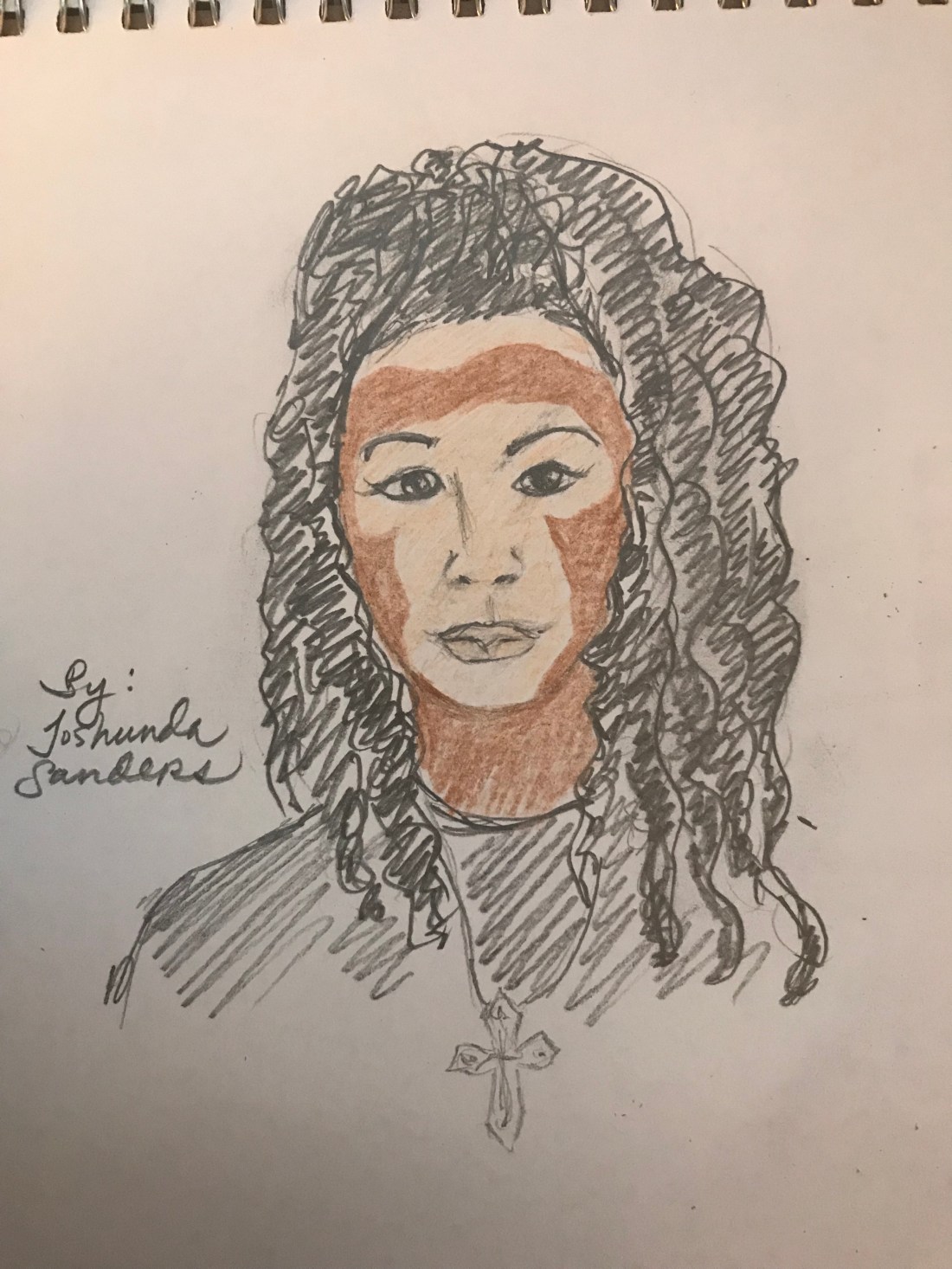


 Joshunda Sanders