Finding Sanctuary & Tribe at Sababa

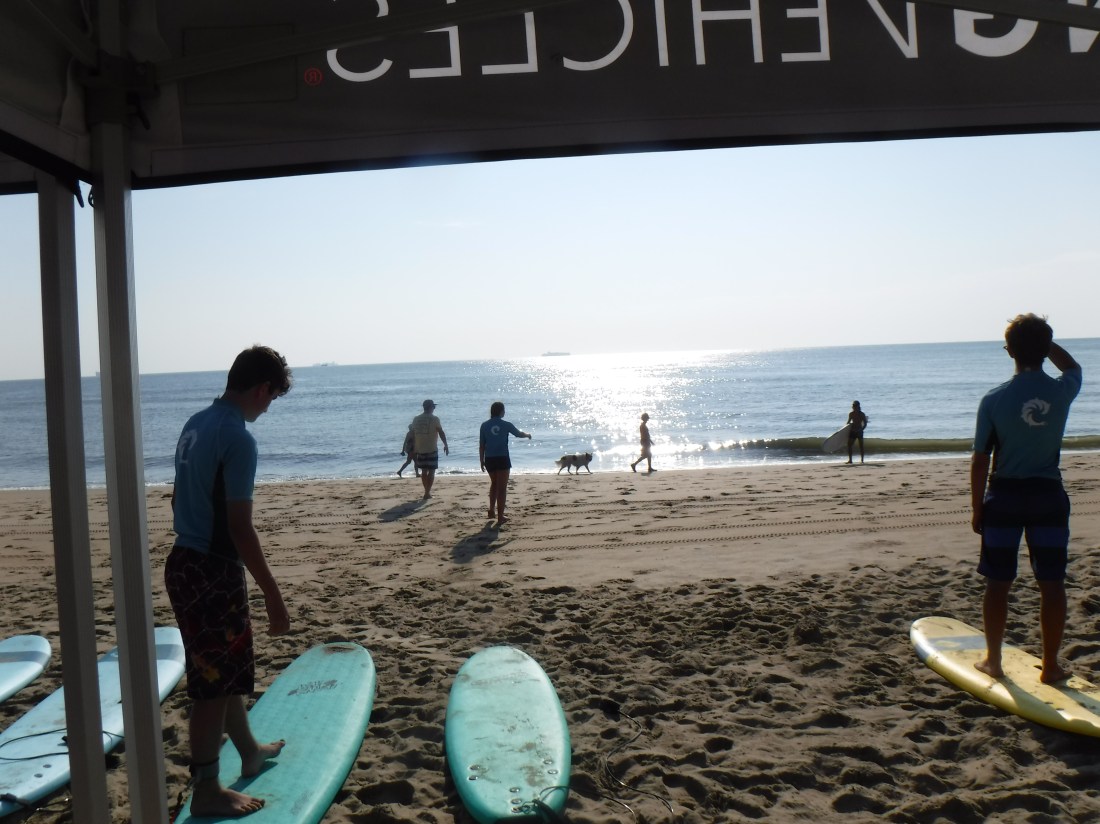
Remember how I said I was having a busy summer, writing all the things? I *was* writing all the things. But I was also revisiting some of the really fun days of my youth by working as Camp Storyteller at Sababa Beachaway in its inaugural season at Old Dominion University. I wrote about it on Medium. I hope you enjoy it. It was a transformative experience to get to witness, and to get to heal a part of myself I didn’t realize was in need of such repair. Here’s a snippet:

Summer camp is, at its heart, an embrace of the best parts of childhood. Your needs are taken care of, even if what you want is another story. Hopefully you make more bonds than you do enemies. You learn things you didn’t know before you showed up, try on a different way of being to see if it matches who you are today, who you want to become tomorrow and maybe after that. You discover the things you never want to try again, usually by failing.

Most everyone around you fails at whatever it is you’re trying differently but in tandem — whether that’s an icebreaker or learning a new skill; You rise and fall and laugh and cry and sleep and lose sleep and get drenched by summer rain and crush hard on one of your camp counselors and write home and make bracelets out of multicolored strings and nothing matters as much as this moment except for the next moment which is so much more fun.

I envy the privilege of being a kid, though I don’t know I was ever afforded the innocence that comes with it, given the body I was born into. Once the innocence is gone, its absence feels permanent, like you can never get it back. Adulthood is the unrelenting weight of knowing, context, responsibility…

(As Camp Storyteller at Sababa) I tried to imagine being a pre-teen or a teenager in the world of today, trying to disconnect from the incessant chatter of the world for even 24 hours straight, then not only learning how to answer the call of the ocean by attempting to surf (I didn’t get a chance to try) but also learning more about how to become more of myself through seeing myself reflected in a community that both saw and affirmed me during this two-week journey.

One of the first items I received and cherished, aside from my trusty waterproof camera, was my Siddur Sababa, which on its cover outlines the Sababa values: To be stoked by fire, propelled by water, nourished by taking only the food that we need and to find balance in the shelter and sanctuary of one another.

Within days of being at Sababa, I felt like I had found some of my people, even as an adult orphan that still struggles sometimes with belonging especially to new groups of people. Before I knew it, the smallest campers — 10 years old and pretty talkative — were among the first to befriend me. (This is a good time to mention that I actually find kids to be the most intimidating, scariest humans of all — they are fragile, they see everything, they know stuff they maybe can’t articulate with big words like adults can, but they break so easily and also they don’t filter anything. They are the bravest, the most honest, the most in need of our protection. They make my nerves so bad because I worry about them more than anything else.)

Each of them offered me presents of found dimes, artful photographs of “big fat fluffy sea birds” (you likely refer to them by their technical names: Seagulls) and an education in competitive ballroom dancing.

I realized just sitting in conversation with them that they were free.

What would it mean, I wondered, to be free most of the time from the perceived, unrelenting social expectation to be perfect? I think for most adults we just assume that’s a wash and we have to be in the game, but for kids, there’s still some hope. Would they not find incredible benefits now, as their identities are still taking shape, and they are deciding who they most want to be in the world, in learning how to disconnect from the endless echo chamber of comparison and social media performance?
DSCF5771


Five Years Since

Dear Mom:

It has been five years since we said goodbye, that word you hate, the one that still gets stuck in my throat.

There are days when it feels like it was last week and days when it feels like a decade has gone by.

This is, usually, a season of joy and reclamation, of hibernation and reflection. I want to forget my loneliness and grief, but in some ways, trying to forget it feels like forgetting you and I can’t.

The number five makes me think of you for so many reasons.

I was five when I was leaving foster care, remember, and you tried to bring me a gift of green plastic jewelry to my pre-school in Philly but the guards took you away because you weren’t allowed to see me because you were the reason I was in foster care on account of the burning me with a straightening comb. They did leave your gift, which I wish I still had, but which time and too many moves took away from me.

When I see five dollar bills, I think of the jubilant look on your face when you would find money on the street – something that has never happened to me once in New York, not ever, not since you were alive.

And I think of the Christmas Day five years ago when I knew it would be the last time I got to hold your hand. My heart breaks for any daughter who survives her mother who has to write a sentence like that, who has to reflect on surviving the person who bore her, who taught her how to live, or who at the very least tried. The trying, itself, is not so easy.

The grief is not so much because I needed you to be my mother, although we all need one. I had given up on that part. I knew it was hard for you, harder than most. It was that I wanted our story to be so much happier. I wanted us to get to the good part together. I did not want to get to the good part alone.

You were so proud of me, of my writing. You modeled shine theory before I knew it would be a thing. You did not talk about an after you were gone and so there’s a way in which I was not ready for that emptiness. It was as if you would keep on living, cheering.

I still view my solitude as a gift. It is the way of an INFJ, an ambivert with a book addiction, enamored of the characters that wake me up and nudge me to my computer or notebook. But it has an edge to it that has lonely, Marguerite-sized craters into which my spirit falls.

Loneliness kills. There is research and data and I have read it, horrified, desperately afraid. Because I am used to having something urgent to worry about, when there is nothing — and there really aren’t that many things like this that come up anymore now that you and Dad are gone —  I worry about the lethal nature of my loneliness. My heavy heart is one that only I carry, being the only child of you and him. It is my unique burden to be missing you in this particular way, without someone to remember with me what it was like to laugh in the midst of our darkness and to cry out in the midst of our shared pain.

Even being the only keeper of our memories has not hardened me, not the way I have wished for over the years, as you can see. I have avoided writing about you now for weeks, if not months, knowing that it would feel like ripping open a wound and pouring salt water into it by the gallons. I was not wrong, but that wasn’t the full truth of the thing.

We spent so many cold winters without in New York City, in the Bronx especially, including that very first one in 1984, when we were mugged crossing a bridge from Harlem to go to the Roberto Clemente shelter. But Mommy, I have more than enough now. Enough space, enough time, enough food, enough warmth.

As alone as I feel in my grief and my missing of you sometimes, I am deeply and widely loved by people who are so gifted and dynamic and sweet. They fill in the gaps. They remind me that you would want deep belly laughs for me in this season and all the others, the laugh you gave me which is one of my most prize inheritances, the one that jolts people awake, that clings to ceilings, that rattles the nerves of those who only know the end of this story, but not the beginning, not the middle, none of the transitions.

This big complex heart of mine receives and mirrors back the joy of those who know what to do with it. I have more than enough, enough to give back, to give away, so that I don’t have to hoard. It is not enough to fill the void of a mother. It is not enough to keep me from crying over missing you. It may never be. Maybe that is the point.

But the gift of missing you is that it helps me to remember that is what the depth of love is. That when someone you cherish, who has shaped you and touched you is gone, you weep because they have had an impact. Sometimes the gift of someone’s love is in the way they reach you where no one ever has and maybe never will.

Merry Christmas. I’m going to be with our beloved family.

Yes, I will tell them you love them.

Better: I will do my best to keep showing them.

Love always,

Your baby girl.

Learning to be Big

I left work completely devastated and in a lot of emotional pain.

I was in a season of severe self-doubt, mired in worry. This was about business, about a professional transition, but it was more than that. I was feeling like I was doing something and I had done something that is all too familiar and damaging to my writing life.

I was in so much pain because I was trying to be small.

As it usually does, it took my best friend’s observation to get me to stop with the ugly crying and chest heaving.

“You are always trying to be small and I don’t understand it,” she said. “But literally nothing about you is small.”

Nothing about me is small.

I have a big laugh, a big smile. I have big feet, a big heart, and a big gift.

This is obvious to so many people, but until now, it has not been at all obvious to me. I don’t take these things for granted as much as I have been so busy thinking of other things that I haven’t allowed myself space to think about this.

My first thought was of Marianne Williamson, because this quote has been a part of my life since I was a teenager. It was my dear friend Portia, when we were pen pals (remember those?) 20 years ago who transcribed it in her remarkably beautiful penmanship in purple ink:

Our deepest fear is not that we are inadequate. Our deepest fear is that we are powerful beyond measure. It is our light, not our darkness that most frightens us. We ask ourselves, Who am I to be brilliant, gorgeous, talented, fabulous? Actually, who are you not to be? You are a child of God. Your playing small does not serve the world. There is nothing enlightened about shrinking so that other people won’t feel insecure around you. We are all meant to shine, as children do. We were born to make manifest the glory of God that is within us. It’s not just in some of us; it’s in everyone. And as we let our own light shine, we unconsciously give other people permission to do the same. As we are liberated from our own fear, our presence automatically liberates others.

These are nice words and I like them and I loved to read them. I read them many times over the years. Each time, I felt the recognition of their truth but I didn’t  own being a child of God. Not really. I talked about it. I wanted desperately to believe it. But I also wanted to hide my lamp under a bushel, even if Scripture is pretty plain about why that’s not a good Standard Operating Procedure.

It is our light, not our darkness that most frightens us. When I was a kid, I was literally smaller. Well, thinner. But I longed to have girth and heft, to be seen, to be a force like my mother, who was physically solid, strong.

The thing about visibility for women, for black women and girls, is that when you are seen, you are also a target. My bookish nerd brain decided, once in the Bronx, where most of us are invisible by default, and again when I entered the workforce, that the best way to keep from being a target of anything was to shrink.

This is where being mildly introverted comes in handy. It allowed me to fold myself and my personality up and tuck it quietly between the pages of a book. This presents to others as a feminine virtue, I think, as modesty and humility. Perhaps I also have some of that, but primarily, this was about survival.

Because God has a sense of humor, my height was always the main inconvenience on this front. Except for the random times when they were lining us up in reverse size order during elementary school — once a year! — I was the last or second to last person in a size order line.

Always visible from the front.

Always subject to someone’s question about my nonexistent basketball-playing ability.

Never ready for the attention.

I think some of this comes from not being used to having things. I wonder if that’s why it has taken so long to accept and to grow into the power of presence that my height has given me or the gift of writing. After all, the natural reaction to being unaccustomed to having things is to give them away.

I gave my power and gifts away in so many ways as a girl and a younger woman that it is impossible to recount them all, and merciless to try. The main reason I wanted to shrink is because of a feeling of deep guilt about succeeding in my life where my mother had failed. She wanted so much for her dreams to come to fruition she repeated them daily until she got sick. She chased them until she decided she was ready to move on to the ultimate dream.

I carried, while Mom was alive, this feeling of both wanting her to have everything that I earned and knowing that I needed to keep what was mine. She had raised me, she had given me this wellspring of compassion and empathy — for all of the difficulty that had come with it. Someone should compensate her for the hard life she had lived, I thought, even though I realized that some of the hard living was her choice.

She said she was jealous and that she wanted me to soar. What I took from those two statements was a rejection of anything I did because she couldn’t have the things she wanted most.

So to believe in my own expansion or expansiveness felt like a betrayal of her. Our mother is the beacon whose every word and action sets our moral and emotional compass. I found myself longing to move out from under my discomfort by undermining and sabotaging myself. Becoming flat. Quiet. Discreet. It seemed there could be only one big woman between us.

I let her be the sun and the sky. I was content to be a shadow, even a few years after her death.

The weird thing about grief is that it can set off in you a series of unconscious reactions. When you lose your footing, when you lose ground, the first thing God sends you is a reminder of what is familiar. You can chose to cling to the blanket or toss it aside for more discomfort in order to grow.

I clung to the blanket. I met people who reminded me so much of my mother; they displayed her ambivalence about how I should be in the world more than anything else. It happened in friendships, new and old, that had run their course for too long. It happened at work and in love, when I was least aware of how my playing small was at the core of so much suffering.

They assured me in one breath that they could nurture me and help me shine. In another, they helped me sabotage myself with manipulation and envy. Even when I was trying so desperately to be small, I was still, apparently, a threat.

It took falling apart in my best friend’s kitchen for me remember myself, to begin to see myself as others see me.

It has always been unfortunately comfortable for me to feel as though my success as a writer has come at the expense and inconvenience of others; That by becoming bigger, becoming my full self, unfolding the fullness of God’s gift to me, I would somehow be stepping on someone else, taking more than I am worthy to have. Being what the world often tells black women we are: Too big for my own britches.

It turns out that I have, in this way, been my own worst enemy. I’m forgiving myself for that, for the fact that I have never really loved myself enough to believe that it is enough to believe in my own expansion.

It is enough to give yourself permission to divest yourself of the opinions and reactions and feelings of others. You can feel and be as limitless as the horizon if you are willing to allow yourself to have all that you are capable of having and become all you are capable of becoming.

I am stepping into the big shoes that have always been mine to fill, at least I am working toward that. Life is too short to settle for a corner, for a side part, a dark shadow. At least, that’s what I’ve been told and it’s what I’ve seen. It is scary but beautiful and necessary to stand in the light or — even better — to become a brighter sun.