
I made this in case it’s soothing or comforting or just a break from the day to day during this time to hear I Can Write the World. Sending you love and wishes for safety and health in this time.
Tag: I Can Write the World
New York Public Library Melrose Branch Visit, February 24th
In case you’re curious how my 2020 is going, this is the kind of story that sums it up nicely.
Last month, a Bronx librarian found I Can Write the World. She loved it so much she wrote a really lovely blog about it. And then she asked if I could come to her library and that’s what I’m doing on February 24th in the afternoon: Letting young people interview me about the somehow adult Bronx girl who now writes things that some people read who only dreamed of this life.
 What Lauren did not know, I don’t think, is how deeply I love the New York Public Library.
I have several distinct memories of growing up and surviving my childhood because of the sanctuaries that are New York Public Library branches. Thank God things were never so hard that our homelessness led us to try to sleep in them, like so many homeless people do. But my mother loved books and paper and knowledge, and libraries, of course, are perfect if you love all of those things. So I viewed them as sacred spaces, just like church and school.
That’s why there’s a big chunk of my short story, “Fly,” that includes a semi-autobiographical chase scene that leads Kelly to safety because the bully who wants to beat her up doesn’t have a library card. I distinctly remember losing library books in multiple evictions, back when the library card was maroon and white, and feeling this overwhelming sense of shame for messing up the whole flow of things. Information and self-edifying knowledge and escape to another world were these free escape hatches and I devoured them as if they were food; a different kind of nurture.
During a class trip when I was in sixth grade, right before the last of a long string of upheavals at home, I’ll never forget my relief when at the end of our visit to the West Farms branch, the librarian looked up at me when I shared my name and she saw the amount of fines. I felt bad because whatever the significant amount was, I definitely would not be able to pay. Those were books, too, that could have helped some else. “Miss, I was homeless, so I couldn’t bring those books back, I’m so sorry,” I said, tearing up. Seeing that I was anxious and afraid, she just smiled this really gentle smile at me and deleted the fines and gave me a brand new library card. I feel like it happened all in one movement like that. Such a small kindness had such a gigantic impact that I still tear up all these years later. And that was in the 1980s!
Often when people say something is an honor, it feels like the right thing to say and the most gracious. But I mean it deeply when I say I’m honored that I’ll get to engage with kids from my hometown in a couple of weeks. It’s a sweet moment and one that is deeply meaningful. And really, truly, an honor.
Also: Next time you see a librarian, thank them for their quiet heroism. They rock.
School Library Connection Author of the Month Interview

I’m delighted to share a Q&A with School Library Connection as its December Author of the Month. I got to share my love of The Bronx, the story behind Ava Murray’s name in the I Can Write the World series and more about faith, solitude and writing across genres. I hope you’ll check it out. You can read the whole thing here, but I’ve included an excerpt below:
I love the way Ava’s mother uses the window frame to explain how journalists “frame” stories. It seems like so much of our news these days is framed to fit a particular narrative, rather than to express the truth. Why do you think this started to happen, and what can be done to fix it?
Thank you; it wasn’t until I had the great honor of sitting on a panel at the 2019 Bologna Children’s Book Fair with Rudine Sims Bishop, whose beautiful description of books as windows preceded Kim’s description in the book, that I thought more about the significance of how we talk to children (or don’t talk to them) about how stories are framed, or shaped.
I think that it’s fairly recent in society—adjacent and aligned with the rise of social media—that everyone sort of considers themselves a journalist. When you think about it, journalists are witnesses, people who report what they see. So in a way, everybody’s right. What everyone doesn’t necessarily have, though, are the ethics that go along with what professional news gatherers have—this inclination to shine a light on injustice and unfairness. Most news reporters get into the business (and it is increasingly considered mainly a business) with the aims of comforting the afflicted and afflicting the comfortable. But I think the reason why news more often resembles propaganda now has to do with a kind of commodification of truth and certainly of news. Integrity or nobility are less emphasized than they used to be because most media moguls are looking for revenue to survive in an environment where no one thinks they need an intermediary for news.
One thing I think all of us could do more of is to consider how powerful our platforms are, whether you think you have one or not. All of us who write, for example, have presences online. How can we use that to help others share their opinions or their stories more mindfully? Sometimes it’s as simple as asking these questions, which I love and did not originate with me: “Does it need to be said? Does it need to be said now? Does it need to be said by me?” The other thing is if we are all journalists, now, it shouldn’t just be when it’s comfortable or cute, but all the time. Ask more difficult questions. Who is the source of this information? Are they lying to me about their objectivity? Why do I believe them? Why should I believe them? When in doubt, find your own credible sources and go with that.
I Can Write the World at ALA 2019
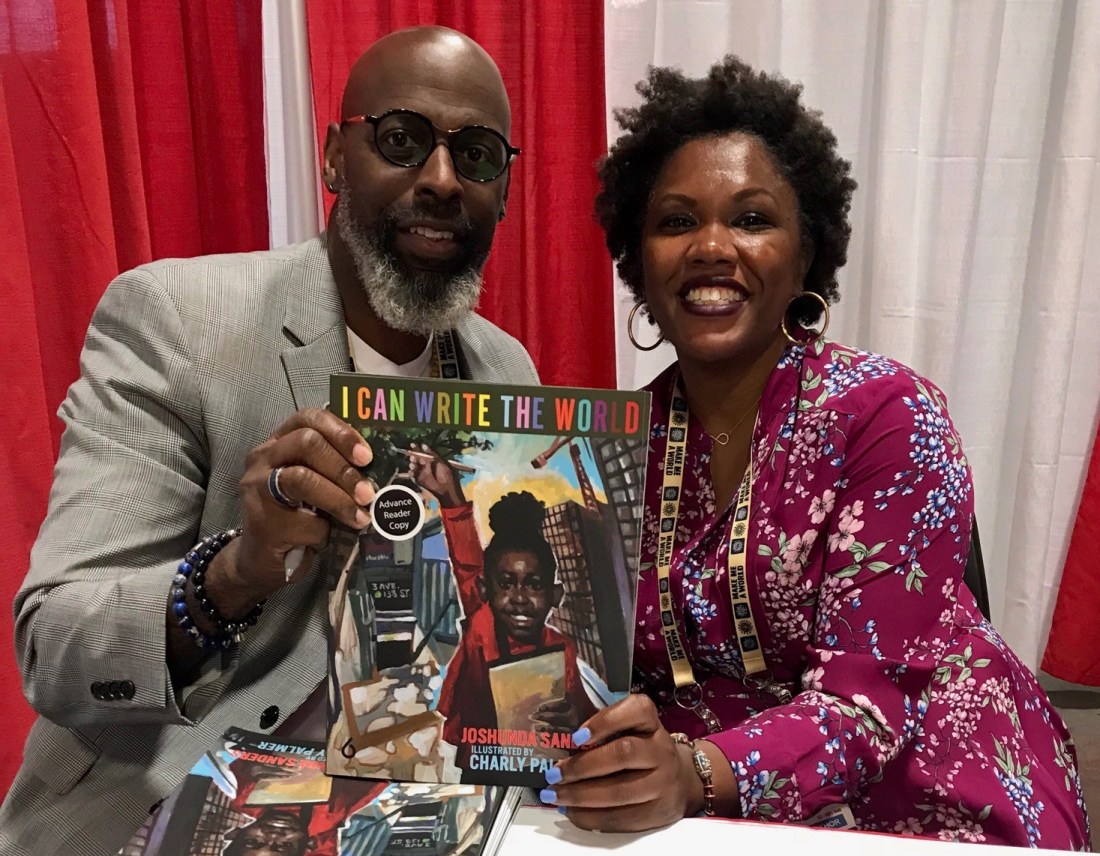

Charly Palmer, the wonderful illustrator for I Can Write the World with me at the Ingram Signing Table

We were out of books within 30 minutes – Librarians are incredible!

Sandra held us down when she volunteered to moderate us – Thank you!

I can’t believe my baby is in the world and being received with such love

Chul R. Kim, Publisher of Six Foot Press, with Charly Palmer

Jamia, my hero, & me & Ava

Alison Miner, my Emma classmate & rock star
I had a whirlwind weekend launching I Can Write the World at the American Library Association Conference in D.C. Librarians, teachers and others were so receptive to the book that I was the first author in my cohorts to run out of books both on Saturday night at a lovely Ingram reception at Spire and on Sunday afternoon after a great panel discussing the importance of representation in Children’s books. I even got to see a former library professor who popped up in the signing line (thanks for coming by, Stan!).
The most common question librarians had is one that most people ask me, which is “What is this book about?” This comes up right after they say, “Wow, the book is so beautiful!” Which makes my heart sing.
The answer is that I Can Write the World is about 8-year old Ava Murray, who lives in the South Bronx. She is named after the brilliant filmmaker Ava DuVernay and the incredible legal scholar, Episcopalian priest & poet Rev. Dr. Pauli Murray, who created the legal precedent known as Jane Crow and, were the world ready for her in her time, might have had a much easier time accepting what we would call her trans identity in this time.
In I Can Write the World, Ava notices the beauty of the Bronx that she knows and loves is at odds with how journalists often depict her world. On the news, a little girl about her age is fined for tagging, which confuses Ava because she sees the colorful murals around her as making the city more beautiful. Her mother, Kim, explains that journalists are like the window frame around their living room window and they shape what we see when we look out of it. Ava decides that she wants to become a journalist so that she can be just like them and shape the world they see.
The first book in the series has Ava exploring more of hip hop culture and how it came to be through a prose poem. I’m honored to say that one of my writing heroines Jacqueline Woodson has called I Can Write the World, “Lovely and timely.” I hope you will find it to be the same. Thank you so much to everyone who has pre-ordered and shared your thoughts with me about the book. I’d be so grateful if you could also write reviews and spread the word. You can find the book on Amazon, Barnes & Noble and several other outlets.
Next stops for I Can Write the World signings are the Children’s Institute (Ci7) & PrideFest on Sunday — which includes a book giveaway for the first 100 kids.
The 2nd Annual Bronx Book Festival is almost here!

I’ve been looking forward to the 2nd Annual Bronx Book Festival now for several months, and I can’t believe June is almost here. VIBE Magazine announced the line up last week & I’ll be speaking on a panel & reading from my new love, I Can Write the World, which publishes June 15th. (Have you pre-ordered? No? You’re in luck because here’s a link…)
- Panel: Publishing Debunked
Time: 11:00 AM – 11:45 AM
Location: Fordham Plaza Main Stage
Panelists: Norma Perez-Hernandez (Assistant Editor at Kensington), Joshunda Sanders (I Can Write The World), Queressa Robinson (Literary Agent at Nelson Literary Agency), Alexis Daria (Take the Lead)
Moderator: Saraciea J. Fennell, founder of The Bronx is Reading
Description: Join editors, agents, and authors from the Bronx as they debunk the publishing industry for Bronxites.
Signing: 11:45 AM – 12:15 PM - Panel: Indie Power Hour
Time: 12:00 PM – 12:45 PM
Location: Fordham Plaza Main Stage
Description: Join three Bronx-based indie authors as they read from their current works. Readers include Joshunda Sanders (I Can Write The World), Josue Caceres (Bronx Stories & Heartbreak), Yajaira Eduardo (If at First You Don’t Succeed)
And it’s special to me that I’ll be there for a dozen reasons, including that just last year I was writing about the significance of the festival for the Village Voice, fellow Vassar alum and Tight author Torrey Maldonado will also be participating & I’m so proud of Saraceia for reinforcing her vision of creating a literary community that thrives in the Bronx. I hope you see you there — organizers ask that you register for this free event at this link.
 Joshunda Sanders