What Black Poets Taught Me

It’s more than halfway through National Poetry Month, which I personally observe in some way every April, and this post, to me, is a little late. What I wrestle with in these times is trying to figure out what to say that is helpful, even when I’m not sure what that is. Trying to make sure that I am not allowing events or bullies to suppress my natural inclination to share, while I am also not adding to the noise.

Here is where I landed, which is where I started with poetry back in the day: I’ve been contemplating what I’ve learned about courage, writing and language from Black poets. And I elaborated on what I posted on Substack with this Medium post:

“…Poetry reminds me that feelings of despair and hopelessness that I sometimes feel are not unique to this time, that beautiful words and unique insights are a common reoccurence.

In the words of Audre Lorde, poetry is not a luxury:

The white fathers told us, I think therefore I am; and the black mothers in each of us-the poet whispers in our dreams, I feel therefore I can be free. Poetry coins the language to express and charter this revolutionary awareness and demand, the implementation of that freedom.

I hope these times find you implementing your freedom in all the ways you see fit. If you are a poetry lover, please share your faves with me in the comments. I made a brief list of some of mine over at Bookshop.

On Belonging

I appreciate being in a period of national relief. There is something so calming, even when the world is still in a shambles, about humane leadership. It allows my creative mind, anyway, room to react to events without trying to problem solve or anticipate the next horrific thing.

One result of that has been more space in my mind to reflect and create. One aspect of my life I’ve been thinking about a lot over the past year has been my connection to The Bronx and why I am so attached to it as a site of my fiction and creative nonfiction, why it is a place that, when I lived far from New York City, pulled me back to it. I think I understand better having written this piece on Medium, but I’m not sure. It may be constantly changing like everything else.

Here’s an excerpt:

It feels like the least a Black woman can expect in the way of belonging and safety in 2021 is to not stand out from the crowd in an era of white nationalist fervor and anger. I want that sentence to mean less in the wake of this historic week but I fear it means more.The safest option, even when the world is quarantining during a pandemic, is to not make oneself more of a target for surveillance or harassment.

In the before times, I found subtle ways of trying to take up less space knowing I would be in a situation, or traveling to a place, where I would be The Only One or One of The Onlies. The stress of living in a cauldron of constant chaos and upheaval is offset by the relief of not having to navigate multiple reactions to my Blackness and my womanhood and their intersection, which seems to be the most intimidating and off-putting fact of my existence of all.

Staying in my lane, or my neighborhood, has become my safety, my insurance. My safety is that I am surrounded by others who more or less expect me to be here. That expectation is reassuring, because when white people are surprised by Black people, the Black people end up dead or in prison. It probably helps that I don’t move that quickly, since there’s a lot of me to move around. Even if I were to be one of those sudden movement types, there is, after all, a police precinct up the street. That said, I am not often made to feel like a suspect in my neighborhood, though I wonder if the Black men in my neighborhood would say the same. I bet even the famous ones would tell a different story.

I wonder: Do you feel like you belong to the place where you live? Why or why not?

On Medium: White Supremacy is an Emergency

Like much of the nation, I am still processing and trying to be productive in the wake of last week’s domestic terrorism. Increasingly, it feels like when there is nothing new to add, there is no reason to post anything here. But I did have thoughts about the urgent threat of white supremacy — that it is, in fact, an emergency — in the same way that I have been pondering how traumatic racism is for all of us. My thoughts are up on Medium today:

Trauma is defined by Merriam-Webster as a disordered psychic or behavioral state resulting from mental or emotional stress or physical injury. It is possible that we cannot reorder the psyches or behaviors of angry, fearful white men who believe their inheritance has been stolen. This is one of the biggest reasons I worry that the rhetoric of hope is not a cure and it will never be. If anything, our insistence on hopefulness only deepens the wound and adds insult to injury. The hope for an equal world displaces white male privilege, which obviously is at the core of preserving white supremacy as a way of life. Hope for equity banishes white men from control and power; it upends the world, because it means imagining a world where white men are not at the center.

A Black History Month Reading List, Part 2

DSC_0015


So you may have already seen my other list of recommendations, but if not, here’s Part I. Part 2 is not meant to be exhaustive or comprehensive, because there are many lists of books about Black history and culture that you can check out for even more recommendations, including the Zora Canon of 100 best books here, this Penguin Random House list of 25 contemporary fiction and nonfiction  or this Electric Literature list of 10 books about Black Appalachia and then there’s Goodreads and Twitter and a dozen other places.

I realized when I was thinking about some of my favorite works of history or of historical significance about Blackness that they were across genres.

For instance, for colored girls who have considered suicide when the rainbow is enuf by Ntozake Shange was actually the second or third book of hers I read. Before that, I was in love with Liliane, Sassafrass, Cypress & Indigo, her poetry collection, The Love Space Demands. But what I loved most about for colored girls — which was recently a sold out production in all of its glory at The Public Theater — was that it showed Black women in our multicultural context. As being in relationship to Latinx, Caribbean and African spiritualities, dreams and aspirations. It showed our love and joy and pain as being Diasporic like a lot of Ms. Shange’s work.

In this way she was definitely a part of the literary tradition of recovering the wholeness of Black womanhood in the way that Zora Neale Hurston did in Their Eyes Were Watching God, one of my favorite novels of all time.

Much has been said about the beauty and timelessness of Their Eyes Were Watching God; to understand more about the life of Zora, however, an essential text is Valerie Boyd’s Wrapped in Rainbows. It is a classic example of the ways Black women’s lives are cherished in unique ways when we have Black women biographers to attend to the beautiful and brutal details of our lives.

Speaking of the unique beauty of having a Black woman author reflecting the details of Black women writers, bell hooks’ work has been foundational in helping me decode and externalize internalized biases that get in the way of my work. This includes everything from Sisters of the Yam, Writing About Race (a book in which I was surprised to find myself cited!!) to one of her most important books to me, Remembered Rapture: The  Writer at Work. I often talk about this book because it was the first time I read a respected black woman author say that no Black woman could write too much; that we are always writing against time because of the illnesses that take us out, because our ancestors were silenced and we don’t have to be and much more.

I have not mentioned one of the most important writers in my development and understanding of the myriad possibilities for Black writers and intellectuals on a global scale yet, James Baldwin, in part because the book by which I was introduced to him is no longer in print. I had the great fortune to pick up a thick book, The Price of the Ticket, a collection of Baldwin’s essays in the early 1990s. Published in 1985, it represents some of his most powerful writing from 1948 to 1985. I read it in seventh grade and kept the book with me, somehow, across a lot of moves to a lot of different places. It reads to me like sacred text, and its beautiful cadences and nuances, the confidence and fear, the anger and disappointment, all elegant and alive, helped me really see America for the country that it is instead of the country I believe most of us want it to be.

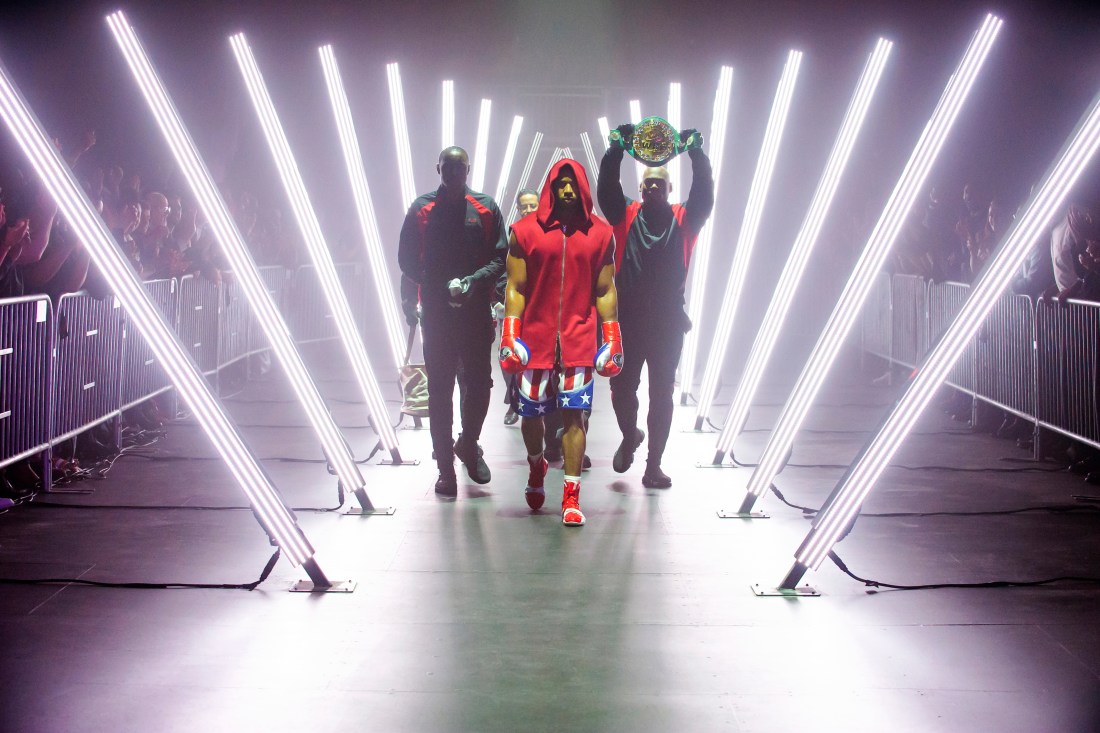
Creed II is not your average boxing flick

I have, finally, written a review that doesn’t have spoilers in it. Whew, that was hard. Sequels are tricky – you want to get the past right but you don’t want to dwell. The pitch and the tone here was perfect.

All of us have some nostalgia for parts of the past that also have painful trauma that keep us stuck in a painful pattern of some sort that it feels like we can’t rewrite. Creed II helps us ask ourselves if we are really fighting to write a new story or if we like the old one better. In this way, it’s deeply satisfying because it evokes memory and tradition while also keeping an eye on the future.

Boxing, after all, is a fight against another person, but before that, it’s a battle with your heart and mind for the soul, for the self to be whole, to be free.

CREED II
Credit: Barry Wetcher / Metro Goldwyn Mayer Pictures / Warner Bros. Pictures © 2018 Metro-Goldwyn-Mayer Pictures Inc. and Warner Bros. Entertainment Inc.

I think I liked “Widows”…

I took myself to a matinee Friday to see “Widows” because I love all things Viola Davis. I was expecting something along the lines of “Oceans 8” but, like, elegant. And “Widows” is something more complex. Not in a bad way. It’s good. It’s just different. Quiet. Intense.

If you’re going to see the movie, I ask that you bookmark my review on Medium and feel free to disagree with me vehemently (but respectfully) there or here. Curious to know what fellow movie lovers think or will say.

5b7c65e38ea82ff5248b474a-960-573

On necessary anger & discomfort

It’s not easy reading, but it needed to be said. On Medium:

What will become of the white women who say they want the world to be better for all of us, but will not gather their white sisters or relatives at the dinner table when they say deeply racist things because they are all bound up in the comforts of the patriarchy that oppresses us all? How will we reconcile the addictive nature of comfort and how comfortable narratives keep us stuck in the lie of solidarity?

Are we willing to be angry with one another in the service of understanding that discomfort might be the thing that saves us?

Audre Lorde also said this back in 1981: “But the strength of women lies in recognizing differences between us as creative, and in standing to those distortions which we inherited without blame, but which are now ours to alter. The angers of women can transform difference through insight into power. For anger between peers births change, not destruction, and the discomfort and sense of loss it often causes is not fatal, but a sign of growth.”

Farewell, Queen Aretha

This summer was the second in a row I got to teach writing with one of my favorite groups on earth, Young Women Empowered. Y-WE Write has educated me about what it means to foster brave space with young people, how to be vulnerable as a creator and writer and teacher, how to find my process through explaining it, which parts of my story are most beneficial to share with this generation of young writers now. It has been held at Whidbey Institute, on Whidbey Island, which is also home to the writer’s residency Hedgebrook. For this reason, the Pacific Northwest has become my healing sanctuary, place where I have been shielded from hard things in recent years.

So it was with a heavy, heaving heart that I peeked at the news to take note of Aretha Franklin dying while I was there. I got there almost two weeks ago Sunday, and spent the full week waking in the morning to some of my favorite songs, trying to articulate what she meant to my life. Before she died that Thursday, one of my students asked a question about how you keep from feeling like so many people are writing about something or someone that anything you write might be inferior — and I could hear their voice in my head as I read and bookmarked long articles and obituaries for Aretha, wondering what, if anything there was left to say.

When I was done showing up for the young women I came there to teach, as we mourned and celebrated Aretha together; after I cried leaving them and they offered me such sweet, adoring words of affirmation and I flew to Newark on a red-eye, landed, drove 2.5 hours to the middle of Pennsylvania for a two-day workshop to discover a really significant shift to my work in progress that will make it soar in a way that I could have never found on my own (Thank you Highlights Foundation!!) drove 2.5 hours back to New York City after being away from home 10 days, attended an all-day faculty orientation the following day that left me with just enough mental energy to finish writing what I needed to, I was able to write this piece about Aretha Franklin and what she means to me, and what I believe she means for Black women, in particular.  It was important to write not because I felt like I needed to write about Aretha because other people were writing about Aretha, but because I wanted to read work about Aretha that centered what I know other Black women would want to read and see lifted up about the Queen of Soul as we prepare for her homegoing.


A review of Black KkKlansman featured on Medium

Happy Summer Friday!

At Cannes Film Festival, Black KkKlansman got something between 7 and 10 standing ovations — the industry magazines literally could not agree on how many times the folks at Cannes broke out in applause between the credits and the end of the movie — and they were well-deserved. If you’ve been reading my work for awhile (thank you! you’re the best!) you know that I’m not a gusher. I don’t do a lot of hyperbole, and I certainly don’t do it in the summer when it’s hot like this and I need to conserve my energy.

But I liked Black KkKlansman so much that I took time away from some other writing to share some thoughts about it because I think it’s important to watch and be in conversation about.

I wrote a review from my notes back in June which is featured on Medium, which is also exciting because I’ve been contributing to Medium for awhile and my work hasn’t been featured on the platform before.

If you’re the kind of person who reads reviews before you see a film, let me know what you think — but I’d be interested in hearing your thoughts anyway, if you see it. (You should also read one of my favorite critics, A.O. Scott, who educated me about that opening shot; I obviously blocked out huge swaths of “Gone With The Wind” but learned a great deal about cross-cutting and “Birth of a Nation” in his review.)

But even if reading reviews isn’t a thing you do, you should see Black KkKlansman because it’s Spike Lee at the height of his potential. Because it’s John David Washington stepping out of his father’s shadow (at least in his own mind and maybe for others who don’t yet know him but certainly will, and he has some exciting additional projects outside of Ballers coming up later this fall) and into his power as a humble but exciting talent to watch as a leading man. It’s also rare for the Black community to have this generation of creatives who have parents and mentors who paved a way for them to take on dynamic roles like this which have nuance and substance.


Finding Sanctuary & Tribe at Sababa

Remember how I said I was having a busy summer, writing all the things? I *was* writing all the things. But I was also revisiting some of the really fun days of my youth by working as Camp Storyteller at Sababa Beachaway in its inaugural season at Old Dominion University. I wrote about it on Medium. I hope you enjoy it. It was a transformative experience to get to witness, and to get to heal a part of myself I didn’t realize was in need of such repair. Here’s a snippet:

Summer camp is, at its heart, an embrace of the best parts of childhood. Your needs are taken care of, even if what you want is another story. Hopefully you make more bonds than you do enemies. You learn things you didn’t know before you showed up, try on a different way of being to see if it matches who you are today, who you want to become tomorrow and maybe after that. You discover the things you never want to try again, usually by failing.

Most everyone around you fails at whatever it is you’re trying differently but in tandem — whether that’s an icebreaker or learning a new skill; You rise and fall and laugh and cry and sleep and lose sleep and get drenched by summer rain and crush hard on one of your camp counselors and write home and make bracelets out of multicolored strings and nothing matters as much as this moment except for the next moment which is so much more fun.

I envy the privilege of being a kid, though I don’t know I was ever afforded the innocence that comes with it, given the body I was born into. Once the innocence is gone, its absence feels permanent, like you can never get it back. Adulthood is the unrelenting weight of knowing, context, responsibility…

(As Camp Storyteller at Sababa) I tried to imagine being a pre-teen or a teenager in the world of today, trying to disconnect from the incessant chatter of the world for even 24 hours straight, then not only learning how to answer the call of the ocean by attempting to surf (I didn’t get a chance to try) but also learning more about how to become more of myself through seeing myself reflected in a community that both saw and affirmed me during this two-week journey.

One of the first items I received and cherished, aside from my trusty waterproof camera, was my Siddur Sababa, which on its cover outlines the Sababa values: To be stoked by fire, propelled by water, nourished by taking only the food that we need and to find balance in the shelter and sanctuary of one another.

Within days of being at Sababa, I felt like I had found some of my people, even as an adult orphan that still struggles sometimes with belonging especially to new groups of people. Before I knew it, the smallest campers — 10 years old and pretty talkative — were among the first to befriend me. (This is a good time to mention that I actually find kids to be the most intimidating, scariest humans of all — they are fragile, they see everything, they know stuff they maybe can’t articulate with big words like adults can, but they break so easily and also they don’t filter anything. They are the bravest, the most honest, the most in need of our protection. They make my nerves so bad because I worry about them more than anything else.)

Each of them offered me presents of found dimes, artful photographs of “big fat fluffy sea birds” (you likely refer to them by their technical names: Seagulls) and an education in competitive ballroom dancing.

I realized just sitting in conversation with them that they were free.

What would it mean, I wondered, to be free most of the time from the perceived, unrelenting social expectation to be perfect? I think for most adults we just assume that’s a wash and we have to be in the game, but for kids, there’s still some hope. Would they not find incredible benefits now, as their identities are still taking shape, and they are deciding who they most want to be in the world, in learning how to disconnect from the endless echo chamber of comparison and social media performance?

DSCF5771