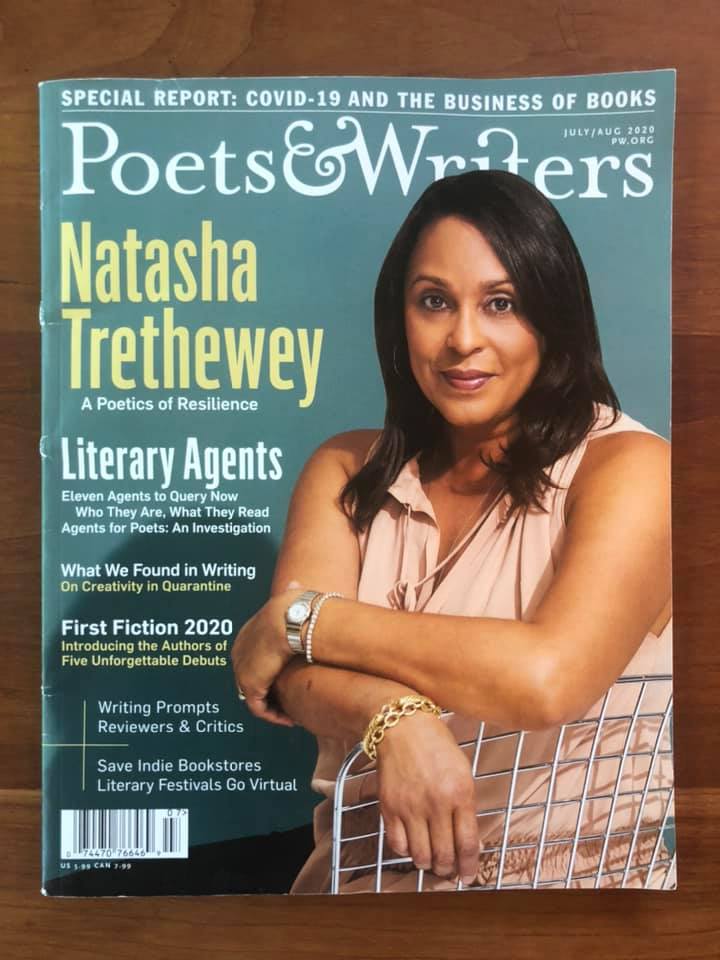
My Poets & Writers Cover on Natasha Trethewey

102965712_10222202564280423_8955403904693343719_n


I’m so excited about this cover story I wrote about Natasha Trethewey for the July/August 2020 issue of Poets & Writers, which is only available in print but you can order your copy here (better yet subscribe!)

I feel like I have been wanting to post about it since I got the assignment months ago, so now I’m bursting with joy and excitement. I wanted to just share some more about the wonder of Black creatives, the lessons we have across timelines & movements.

I thought when I read Memorial Drive that what magnetized me to Natasha Trethewey’s work was our common mother loss, but no, it was so much deeper than that. I loved and still do her resilience, her strength, her vulnerability and her focused ability to transmute pain into real, lasting beauty and triumph.

In our interview, I was honored that she trusted me so much to hold space for so much of her journey. She talked about going up to read her work and people introducing the life-shaping story of her mother’s death “with the word murder hanging in the air,” so her memoir was an opportunity to re-contextualize the life of her mother, the social worker and self-advocate who did not live because we have no way of really protecting victims of intimate partner violence and what a failure that is.

There’s so much more and I hope you will read the print issue. Here is more, another part that stays with me: “They have a saying in South Korea that you don’t bury a mother in the ground; you bury her in the chest, or you carry her corpse on your back…As much as I carry her corpse around, I have also planted my living mother in my chest, and she grows there continuously. I have both, two mothers.” May that offer some kind of comfort and/or recognition to all of us as we mourn not just our mothers, but Black daughters like Breonna Taylor & the many others whose names we can’t forget to keep saying.

Stolen Youth

JoshundaSandersasaChildcirca1984
Me as a little girl, sometime in the 1980s

June 25th should be Tamir Rice’s birthday, but he was killed in 2014 by police officers who thought he was grown, they said. I have read accounts that say the call to 911 was from someone who said she thought she saw an adult. He was 12.

Tamir’s mother held a Sweet Sixteen party for what would have been the beginning of his rite of passage into his becoming a young man. Black mothers, especially, have had to learn how to transform the dehumanizing separation of us from our children — permanently or temporarily —  into something less tragic for a long time.

Had Tamir survived, like Antwon Rose, like so many other of our children whose youth is taken from them, he would have had to battle for the rest of his life to overcome what health experts call Adverse Childhood Experiences (ACES) or the kind of trauma that some children survive that shows up in mental and physical health problems that can last for the rest of their lives.

This heartbreaking story about a father separated from his 6-year-old daughter evoked in me the memory of being taken from my mother in the same way that Tamir’s death and the death of young black people often has. In my case, it was foster care, and probably necessary, because of neglect.

I was 5 when I was sent on a year-long journey through the homes of strangers in the Philly area. Around 6 years old when I was returned to her and we arrived in New York. I don’t remember much of that year, in part because I was young. I know that there are formative things that children learn from their parents that I did not — how to ride a bike, brushing my teeth twice a day, eating the right kind of foods in the right amounts — that year. I remember feeling as if the entire world was unsafe from the moment I was taken from my mother’s home and placed in a strange environment without any understanding of when — or if —  I could return.

I don’t think it’s the kind of thing you ever really recover from. It took me many years of therapy and incredible friends and faith to get even close to healing and I’m not all the way there.

No matter what happens now, the hundreds of children who were stolen from their parents have had their lives irreparably changed to prove one man’s political point.


But just like it’s a privilege to grow old and to grow up, it’s also a privilege to have the humanity extended to you to be allowed to be a child. When the humanity of children is recognized, we protect them. We show them that the world is safe for them to grow in, that we will give them room to be and flourish, that they will not have to live in spite of their wounds, they will not have to begin their lives by overcoming the traumas of their beginnings.

The hardest stretch of time, after all, is between when we are young and when we find out who we are supposed to become, if we ever get a chance to get to the latter or if we ever get to be the former.


The Story of Our Talent for Survival

I remember exactly when I learned that reading in the hood is a revolutionary act.

It was at the heavy hands of Michelle, the largest sixth grader I’d ever seen, who was one of the Bronx girls around the way who liked to chase me to deliver a beat down as punishment for not letting her cheat off of my spelling test.

Reading was dangerous because it sent a signal to hood residents that you did not intend to stay, even if they were not considering a way out. Books seemed to suggest that even if your body was stuck in tenements or housing projects or welfare hotels, your mind was on the path to freedom.

That’s why I became a professional reader long before I was a writer. Books gave me hope when I was living in homeless shelters, subsidized housing, and welfare hotels with my mother in New York City. They helped me shape a future for myself that was beyond the limits of poverty, neglect and my mother’s mental illness.

Most of the middle class and affluent black folks I would come to know in the future would wince and give me a look I couldn’t read when I would tell the story that I outline in my new memoir, The Beautiful Darkness: A Handbook for Orphans. Even the presence of the elegant, poised, brilliant President and First Family does not negate the long shadow of prevalent biases about all black people as subject to abject poverty and dysfunction. But that was the real life that I led, even if it wasn’t particularly attractive.

I read to cope. I found solace at the library. Especially from Michelle, because you couldn’t get in the West Farms public library branch without a library card and she definitely didn’t have one.

I inhaled whatever was in the new book section. Self-help books, like How to Have Better Self-Esteem, because I hated myself. Because as a third or fourth grader in and out of public schools in each of the five boroughs because my bipolar mother was not medicated and couldn’t keep a job, I felt like a burden. In Search of Our Mothers Gardens and Zami: A New Spelling of My Name and for colored girls who have considered suicide when the rainbow is enuf fed my spirit. Resting my mind in black girl poetry and prose gave me hope when my mother’s manic episodes or neglect threatened to erase the slight will to live that I hung on to.

I had not grown up in a big family, it was just me and mom. And my mom had been broken by life long before me. Her own mother had died when she was a teenager in a mental institution. She went on to have five children but I was born only came after Jose was killed by a city bus when he was 12 years old — a turning point in her life that I believe triggered the worst parts of her bipolar and borderline personality illnesses.

Reading was my main connection to the world, the only thing that I believed and felt connected me to an invisible community of other homeless children, other aspiring writers, dreamers, black girls, the poor who wanted to be anything but. So I got beat at home for no reason other than my mother’s mania, and I was bullied at school for trying to find safe haven in the pages of books. While I grew up with my mother and she did her best to care for me, I was an orphan in the sense that I mothered myself and sometimes tried as a kid to mother my mother. That is obviously not the work of a child, but I did try. The main plague of my childhood in all of its adversities was loneliness, isolation.

I wrote The Beautiful Darkness to save others from their loneliness. To offer empathy and community to those who know what it is like to live with anything like a broken black family and are resilient in the face of it regardless. We have often heard the stories of black women struggling with poverty and adversities with their children through journalists and sociologists who do outstanding work. Rarely do we hear directly from survivors.

Maybe like me, they feel the weight of stereotypes and stigma pressing them away from the page. Maybe they think no one will want to hear their story or will buy their book, or it will not resonate because they have already read something similar — all variations of what I have heard. But here is the dream I hope becomes real. Maybe, just maybe, a little black girl who is between homes with her mom who struggles with depression will be searching for a roadmap for herself way from despair on a library bookshelf somewhere.

This book is for her.