Lane Moore’s How to Be Alone

“Your commitment to survival is more than a notion; it’s a balm, an affirmation, an eternal love note, and a sacred love manifestation that starts as a whisper and rises into the atmosphere. How to be Alone gave me closure. What a gift it is to know that there’s another person in the world who’s so brave and true to her spirit that she survived the hardest parts of being alive. Instead of sinking into despair or madness; being waylaid by bitterness or tragedy; or turning the grueling and terrifying dark of isolation against yourself, you’ve transmuted it into a fire so bright that it blazes brilliantly, with a classic, universal humanity. James Baldwin said, “You think your heartbreak is unprecedented in the world, and then you read.” How To Be Alone is like that.”

— In which I write a very vulnerable open letter-review for Bitch Media to the beautiful bad ass Lane Moore, whose tremendous and lovely book, How To Be Alone, really helped me sort some things out in the best, most heartbreaking way. Shout out to those of you who remember my Single & Happy blog & eBook days. Feels like a lifetime ago now.

P.S. New Yorkers: Lane will be in convo with the HQ host (!!) at The Strand tonight at 7 p.m.

how-to-be-alone-9781501178832_hr.jpg

Three Ways to Help Alleviate Hunger

I do a lot of talking to my students and others these days about the importance of being specific in writing and in life. One of the things that’s hardest for me to be specific about, both in terms of cultivating self-compassion around the trauma it brings up to write about it, but also the ways that our society stigmatizes black female experiences of poverty, is hunger — in the physical sense, but also in the emotional and mental sense.

I always say that fall is my favorite season. I love the delicious feeling of the air cooling in New York City, the way the leaves transform from green to marigold. I break out my new boots, my favorite sweaters & my best turkey chili slow-cooker recipe.

But autumn also brings a familiar, old ache in my body, somewhere between my heart and my stomach. My heart longs for what I imagine families or couples or people who belong to broader fabrics are preparing for, but that’s not the whole story of this ache.

Some of the story is that Thanksgiving calls to mind my great-grandmother Patty Randolph, who was Cherokee in South Carolina long before I was even an idea in anyone’s concept of the future, though I’m not certain if she was listed on anybody’s official tribal rolls because of our connection to blackness. (It is, apparently, another inheritance of mine to be a perpetual outsider and I may forever belong to the tribe of misfits.)

Nevertheless, I’m grateful to have inherited her high cheekbones and the scarlet blood that runs hot right beneath the undertones of my skin. I carry her imprint on my face, in my eyes, in my flesh, the same way my mother did.

What I know, what I have learned is that Native Americans have a different view of what harvest looks like, of what the Thanksgiving meal looks like, or should. Still, tradition and ritual are the arms we wrap around the narratives we prefer to inform our legacies in the world. Put another way, at the end of my life, I imagine I’ll look back on moments and highlights and collect the holidays at tables with chosen and/or biological family as those defining moments in which I became more whole. When I found another part of myself that fell away from me when I was young.

To say these parts fell away, too, is a bit passive, even; but to say they were stripped is too harsh. Like I said, the specificity of it is hard.

It’s one thing to tell people that when you were a child you sometimes didn’t eat for days, or that you were homeless sometimes, but what I’ve found is that you can never really explain to another person what it means not to be able to eat three meals a day because there just isn’t food in the house. It’s one thing to say that the UN estimates that 820 million people in the world suffer from chronic undernourishment.

It’s another to explain that if you live at a shelter as a kid with your single mom, you eat when meal times are. If you miss the meal times because the train was late or your mom’s appointment with her social worker ran later than she expected, you might just have juice because meal time is now over. Also, meal time can mean a cold sandwich on a cold day andan ice cold drink.

James Baldwin said it was expensive to be poor. This is what he meant.

I experienced hunger like this: drinking water and sleeping and listening to music and reading books to quiet my thoughts and fantasies and longing for food, wondering about when the next food pantry day would be at the nearest church. Those were the days, between checks or public assistance or money Western Union-ed from my brother, that made the real difference.

Beggars, they say, couldn’t be choosers. I was always grateful, truly. Thankful.

When other people donated food, though, we got whatever was second or third best – canned creamed corn, or canned peaches, or green beans. Mixed vegetables. Canned pork in a silver can with a pig drawn crudely on it. Corn Flakes. It was not for us. It was for some hungry desperate family of two and we happened to be the receptacles, like garbage, which is exactly how I felt for many years.

I can’t even tell you how often I was hungry in this desperate way as a kid – probably two, three times a month from the timeI was five until I went to boarding school on scholarship when I was 15. If we didn’t have money to travel to see our family for Thanksgiving, we went to a Catholic church, a soup kitchen, a Salvation Army with people who only had it slightly worse than we did, since sometimes we were actually living in an apartment when we had our Thanksgiving meals with other homeless people – but sometimes we didn’t.

I mention all of this because the reason I’m a proud member of the Junior Board at the New York Common Pantry is not necessarily because I like the way it sounds, or because I am affluent enough to remain on the board without stressing out a little bit about it, honestly. I volunteer and evangelize onbehalf of the New York Common Pantry because hunger and poverty are like so many other problems in our world — it’s much easier to see and talk in generic terms about what other people should be doing on other continents. But here, in the U.S., in your state, perhaps in your very building, on your block, maybe in your family, there may be someone who can’t afford to buy groceries for Thanksgiving. Maybe there’s a single mom with a little girl nerd like yours truly, and they are living a story just like mine, but they are too proud, too ashamed, too close to the ache to say anything.

The best thing about growing into a different narrative, or many different narratives, is that I can write my story in the service of action. I can do my small part to make sure others don’t go hungry. if you’re reading this, the same is true for you. If it is, here are some ways you can help alleviate food insecurity for some of the 1.4 million New Yorkers who rely on emergency food assistance every year:

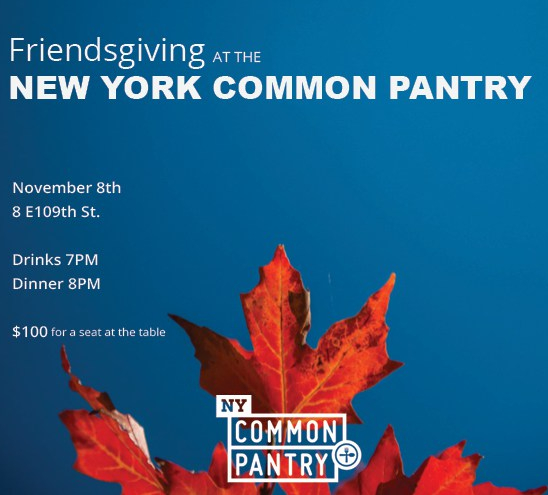
  • The Junior Board is holding its third annual fundraiser, Friendsgiving, on November 8th. Tickets are $100 for a meal at the New York Common Pantry headquarters.
nycp invite 0918_3

  • You can also enter to win baskets that include high quality experiences like tickets to performances at Carnegie Hall or the One World Observatory or Gospel Brunch at RedRooster. (Thank you very much to the generous sponsors/donors who have donated to us, especially the ones who responded to my awkward emails — I hate asking for money but I will definitely do it if it means more people have food in the city I love, so thank you for bearing with meand even more important, thank you for your generosity!) Whether you want to attend the dinner (it will be delish!) or just want to give a donation, please list my name in the “In honor of” section: https://ycp.ejoinme.org/MyPages/JuniorBoardFriendsgiving2018/tabid/1003286/Default.aspx
  • From now through November 9th, the New York Common Pantry is hosting a food drive. You can shop and send food items to the New York Common Pantry that are most needed directly online from this link: https://yougivegoods.com/shop?drive=7972
  • You can arrange to have items from your company or organization’s food drive picked up by November 14th by filling out the Google Link here: http://nycommonpantry.org/2018-thanksgiving-food-drive/

Finally, if you will be in New York this Thanksgiving, or if you have been in the past, and you know of valuable ways to commemorate the third (?) Thursday in November, I’d love to hear them. I’d love to volunteer on Thanksgiving morning or make a new tradition — possibly involving my slow cooker to serve others — but maybe something else I haven’t yet imagined.

Finding Sanctuary & Tribe at Sababa

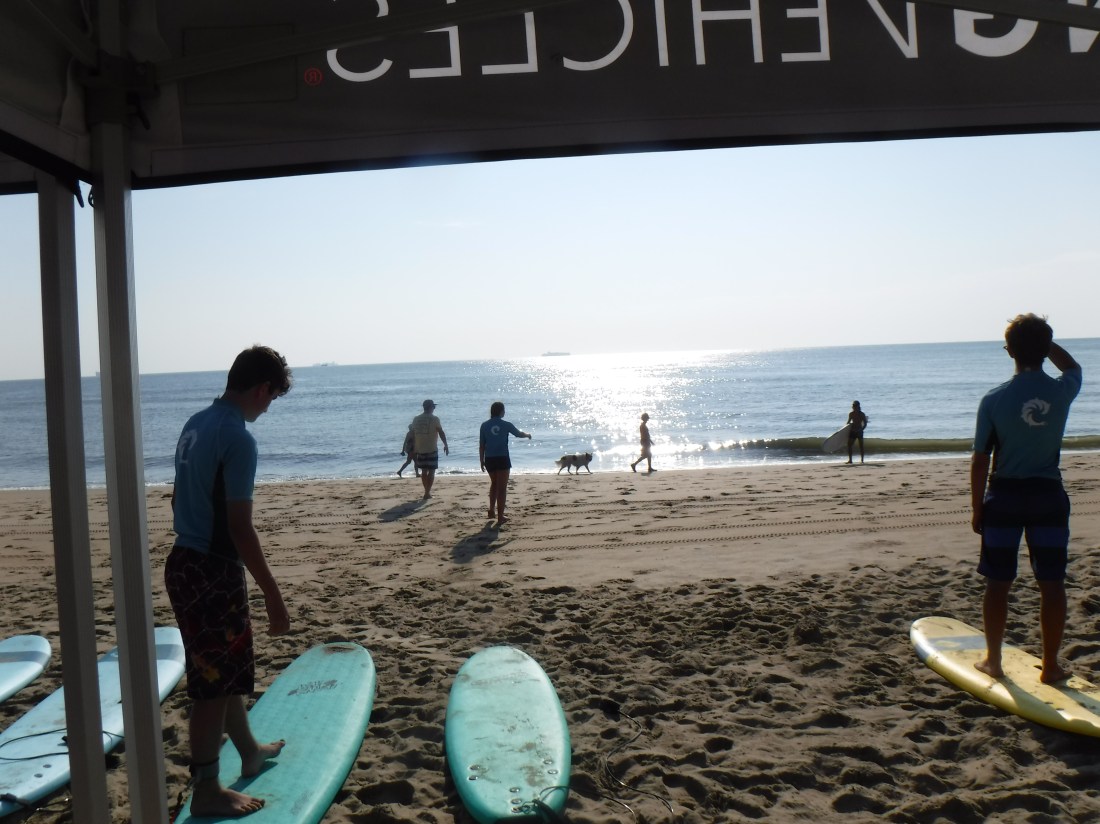
Remember how I said I was having a busy summer, writing all the things? I *was* writing all the things. But I was also revisiting some of the really fun days of my youth by working as Camp Storyteller at Sababa Beachaway in its inaugural season at Old Dominion University. I wrote about it on Medium. I hope you enjoy it. It was a transformative experience to get to witness, and to get to heal a part of myself I didn’t realize was in need of such repair. Here’s a snippet:

Summer camp is, at its heart, an embrace of the best parts of childhood. Your needs are taken care of, even if what you want is another story. Hopefully you make more bonds than you do enemies. You learn things you didn’t know before you showed up, try on a different way of being to see if it matches who you are today, who you want to become tomorrow and maybe after that. You discover the things you never want to try again, usually by failing.

Most everyone around you fails at whatever it is you’re trying differently but in tandem — whether that’s an icebreaker or learning a new skill; You rise and fall and laugh and cry and sleep and lose sleep and get drenched by summer rain and crush hard on one of your camp counselors and write home and make bracelets out of multicolored strings and nothing matters as much as this moment except for the next moment which is so much more fun.

I envy the privilege of being a kid, though I don’t know I was ever afforded the innocence that comes with it, given the body I was born into. Once the innocence is gone, its absence feels permanent, like you can never get it back. Adulthood is the unrelenting weight of knowing, context, responsibility…

(As Camp Storyteller at Sababa) I tried to imagine being a pre-teen or a teenager in the world of today, trying to disconnect from the incessant chatter of the world for even 24 hours straight, then not only learning how to answer the call of the ocean by attempting to surf (I didn’t get a chance to try) but also learning more about how to become more of myself through seeing myself reflected in a community that both saw and affirmed me during this two-week journey.

One of the first items I received and cherished, aside from my trusty waterproof camera, was my Siddur Sababa, which on its cover outlines the Sababa values: To be stoked by fire, propelled by water, nourished by taking only the food that we need and to find balance in the shelter and sanctuary of one another.

Within days of being at Sababa, I felt like I had found some of my people, even as an adult orphan that still struggles sometimes with belonging especially to new groups of people. Before I knew it, the smallest campers — 10 years old and pretty talkative — were among the first to befriend me. (This is a good time to mention that I actually find kids to be the most intimidating, scariest humans of all — they are fragile, they see everything, they know stuff they maybe can’t articulate with big words like adults can, but they break so easily and also they don’t filter anything. They are the bravest, the most honest, the most in need of our protection. They make my nerves so bad because I worry about them more than anything else.)

Each of them offered me presents of found dimes, artful photographs of “big fat fluffy sea birds” (you likely refer to them by their technical names: Seagulls) and an education in competitive ballroom dancing.

I realized just sitting in conversation with them that they were free.

What would it mean, I wondered, to be free most of the time from the perceived, unrelenting social expectation to be perfect? I think for most adults we just assume that’s a wash and we have to be in the game, but for kids, there’s still some hope. Would they not find incredible benefits now, as their identities are still taking shape, and they are deciding who they most want to be in the world, in learning how to disconnect from the endless echo chamber of comparison and social media performance?

DSCF5771


On Rest in Power: The Trayvon Martin Story & Memoirs on the Movement for Black Lives

I’ve been reading some of the beautiful and important memoirs of the Movement for Black Lives that are forthcoming from Black feminists like Barbara Ransby & Charlene Carruthers as well as screening Rest in Power: The Trayvon Martin story, which begins airing tonight on the Paramount Network, since the end of June. I wrote about the docuseries, as well as the books, for the Village Voice:

“They say that time heals all wounds. It does not,” observes Sybrina Fulton, Trayvon Martin’s mother, in Rest in Power: The Trayvon Martin Story. “Had the tragedy not been so public, I probably would have taken more time to grieve, but I wasn’t given that type of privilege.”

The six-part documentary series, produced by Jay-Z and the Cinemart, begins and ends as it should, with the murdered seventeen-year-old’s parents. Over the course of subsequent episodes, the audience hears a series of 911 calls from Martin’s killer, George Zimmerman, the aspiring police officer who became neighborhood watch captain in his previously exclusive gated community in part to live out a racist vigilante fantasy.

Rest in Power establishes a pattern of behavior from Zimmerman: He calls the cops so frequently on Black children who moved to his neighborhood after the 2008 economic crisis that dispatchers know his voice and refer to him by his first name.  Yet, as the series documents, it still took more than forty days, not to mention the intervention of media-savvy civil rights attorney Benjamin Crump, for Zimmerman to be arrested and charged with Martin’s fatal shooting, and to get the killing reported in context by the media.

Martin’s death was the first real major convergence of race and policing in President Barack Obama’s presidency after the euphoria of post-racial liberalism had worn off. In Rest in Power, we see Obama graying at a rapid pace, weary, saying that if he had a son, his son “would look like Trayvon.” He doubles down and says that, put another way, he could have been Trayvon Martin when he was younger. As author Mychal Denzel Smith puts it in an interview, it becomes clear that there will always be more Trayvon Martins than Barack Obamas.

Rest in Power captures this monumental moment in American resistance with moving detail, showing scenes from protests around the country. And forthcoming soon are some additional invaluable histories of this period that provide a broader picture of the modern articulation of Black protest and mobilization in response to racist and vigilante violence.

These books are particularly remarkable because all too often, the narratives of resistance that do exist are positioned as though cisgender heterosexual men have always been at the forefront. As these works demonstrate, Black women have been the unsung architects of many of these protest movements — and they have only recently started to get their due.

Indeed, as we see the signs of hate rising all around us today, it becomes clear that Black women tried to warn us. Khan-Cullors notes this in When They Call You a Terrorist, writing on how she and her co-founders of Black Lives Matter as a movement were nearly erased from early reporting: “Despite it being a part of the historical record that it is always women who do the work, even as men get the praise — it takes a long time for us to occur to most reporters in the mainstream. Living in patriarchy means that the default inclination is to center men and their voices, not women and their work.”

That is true both for how she situates the BLM founders in relation to Martin’s case and for how she writes about the uprising in Ferguson, Missouri, after unarmed teen Michael Brown’s shooting by police officer Darren Wilson. In a chapter dedicated to activism in Ferguson, Ransby profiles Black feminist organizers, including Darnell Moore, Kayla Reed, Brittany Ferrell, Alexis Templeton, and Jamala Rogers.

“When I suggest that the movement is a Black feminist-led movement, I am not asserting that there was no opposition and contestation over leadership, or that everyone involved subscribed to feminist views,” Ransby writes. “Nevertheless, when we listen carefully, we realize that the most coherent, consistent, and resolute political voices to emerge over the years since 2012 have been Black feminist voices, or Black feminist-influenced voices.”

When your greatest shame is also what makes you free

The spring before I left the Bronx to go to boarding school, to accept a scholarship that would change the entire trajectory of my life, I had an abortion. I was 15.

I was raised a devout Catholic; I’ve always been a deeply spiritual person. But I also had been so desperately lonely for such a long time. My high school boyfriend was a dumb ass and so was I. But he was lonely, too, in a different way. Poverty, violence, rage: They make you want the instant gratification it seems that sex can provide when you’re young.

I got pregnant not long after my mother had a manic episode during which she threatened to kill me. I’d run away from home to my best friend’s apartment in the projects as a temporary solution, to gather my thoughts. That was the weekend, when I was 14, that I first had sex. Looking for safety, a home, somewhere, with someone.

I had been keeping a journal daily for at least six months up to that point. When I told social workers I’d applied to boarding school, that I didn’t want to go home because it wasn’t safe, but I just needed a few more months to figure something out, they told me I could go to a group home, but it was unlikely that I could go to boarding school from any group home.

Reluctantly, I returned home. When she tried to hit me again, I held her wrists. “The next time you hit me, I will hit you back.”

It was a small win compared to what came next, which was that she found my journal, which, because I was an idiot, detailed how ambivalent I was about a future I didn’t know I could believe in. On one hand, I believed that if I had a baby, my boyfriend would always have to love me, and it would mean on some level that at least two people — he and the child — would have to love me. Right?

On the other, I have never wanted to be a mother. I have seen what this world does to Black babies. I am named for one who was killed at 12. A day does not pass when one is not harassed, though these days, it feels lucky that they are not murdered.

My mother’s discovery of my journal triggered our visit to Planned Parenthood, where she recited her rosary, loudly, while we waited to see the doctor. This was, for the doctors, a red flag, that she would be so bold. They saw us separately — in retrospect, I don’t know if this was legal or not. Is it safe, they wondered, to tell her that you’re pregnant?

“Absolutely not,” I said, shaking my head.

When they called her in, they lied to her. I lied to her on the day that I went to have the abortion with one of my Catholic school classmates. I have never cried so much or so hard in my life as I did as I mourned my deepest shame.

By then, the packet of summer reading for my first year at the new elite school had arrived in the mail. I had stopped writing things down. I was going to read my way to my future.

Continue reading “When your greatest shame is also what makes you free”

Stolen Youth

JoshundaSandersasaChildcirca1984
Me as a little girl, sometime in the 1980s

June 25th should be Tamir Rice’s birthday, but he was killed in 2014 by police officers who thought he was grown, they said. I have read accounts that say the call to 911 was from someone who said she thought she saw an adult. He was 12.

Tamir’s mother held a Sweet Sixteen party for what would have been the beginning of his rite of passage into his becoming a young man. Black mothers, especially, have had to learn how to transform the dehumanizing separation of us from our children — permanently or temporarily —  into something less tragic for a long time.

Had Tamir survived, like Antwon Rose, like so many other of our children whose youth is taken from them, he would have had to battle for the rest of his life to overcome what health experts call Adverse Childhood Experiences (ACES) or the kind of trauma that some children survive that shows up in mental and physical health problems that can last for the rest of their lives.

This heartbreaking story about a father separated from his 6-year-old daughter evoked in me the memory of being taken from my mother in the same way that Tamir’s death and the death of young black people often has. In my case, it was foster care, and probably necessary, because of neglect.

I was 5 when I was sent on a year-long journey through the homes of strangers in the Philly area. Around 6 years old when I was returned to her and we arrived in New York. I don’t remember much of that year, in part because I was young. I know that there are formative things that children learn from their parents that I did not — how to ride a bike, brushing my teeth twice a day, eating the right kind of foods in the right amounts — that year. I remember feeling as if the entire world was unsafe from the moment I was taken from my mother’s home and placed in a strange environment without any understanding of when — or if —  I could return.

I don’t think it’s the kind of thing you ever really recover from. It took me many years of therapy and incredible friends and faith to get even close to healing and I’m not all the way there.

No matter what happens now, the hundreds of children who were stolen from their parents have had their lives irreparably changed to prove one man’s political point.


But just like it’s a privilege to grow old and to grow up, it’s also a privilege to have the humanity extended to you to be allowed to be a child. When the humanity of children is recognized, we protect them. We show them that the world is safe for them to grow in, that we will give them room to be and flourish, that they will not have to live in spite of their wounds, they will not have to begin their lives by overcoming the traumas of their beginnings.

The hardest stretch of time, after all, is between when we are young and when we find out who we are supposed to become, if we ever get a chance to get to the latter or if we ever get to be the former.


Coping with Father’s Day as a Suicide Survivor in 2018

I self-published my memoir The Beautiful Darkness: A Handbook for Orphans in October 2016 after spending more than 20 years working on one version of the story or another. The book’s name comes from two sources.

The concept of being an orphan, particular in the Black community, may seem jarring. We are, after all, known for taking care of one another even when we’re messy.

But even before my parents died – my father by suicide in 2010, my mother from cervical cancer in 2012 – I had been orphaned by them in many ways, largely because of untreated mental illness.

In Mira Bartok’s The Memory Palace, she wrote:

The Sami call the period from mid-November to mid-January the Dark Time, or Skabma Dalvi — the Beautiful Darkness. Most of the day, the sky is a deep indigo blue, even in the morning. It is so hard to know when to wake up, when to work, when to eat a meal.

The phrase the Beautiful Darkness stayed with me for a number of reasons: I’m a winter baby; I prefer cold weather to warm; I last saw my mother alive and forgave her for our hard times together during this time and it was the season in which she also made her transition.

The Beautiful Darkness, for me, is also a way of thinking about grief that has been helpful. It’s a time that can be disorienting in the way that Bartok describes, so that you feel lost. This can also be a gift, a way of learning new way.

These days, this season reminds me that we learn these things in order to share them.

Continue reading “Coping with Father’s Day as a Suicide Survivor in 2018”

Five Years Since

Dear Mom:

It has been five years since we said goodbye, that word you hate, the one that still gets stuck in my throat.

There are days when it feels like it was last week and days when it feels like a decade has gone by.

This is, usually, a season of joy and reclamation, of hibernation and reflection. I want to forget my loneliness and grief, but in some ways, trying to forget it feels like forgetting you and I can’t.

The number five makes me think of you for so many reasons.

I was five when I was leaving foster care, remember, and you tried to bring me a gift of green plastic jewelry to my pre-school in Philly but the guards took you away because you weren’t allowed to see me because you were the reason I was in foster care on account of the burning me with a straightening comb. They did leave your gift, which I wish I still had, but which time and too many moves took away from me.

When I see five dollar bills, I think of the jubilant look on your face when you would find money on the street – something that has never happened to me once in New York, not ever, not since you were alive.

And I think of the Christmas Day five years ago when I knew it would be the last time I got to hold your hand. My heart breaks for any daughter who survives her mother who has to write a sentence like that, who has to reflect on surviving the person who bore her, who taught her how to live, or who at the very least tried. The trying, itself, is not so easy.

The grief is not so much because I needed you to be my mother, although we all need one. I had given up on that part. I knew it was hard for you, harder than most. It was that I wanted our story to be so much happier. I wanted us to get to the good part together. I did not want to get to the good part alone.

You were so proud of me, of my writing. You modeled shine theory before I knew it would be a thing. You did not talk about an after you were gone and so there’s a way in which I was not ready for that emptiness. It was as if you would keep on living, cheering.

I still view my solitude as a gift. It is the way of an INFJ, an ambivert with a book addiction, enamored of the characters that wake me up and nudge me to my computer or notebook. But it has an edge to it that has lonely, Marguerite-sized craters into which my spirit falls.

Loneliness kills. There is research and data and I have read it, horrified, desperately afraid. Because I am used to having something urgent to worry about, when there is nothing — and there really aren’t that many things like this that come up anymore now that you and Dad are gone —  I worry about the lethal nature of my loneliness. My heavy heart is one that only I carry, being the only child of you and him. It is my unique burden to be missing you in this particular way, without someone to remember with me what it was like to laugh in the midst of our darkness and to cry out in the midst of our shared pain.

Even being the only keeper of our memories has not hardened me, not the way I have wished for over the years, as you can see. I have avoided writing about you now for weeks, if not months, knowing that it would feel like ripping open a wound and pouring salt water into it by the gallons. I was not wrong, but that wasn’t the full truth of the thing.

We spent so many cold winters without in New York City, in the Bronx especially, including that very first one in 1984, when we were mugged crossing a bridge from Harlem to go to the Roberto Clemente shelter. But Mommy, I have more than enough now. Enough space, enough time, enough food, enough warmth.

As alone as I feel in my grief and my missing of you sometimes, I am deeply and widely loved by people who are so gifted and dynamic and sweet. They fill in the gaps. They remind me that you would want deep belly laughs for me in this season and all the others, the laugh you gave me which is one of my most prize inheritances, the one that jolts people awake, that clings to ceilings, that rattles the nerves of those who only know the end of this story, but not the beginning, not the middle, none of the transitions.

This big complex heart of mine receives and mirrors back the joy of those who know what to do with it. I have more than enough, enough to give back, to give away, so that I don’t have to hoard. It is not enough to fill the void of a mother. It is not enough to keep me from crying over missing you. It may never be. Maybe that is the point.

But the gift of missing you is that it helps me to remember that is what the depth of love is. That when someone you cherish, who has shaped you and touched you is gone, you weep because they have had an impact. Sometimes the gift of someone’s love is in the way they reach you where no one ever has and maybe never will.

Merry Christmas. I’m going to be with our beloved family.

Yes, I will tell them you love them.

Better: I will do my best to keep showing them.

Love always,

Your baby girl.

Live On Your Own Terms: A Memoir Excerpt

Winter is one of my favorite seasons, and I really want to like Christmas, but it’s complicated by the fact that my mother died during this season five years ago. Even before she fell ill with terminal cervical cancer, the holidays have always been challenging, and I’ve never been particularly good at knowing how to genuinely celebrate while also holding the sadness that is also present other than doing what I always do — which is writing through it. Below is an excerpt from my memoir, published in 2016, The Beautiful Darkness: A Handbook for Orphans. 

2011
Marguerite loved to celebrate. You didn’t have to take the party to her: she was the party. Lights flickered in her eyes, her mouth would curl up at the sides, and she’d nod her head and shake her shoulders to music, shuffling her wide feet with socks curled over her toes leaving her heels bare, side to side, off-beat.

In the house of her best friend in Philadelphia or in one of our many apartments, she liked the music turned all the way up, and she could easily get lost, her arms lifted up, fingers snapping. She loved Christmas the most. She would wash her favorite red blouse in the sink and hang it on the shower curtain to dry a day ahead of time.

She said an extra rosary for the season, dragging in real or fake trees some years just to have the lights around her. There were rarely gifts under the tree or even blankets to catch the shedding pine needles. She would say, “You’re my gift. I’m your gift. Merry Christmas!”

We usually scrambled for food and warmth during Christmastime in New York City. The scalding radiators in our apartment were loud, rusty pieces of shit that sent steam spraying toward the ceiling in loud squeals. The refrigerator was often empty, but my junior high school principal, Brother Brian, or church volunteers usually made sure we didn’t go hungry on Christmas.

We made turkey and stuffing and plopped in front of us on a couch or plastic chairs to set in front of a TV where we watched It’s a Wonderful Life or the Charlie Brown Christmas Special or Rudolph the Red-nosed Reindeer.

“You kind of look like him, Shan,” Mom said.
“The reindeer?”
“Your nose gets red like that in the cold,” she said. She started to crack up, and the gap in her front teeth showed.
“No, it doesn’t,” I said, smiling shyly at her.
“It does, and you have a dimple on your forehead too.”
“You know a lot about my face!”
“When you frown I can see it. It’s cute, Shan,” she would say. “It’s where your brother kissed you before you were born and came to me from heaven.”


Most years, instead of decorating with lights at home, we went to see the city’s most famous tree at Rockefeller Center, a few blocks from Saint Patrick’s Cathedral. It towered over the ice skating rink below, and both Mom and I stared wide-eyed at it, year after year: the giant, multicolored bulbs, the dark space between the branches, the giant toys. It was the real-life version of what she imagined a good monument to Christmas to be, better than any replica she could try to make with her hands.

“All we’re going to do is look at it?”

She said breathlessly, nodding, “It’s beautiful.”

Our last Christmas together, I woke up in the house of a family friend in Philadelphia, getting ready for church after a house full of children had been up for hours ripping open presents and running around the house. I had been sleeping on a twin bed in Rita’s home for almost three weeks, missing my own bed back home in Austin but afraid to leave since we didn’t know how long Mom would be alive.


My phone broke around the same time, and my big sister Rita teased me about the way I wrestled with the broken buttons before giving up. I held onto it for a few days too long because everything in the world seemed broken. Mothers leave their children; they die before we do, yes, but Marguerite was not yet old enough to leave me. Our lives were still broken in a way I believed only she had the power to mend.

I sat next to Rita at Stronghold Baptist Church, and I wept. I could only really cry in two places by then, in the house of God and at my mother’s bedside. For all my traveling and adventures, for all my ambition and making my way in the world, I was still a frightened little kid. We were in a season of celebration, and it felt like a betrayal to smile or give gifts. It felt like a betrayal of my mother’s life to even breathe, to just keep living my life as if it had meaning without her in it.

I needed the word, the exaltation of something much bigger than me, than us. I needed the infusion of glory and spirit, some light in a season of darkness to baptize me in a hopeful future. The present was breaking my heart. Whatever was coming for Marguerite had to be better than what she was feeling now. I was sitting in the pew with my sister, but my heart and mind were with Mom in that nursing home, so I asked Rita to take me there.

I cried tears of anger, release, and surrender. What if Mom made it through, by some miracle that she had always talked about, and she took medication, and we could be, finally, like all mothers and daughters? She hadn’t guided me like mothers are supposed to, but dear God, I was here and breathing and by most accounts a good human: that was something.

Hours later, I sat at my mother’s bedside. She had shit on her wrist again, which Rita wiped off with hard tissue. Mom’s wig was in the corner of her cubby. Rita sat staring at the television while I held Mom’s hand. Her fingernails were yellow but soft now; her fingers as thin as mine.

“I’m so happy to see you,” she said. She talked again about com- ing into money, about wanting to move into her house. “Maybe not that house. Well. God will take care of us,” she said, finally. She was high on morphine, and her eyelids would drop mid-sentence, like she was about to go to sleep.

I moved my chair up, trying to get close to her face. She couldn’t understand what I was saying when I asked what happened to her scarf. She was wearing a towel over her cropped gray hair.

“So are you going back to work or what?”

“I’m going to write.” I didn’t want to waste anytime talking to her about my future, knowing that she wouldn’t be around to see it.

“That sounds nice,” she said. “When are you coming back?”

After you’re gone, I thought. The next time I’ll be here is during your funeral. My eyes welled up, and I remembered that she hated to see me cry.

“I don’t know,” I said. I realized then that I could tell her what I wanted to tell her without saying goodbye. “I’m going to miss you very much,” I said. I told her I was leaving Philadelphia in a few days. In my head and in my heart I added, Goodbye.

She touched my arm. I rubbed hers, which was too thin, and moved from the chair to sit on the side of the bed, while she mostly stared at the television. She was curious about the coffee cup I had brought in with me. She looked at it and then me, and then she smiled, and I felt like she really saw me and really understood where my heart was. I smiled back at her, the most light I could muster.

“I love you very much,” she said.


“I love you, too, Mom,” I answered. I closed my eyes. I thought, I forgive you. God, please don’t let her feel too much pain. I hope this is enough, this sitting with her and kissing her on the forehead and letting her kiss me on the cheek.

She started to nod off. We left the nursing home, and for the rest of the night, I was in a fog. I wanted Christmas to come and go because I knew Marguerite wouldn’t live to see another one.